Kirjojen hintavertailu. Mukana 12 390 323 kirjaa ja 12 kauppaa.

Kirjailija

Jon A. Krosnick

Kirjat ja teokset yhdessä paikassa: 4 kirjaa, julkaisuja vuosilta 1996-2014, suosituimpien joukossa Valuing Oil Spill Prevention. Vertaile teosten hintoja ja tarkista saatavuus suomalaisista kirjakaupoista.

4 kirjaa

Kirjojen julkaisuhaarukka 1996-2014.

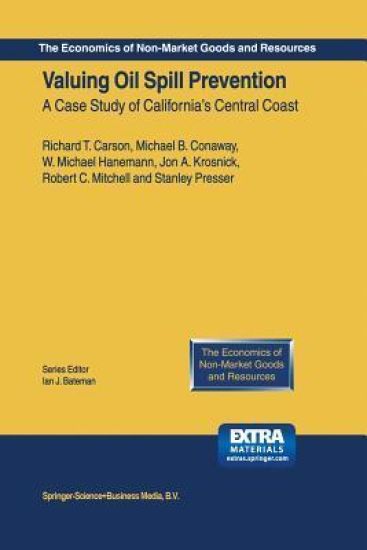
Valuing Oil Spill Prevention

Valuing Oil Spill Prevention

Richard T. Carson; Michael B. Conaway; W. Michael Hanemann; Jon A. Krosnick; Robert C. Mitchell; Stanley Presser

Springer
2014
nidottu
On April 22-23, 1988, approximately 432,000 gallons of San Joaquin Valley crude oil spilled from an aboveground storage tank at a Shell Oil Company refinery into the surrounding environment, including the northern reaches of San Francisco Bay (the Martinez spill). Pursuant to the settlement of the resulting litigation (United States/California v. Shell Oil Co., No. C89-4220, (N.D. Cal1990)), Shell Oil Company provided funding for, among other things, studies to improve future response strategies to oil spills and ensure better restoration of resources and services affected by such spills. The California Oil Spill Contingent Valuation Study was one of the studies funded by the settlement. The purpose of the California Oil Spill (COS) Contingent Valuation (CV) Study was "to execute and document a contingent valuation study of natural resource damages associated with offshore, coastal, or estuarine oil spills in California" (State of California, Department of Justice, Contract Number 89-2126). The COS CV study developed an estimate of per household ex ante economic value for a program to prevent a specified set of natural resource injuries to those species of birds and intertidal life that are consistently affected by oil spills along California's Central Coast. The principal investigators on the COS study team were Richard T. Carson of the University of California, San Diego, and W. Michael Hanemann of the University of California, Berkeley. The study's project manager was Kerry M.
Valuing Oil Spill Prevention

Valuing Oil Spill Prevention

Richard T. Carson; Michael B. Conaway; W. Michael Hanemann; Jon A. Krosnick; Robert C. Mitchell; Stanley Presser

Springer
2004
sidottu
On April 22-23, 1988, approximately 432,000 gallons of San Joaquin Valley crude oil spilled from an aboveground storage tank at a Shell Oil Company refinery into the surrounding environment, including the northern reaches of San Francisco Bay (the Martinez spill). Pursuant to the settlement of the resulting litigation (United States/California v. Shell Oil Co., No. C89-4220, (N.D. Cal1990)), Shell Oil Company provided funding for, among other things, studies to improve future response strategies to oil spills and ensure better restoration of resources and services affected by such spills. The California Oil Spill Contingent Valuation Study was one of the studies funded by the settlement. The purpose of the California Oil Spill (COS) Contingent Valuation (CV) Study was "to execute and document a contingent valuation study of natural resource damages associated with offshore, coastal, or estuarine oil spills in California" (State of California, Department of Justice, Contract Number 89-2126). The COS CV study developed an estimate of per household ex ante economic value for a program to prevent a specified set of natural resource injuries to those species of birds and intertidal life that are consistently affected by oil spills along California's Central Coast. The principal investigators on the COS study team were Richard T. Carson of the University of California, San Diego, and W. Michael Hanemann of the University of California, Berkeley. The study's project manager was Kerry M.
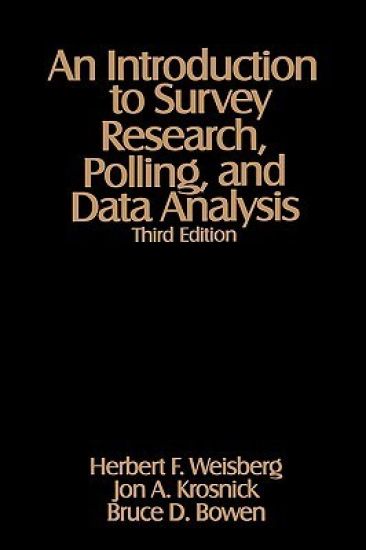
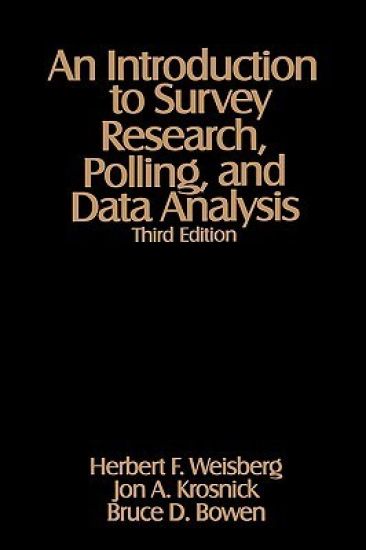
An Introduction to Survey Research, Polling, and Data Analysis

An Introduction to Survey Research, Polling, and Data Analysis

Herbert F. Weisberg; Jon A. Krosnick; Bruce D. Bowen

SAGE Publications Inc
1996
sidottu
"The writing style is mature and experienced. There is noticeable care in the presentation of materials and appropriate sensitivity to the intended audience. . . . The book categorizes large bodies of wisdom in the conduct of survey research over the past half century and provides ''rules-of-thumb'' guidance to the production, analysis, and consumption of survey data." --Steve Seitz, University of Illinois "The authors have provided a well-written update of their textbook, which will be useful as a textbook or supplement in upper-division undergraduate or introductory graduate courses on survey research, statistical data analysis, or research design. The book provides readers with the knowledge that enables them to evaluate the results of survey research. It sensitizes the readers to potential problems that arise from flaws in research design, sampling, questionnaire construction, data collection, coding, data analysis techniques, and improper presentation or interpretation of findings." --Mike Margolis, University of Cincinnati Why should we believe the results of surveys based on relatively few interviews? What are the appropriate cautions in interpreting survey reports? Aimed at answering these questions, An Introduction to Survey Research, Polling, and Data Analysis, Third Edition describes how surveys are conducted in such a way that they can be believed, explains how to read statistical reports and analyze data, and provides guidelines that are useful in evaluating polls. Using frequent examples from contemporary, large national surveys and polls as well as from the media, the authors stress understanding tables thoroughly before moving to interval statistics. In addition, they cover survey design, sampling and question-writing steps, interviewing and coding strategies, and survey analysis from frequency distributions and cross-tabulations to control tables and correlation/regression. They also cover the ethics of survey research and how to read and write survey research reports. Readers of this book will learn to distinguish good from bad polls and to better design and conduct their own surveys and polls.
An Introduction to Survey Research, Polling, and Data Analysis

An Introduction to Survey Research, Polling, and Data Analysis

Herbert F. Weisberg; Jon A. Krosnick; Bruce D. Bowen

SAGE Publications Inc
1996
nidottu
"The writing style is mature and experienced. There is noticeable care in the presentation of materials and appropriate sensitivity to the intended audience. . . . The book categorizes large bodies of wisdom in the conduct of survey research over the past half century and provides ''rules-of-thumb'' guidance to the production, analysis, and consumption of survey data." --Steve Seitz, University of Illinois "The authors have provided a well-written update of their textbook, which will be useful as a textbook or supplement in upper-division undergraduate or introductory graduate courses on survey research, statistical data analysis, or research design. The book provides readers with the knowledge that enables them to evaluate the results of survey research. It sensitizes the readers to potential problems that arise from flaws in research design, sampling, questionnaire construction, data collection, coding, data analysis techniques, and improper presentation or interpretation of findings." --Mike Margolis, University of Cincinnati Why should we believe the results of surveys based on relatively few interviews? What are the appropriate cautions in interpreting survey reports? Aimed at answering these questions, An Introduction to Survey Research, Polling, and Data Analysis, Third Edition describes how surveys are conducted in such a way that they can be believed, explains how to read statistical reports and analyze data, and provides guidelines that are useful in evaluating polls. Using frequent examples from contemporary, large national surveys and polls as well as from the media, the authors stress understanding tables thoroughly before moving to interval statistics. In addition, they cover survey design, sampling and question-writing steps, interviewing and coding strategies, and survey analysis from frequency distributions and cross-tabulations to control tables and correlation/regression. They also cover the ethics of survey research and how to read and write survey research reports. Readers of this book will learn to distinguish good from bad polls and to better design and conduct their own surveys and polls.