Kirjojen hintavertailu. Mukana 12 390 323 kirjaa ja 12 kauppaa.

Kirjailija

Jon Butler

Kirjat ja teokset yhdessä paikassa: 14 kirjaa, julkaisuja vuosilta 1978-2023, suosituimpien joukossa Power, Authority, and the Origins of American Denominational Order. Vertaile teosten hintoja ja tarkista saatavuus suomalaisista kirjakaupoista.

14 kirjaa

Kirjojen julkaisuhaarukka 1978-2023.

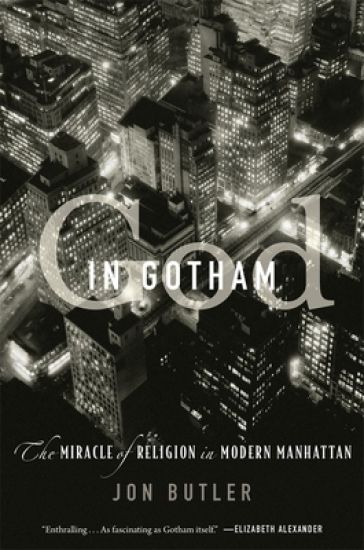
God in Gotham

God in Gotham

Jon Butler

HARVARD UNIVERSITY PRESS
2023
nidottu
“Are you there, God? It’s me, Manhattan…Butler…argues that far from being a Sodom on the Hudson, New York was a center of religious dynamism throughout the 20th century.” —Wall Street Journal“What a pleasure it is to take a tour of Manhattan’s sacred past led by one of the nation’s preeminent religious historians.”—Christianity Today“A masterwork by a master historian…God in Gotham should be an instant classic.”—Jonathan D. Sarna, author of American JudaismIn Gilded Age Manhattan, religious leaders agonized over the fate of traditional faith practice amid chaotic and sometimes terrifying change. Massive immigration, urban anonymity, and the bureaucratization of modern life tore at the binding fibers of religious community.Yet fears of the demise of religion were dramatically overblown. Jon Butler finds a spiritual hothouse in the supposed capital of American secularism as Catholics, Jews, and Protestants peppered the borough with sanctuaries. A center of religious publishing and broadcasting, by the 1950s it was home to Reinhold Niebuhr, Abraham Heschel, Dorothy Day, and Norman Vincent Peale. While white spiritual seekers sometimes met in midtown hotels, black worshippers gathered in Harlem’s storefront churches. Though denied the ministry almost everywhere, women shaped congregations, founded missionary societies, and fused spirituality and political activism. God in Gotham portrays a city where people of faith embraced modernity and thrived.
God in Gotham

God in Gotham

Jon Butler

The Belknap Press
2020
sidottu
A master historian traces the flourishing of organized religion in Manhattan between the 1880s and the 1960s, revealing how faith adapted and thrived in the supposed capital of American secularism.In Gilded Age Manhattan, Catholic, Jewish, and Protestant leaders agonized over the fate of traditional religious practice amid chaotic and multiplying pluralism. Massive immigration, the anonymity of urban life, and modernity’s rationalism, bureaucratization, and professionalization seemingly eviscerated the sense of religious community.Yet fears of religion’s demise were dramatically overblown. Jon Butler finds a spiritual hothouse in the supposed capital of American secularism. By the 1950s Manhattan was full of the sacred. Catholics, Jews, and Protestants peppered the borough with sanctuaries great and small. Manhattan became a center of religious publishing and broadcasting and was home to august spiritual reformers from Reinhold Niebuhr to Abraham Heschel, Dorothy Day, and Norman Vincent Peale. A host of white nontraditional groups met in midtown hotels, while black worshippers gathered in Harlem’s storefront churches. Though denied the ministry almost everywhere, women shaped the lived religion of congregations, founded missionary societies, and, in organizations such as the Zionist Hadassah, fused spirituality and political activism. And after 1945, when Manhattan’s young families rushed to New Jersey and Long Island’s booming suburbs, they recreated the religious institutions that had shaped their youth.God in Gotham portrays a city where people of faith engaged modernity rather than foundered in it. Far from the world of “disenchantment” that sociologist Max Weber bemoaned, modern Manhattan actually birthed an urban spiritual landscape of unparalleled breadth, suggesting that modernity enabled rather than crippled religion in America well into the 1960s.
The Lively Experiment

The Lively Experiment

Jon Butler

Rowman Littlefield
2016
nidottu
Three hundred and fifty years ago, Roger Williams launched one of the world’s first great experiments in religious toleration. Insisting that religion be separated from civil power, he founded Rhode Island, a colony that welcomed people of many faiths. Though stark forms of intolerance persisted, Williams’ commitments to faith and liberty of conscience came to define the nation and its conception of itself. Through crisp essays that show how Americans demolished old prejudices while inventing new ones, The Lively Experiment offers a comprehensive account of America’s boisterous history of interreligious relations.
The Lively Experiment

The Lively Experiment

Jon Butler

Rowman Littlefield
2015
sidottu
Three hundred and fifty years ago, Roger Williams launched one of the world’s first great experiments in religious toleration. Insisting that religion be separated from civil power, he founded Rhode Island, a colony that welcomed people of many faiths. Though stark forms of intolerance persisted, Williams’ commitments to faith and liberty of conscience came to define the nation and its conception of itself. Through crisp essays that show how Americans demolished old prejudices while inventing new ones, The Lively Experiment offers a comprehensive account of America’s boisterous history of interreligious relations.
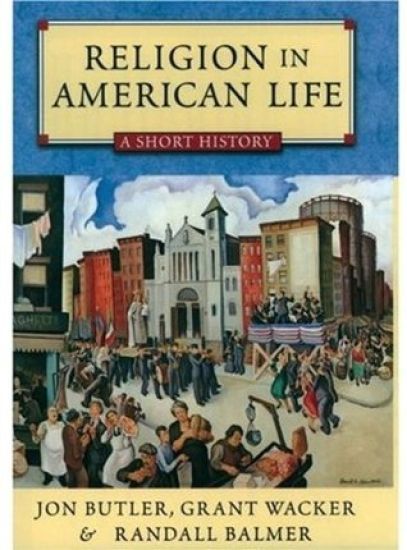
Religion in American Life

Religion in American Life

Jon Butler; Grant Wacker; Randall Balmer

Oxford University Press Inc
2011
nidottu
"Quite ambitious, tracing religion in the United States from European colonization up to the 21st century.... The writing is strong throughout."--Publishers Weekly (starred review) "One can hardly do better than Religion in American Life.... A good read, especially for the uninitiated. The initiated might also read it for its felicity of narrative and the moments of illumination that fine scholars can inject even into stories we have all heard before. Read it."--Church History This new edition of Religion in American Life, written by three of the country's most eminent historians of religion, offers a superb overview that spans four centuries, illuminating the rich spiritual heritage central to nearly every event in our nation's history. Beginning with the state of religious affairs in both the Old and New Worlds on the eve of colonization and continuing through to the present, the book covers all the major American religious groups, from Protestants, Jews, and Catholics to Muslims, Hindus, Mormons, Buddhists, and New Age believers. Revised and updated, the book includes expanded treatment of religion during the Great Depression, of the religious influences on the civil rights movement, and of utopian groups in the 19th century, and it now covers the role of religion during the 2008 presidential election, observing how completely religion has entered American politics.
Progress in Applications of Boolean Functions

Progress in Applications of Boolean Functions

Tsutomu Sasao; Jon Butler

Springer International Publishing AG
2009
nidottu
This book brings together five topics on the application of Boolean functions. They are 1. Equivalence classes of Boolean functions: The number of n-variable functions is large, even for values as small as n = 6, and there has been much research on classifying functions. There are many classifications, each with their own distinct merit. 2. Boolean functions for cryptography: The process of encrypting/decrypting plaintext messages often depends on Boolean functions with specific properties. For example, highly nonlinear functions are valued because they are less susceptible to linear attacks. 3. Boolean differential calculus: An operation analogous to taking the derivative of a real-valued function offers important insight into the properties of Boolean functions. One can determine tests or susceptibility to hazards. 4. Reversible logic: Most logic functions are irreversible; it is impossible to reconstruct the input, given the output. However, Boolean functions that are reversible arenecessary for quantum computing, and hold significant promise for low-power computing. 5. Data mining: The process of extracting subtle patterns from enormous amounts of data has benefited from the use of a graph-based representation of Boolean functions. This has use in surveillance, fraud detection, scientific discovery including bio-informatics, genetics, medicine, and education. Written by experts, these chapters present a tutorial view of new and emerging technologies in Boolean functions. Table of Contents: Equivalence Classes of Boolean Functions / Boolean Functions for Cryptography / Boolean Differential Calculus / Synthesis of Boolean Functions in Reversible Logic / Data Mining Using Binary Decision Diagrams
Power, Authority, and the Origins of American Denominational Order

Power, Authority, and the Origins of American Denominational Order

Jon Butler; Keith Harper

The University of Alabama Press
2009
nidottu
This new edition and update of the seminal study, ""Power, Authority, and the Origins of American Denominational Order"", questions the assumption that colonial American churches were seedbeds of democratic sentiment merely awaiting the American Revolution to cast off the shackles of both political and religious domination. Jon Butler points out that pre-Revolutionary Americans spoke of themselves as British and replicated familiar British forms in their North American settlements. In this work, he shows that colonial American religious organization reflected a clear and conscious commitment to British patterns of life and faith.Examining late-17th - century and early-18th - century North American Quaker, Baptist, Presbyterian, and Anglican groups and religious structures, Butler finds that ministers wielded considerable power over their congregations, and the minutes of their meetings reveal that these ministers were hardly 'proto-democrats' or individualists impatient with religious discipline. On the contrary, they themselves seem to have enthusiastically followed established norms of faith and order, and their congregations seemed quite satisfied with such proceedings. In a nation still grappling with issues about religion in the public sphere and the ways religious bodies assert their own authority, this history of four English Protestant groups in America's earliest plural colonies speaks with a remarkably prescient voice.
New World Faiths

New World Faiths

Jon Butler

Oxford University Press Inc
2008
nidottu
Many people believe that the piety of the Pilgrims typified early American religion. However, by the 1730s Catholics, Jews, and Africans had joined Native Americans, Puritans, and numerous other Protestants in the colonies. Jon Butler launches his narrative with a description of the state of religious affairs in both the Old and New Worlds. He explores the failure of John Winthrop's goal to achieve Puritan perfection, the controversy over Anne Hutchinson's tenacious faith, the evangelizing stamina of ex-slave and Methodist preacher Absalom Jones, and the spiritual resilience of the Catawba Indians. The meeting of these diverse groups and their varied use of music, dance, and ritual produced an unprecedented evolution of religious practice, including the birth of revivals. And through their daily interactions, these Americans created a living foundation for the First Amendment. After Independence their active diversity of faiths led Americans to the groundbreaking idea that government should abandon the use of law to support any religious group and should instead guarantee free exercise of religion for everyone.
Religion in American Life: A Short History

Religion in American Life: A Short History

Jon Butler; Grant Wacker; Randall Herbert Balmer

Oxford University Press
2003
sidottu
Accessible and wide-ranging, Religion in American Life illuminates the rich spiritual heritage central to nearly every event in American history. Jon Butler begins by describing the state of religious affairs in both the Old and New Worlds on the eve of colonization. He traces the progress of religion in the colonies through the time of the American Revolution, covering all the religious groups in the colonies: Protestants, Jews, Catholics, as well as the unique religious experiences of Native Americans and African Americans Grant Wacker continues the story with a fascinating look at the ever-shifting religious landscape of 19th-century America. He focuses on the rapid growth of evangelical Protestants-Methodists, Presbyterians, Baptists, and others-and their competition for dominance over religions such as Catholicism and Judaism, which continued to increase with large immigrant arrivals from Ireland, Eastern Europe, and other countries. The 20th century saw massive cultural changes. Randall Balmer discusses the effects industrialization, modernization, and secularization had on new and established religions. He examines Protestants, Hindus, Jews, New Age believers, Mormons, Buddhists, Roman Catholics, and many more, providing a clear look into the kaleidoscope of religious belief in modern-day America
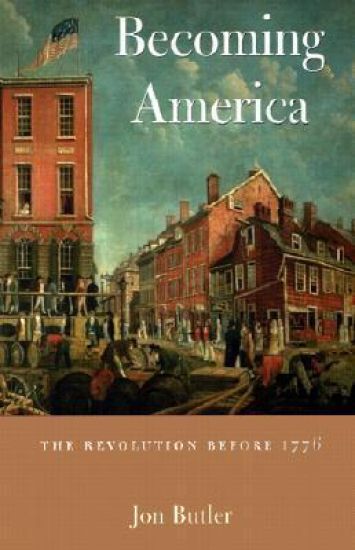
Becoming America

Becoming America

Jon Butler

Harvard University Press
2001
nidottu
Winner of the John G. Cawelti Award, Popular Culture Association and American Culture Association“We must congratulate Butler for [bringing] under control [a] profusion of scholarship and [making] sense of it in fewer than 250 pages. His book is a tour de force…Compelling and readable.”—Gordon S. Wood, New Republic“Americans today think of the colonial period, if at all, as a time remote from modern America, in which society was unimaginably different from ours. Butler argues persuasively that America during the late colonial period…displayed distinctive traits of modern America, among them vigorous religious pluralism, bewildering ethnic diversity, tremendous inequalities of wealth, and a materialistic society with pervasively commercial values.”—Kirkus ReviewsMultinational, profit-driven, materialistic, power-hungry, religiously plural: America today—and three hundred years ago. Jon Butler’s panoramic view of the mainland American colonies after 1680 transforms our customary picture of pre-Revolutionary America; it reveals a strikingly “modern“ character that belies the eighteenth-century quaintness fixed in history. Stressing the middle and late decades (the hitherto “dark ages”) of the American colonial experience, Butler shows us vast revolutionary changes in a society that, for ninety years before 1776, was already becoming America.
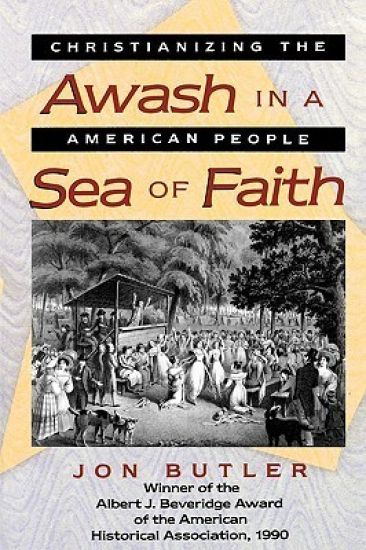
Awash in a Sea of Faith

Awash in a Sea of Faith

Jon Butler

Harvard University Press
1992
nidottu
Challenging the formidable tradition that places early New England Puritanism at the center of the American religious experience, Yale historian Jon Butler offers a new interpretation of three hundred years of religious and cultural development. Butler stresses the instability of religion in Europe where state churches battled dissenters, magic, and astonishingly low church participation. He charts the transfer of these difficulties to America, including the failure of Puritan religious models, and describes the surprising advance of religious commitment there between 1700 and 1865. Through the assertion of authority and coercion, a remarkable sacralization of the prerevolutionary countryside, advancing religious pluralism, the folklorization of magic, and an eclectic, syncretistic emphasis on supernatural interventionism, including miracles, America emerged after 1800 as an extraordinary spiritual hothouse that far eclipsed the Puritan achievement—even as secularism triumphed in Europe.Awash in a Sea of Faith ranges from popular piety to magic, from anxious revolutionary war chaplains to the cool rationalism of James Madison, from divining rods and seer stones to Anglican and Unitarian elites, and from Virginia Anglican occultists and Presbyterians raised from the dead to Jonathan Edwards, Joseph Smith, and Abraham Lincoln. Butler deftly comes to terms with conventional themes such as Puritanism, witchcraft, religion and revolution, revivalism, millenarianism, and Mormonism. His elucidation of Christianity’s powerful role in shaping slavery and of a subsequent African spiritual “holocaust,” with its ironic result in African Christianization, is an especially fresh and incisive account.Awash in a Sea of Faith reveals the proliferation of American religious expression—not its decline—and stresses the creative tensions between pulpit and pew across three hundred years of social maturation. Striking in its breadth and deeply rooted in primary sources, this seminal book recasts the landscape of American religious and cultural history.