Kirjojen hintavertailu. Mukana 12 390 323 kirjaa ja 12 kauppaa.

Kirjailija

Jon Nixon

Kirjat ja teokset yhdessä paikassa: 16 kirjaa, julkaisuja vuosilta 2008-2024, suosituimpien joukossa Hans-Georg Gadamer. Vertaile teosten hintoja ja tarkista saatavuus suomalaisista kirjakaupoista.

16 kirjaa

Kirjojen julkaisuhaarukka 2008-2024.

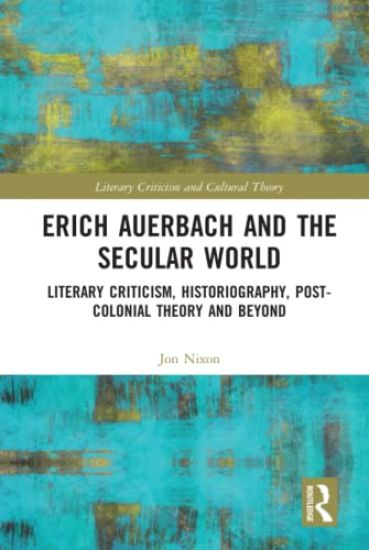
Erich Auerbach and the Secular World

Erich Auerbach and the Secular World

Jon Nixon

TAYLOR FRANCIS LTD
2024
nidottu
Auerbach was one of the foremost literary critics of the 20th century whose work has relevance within the fields of literary criticism, historiography and postcolonial theory. The opening chapter of this book explains how he understood the task of interpretation and his role as an interpreter. The following chapter outlines the important phases in his life with reference to the writers and thinkers who influenced him in his thinking and practice. The central chapters of the book focus on specific themes in his work: the historical grounding of the ‘figural’ imagination; the relation between the secular and the sacred; the emergence of tragic realism; and the notion of ‘inner history’ as a defining feature of early 20th-cenntury modernism. The final two chapters focus on broader issues relating to the development of Auerbach’s understanding of the development of an educated readership within Europe and of his concerns regarding the emergence of what he terms ‘a world literature’.
Erich Auerbach and the Secular World

Erich Auerbach and the Secular World

Jon Nixon

TAYLOR FRANCIS LTD
2022
sidottu
Auerbach was one of the foremost literary critics of the 20th century whose work has relevance within the fields of literary criticism, historiography and postcolonial theory. The opening chapter of this book explains how he understood the task of interpretation and his role as an interpreter. The following chapter outlines the important phases in his life with reference to the writers and thinkers who influenced him in his thinking and practice. The central chapters of the book focus on specific themes in his work: the historical grounding of the ‘figural’ imagination; the relation between the secular and the sacred; the emergence of tragic realism; and the notion of ‘inner history’ as a defining feature of early 20th-cenntury modernism. The final two chapters focus on broader issues relating to the development of Auerbach’s understanding of the development of an educated readership within Europe and of his concerns regarding the emergence of what he terms ‘a world literature’.
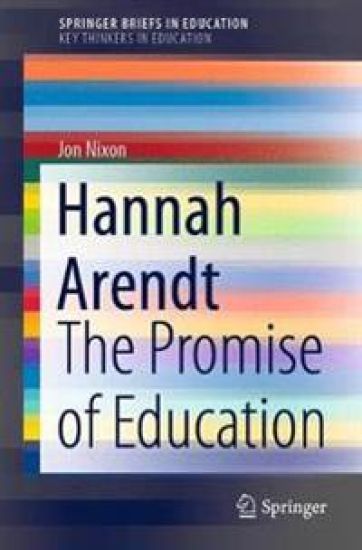
Hannah Arendt

Hannah Arendt

Jon Nixon

Springer Nature Switzerland AG
2020
nidottu
This book gathers some of Hannah Arendt’s core themes and focuses them on the question, ‘What is education for?’ For Arendt, as for Aristotle, education is the means whereby we achieve personal autonomy through the exercise of independent judgement, attain adulthood through the recognition of others as equal but different, gain a sense of citizenship through the assumption of our civic rights and responsibilities, and realize our full potential as sentient beings with the capacity for human ‘flourishing’ and ‘happiness’ (eudaimonia). In order to appreciate the pivotal role that education plays in Arendt’s analysis of the human condition, we have to understand the emphasis she placed on ‘thoughtfulness’, as the measure of our humanity and on ‘thoughtlessness’, as the measure of our inhumanity. Education sustains and develops the human capacity: to think together (phronesis), to think for oneself (what Arendt called ‘the two-in-one’ of thinking), and to think from the point of view of others (what she termed ‘representative thinking’). From the developing constellation of ideas embedded in her vast and varied body of work, the author infers a notion of education as a necessary preparation for personal fulfillment, social engagement, and civic participation.
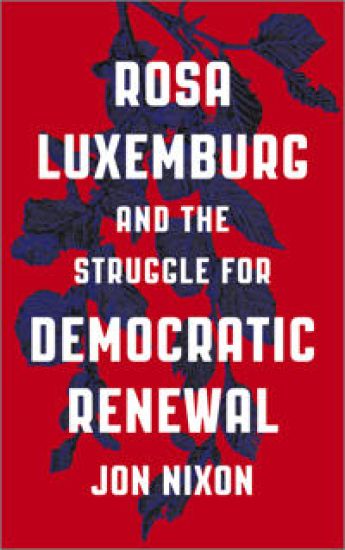
Rosa Luxemburg and the Struggle for Democratic Renewal
What can contemporary activists and political theorists learn from the life and work of Rosa Luxemburg? Examining her contribution to radical democracy and revolutionary socialism, Jon Nixon shows why Red Rosa's legacy lives on. Luxemburg's political and intellectual formation was in itself a 'long revolution', conceived of over time and in response to world events; her groundbreaking ideas around internationalism and spontaneity were formulated in the context of revolution. Returning to her thinking on global capitalism, democratic renewal, state militarism, and the social question, Nixon draws out the enduring nature of her work, using her framework of ideas as a lens through which to view the contemporary debates. By establishing a rich and distinctive account of Luxemburg, Nixon makes the argument for why her struggle for democratic renewal is as relevant as ever.
Rosa Luxemburg and the Struggle for Democratic Renewal
What can contemporary activists and political theorists learn from the life and work of Rosa Luxemburg? Examining her contribution to radical democracy and revolutionary socialism, Jon Nixon shows why Red Rosa's legacy lives on. Luxemburg's political and intellectual formation was in itself a 'long revolution', conceived of over time and in response to world events; her groundbreaking ideas around internationalism and spontaneity were formulated in the context of revolution. Returning to her thinking on global capitalism, democratic renewal, state militarism, and the social question, Nixon draws out the enduring nature of her work, using her framework of ideas as a lens through which to view the contemporary debates. By establishing a rich and distinctive account of Luxemburg, Nixon makes the argument for why her struggle for democratic renewal is as relevant as ever.
Hans-Georg Gadamer

Hans-Georg Gadamer

Jon Nixon

Springer International Publishing AG
2017
nidottu
This book provides an introduction to Hans-Georg Gadamer’s thinking and shows how it might inform our own thinking about education as a lifelong process of engaging with one another and with the wider world. He insisted on the supreme importance of prior learning, but also on the unpredictability of human understanding and on the possibility of new and unforeseeable beginnings. Having lived through the catastrophe of two world wars, he became an important voice in the debate on the future of a reunified Germany and the role of the university in shaping the values and outlook of the new Europe.His work is of immense significance for all those involved in the education of future generations. 'In Gadamer: The Hermeutical Imagination, Jon Nixon has pulled off quite a feat. In his customary lucid, accessible and dialogical style, we are treated to a masterly tour that both opens the complex thinking of Hans-Georg Gadamer and draws out its implicationsfor our understanding of education. In the process, a strong critique emerges of contemporary instrumental approaches to education. Many will assuredly gain much from this enjoyable text, both those interested in Gadamer as such and those working in the philosophy of education.'Ronald Barnett, Emeritus Professor of Higher Education, UCL Institute of Education, UK‘This book simultaneously invites the reader to engage with the transformative potential of education and provokes the reader to imagine an educational landscape that values freedom, democracy and authenticity. Jon Nixon skilfully and eloquently draws the reader into the philosophies, life and legacy of Hans-Goerg Gadamer, a key thinker of the 20th century. Meticulously researched, this original study offers a biographical insight as well as critical commentary on Gadamer’s contribution to wider educational debates. An impressive contribution to the field.’Tanya Fitzgerald, Professor of History of Education, La Trobe University, Australia‘Gadamer: The Hermeneutical Imagination provides an excellent introduction to Gadamer's key ideas. Jon Nixon draws his readers into a conversation with Gadamer, inviting them to imagine the possibility of applying Gadamer's hermeneutical philosophy to their own educational practice. It is essential reading for all those who have an interest in – and commitment to – the future of education.’ Feng Su, Senior Lecturer in Education, Liverpool Hope University, UK
Hannah Arendt and the Politics of Friendship
This book is available as open access through the Bloomsbury Open Access programme and is available on www.bloomsburycollections.com.For Hannah Arendt, friendship had political relevance and importance. The essence of friendship, she believed, consisted in discourse, and it is only through discourse, she argued, that the world is rendered humane. This book explores some of the key ideas in Hannah Arendt's work through a study of four lifelong friendships -- with Heinrich Blücher, Martin Heidegger, Karl Jaspers and Mary McCarthy. The book draws on correspondence from both sides, illuminating our understanding of the social contexts within which Arendt's thinking developed and was clarified. It offers a cultural history of ideas: shedding light on two core ideas in Arendt - of 'plurality' and 'promise', and on how those particular ideas emerged through a particular set of relationships, at a significant moment in the history of the West. This book offers an original and accessible 'way in' to Arendt's work for students and scholars of politics, philosophy, intellectual history and literature.
Hannah Arendt and the Politics of Friendship
This book is available as open access through the Bloomsbury Open Access programme and is available on www.bloomsburycollections.com.For Hannah Arendt, friendship had political relevance and importance. The essence of friendship, she believed, consisted in discourse, and it is only through discourse, she argued, that the world is rendered humane. This book explores some of the key ideas in Hannah Arendt's work through a study of four lifelong friendships -- with Heinrich Blücher, Martin Heidegger, Karl Jaspers and Mary McCarthy. The book draws on correspondence from both sides, illuminating our understanding of the social contexts within which Arendt's thinking developed and was clarified. It offers a cultural history of ideas: shedding light on two core ideas in Arendt - of 'plurality' and 'promise', and on how those particular ideas emerged through a particular set of relationships, at a significant moment in the history of the West. This book offers an original and accessible 'way in' to Arendt's work for students and scholars of politics, philosophy, intellectual history and literature.
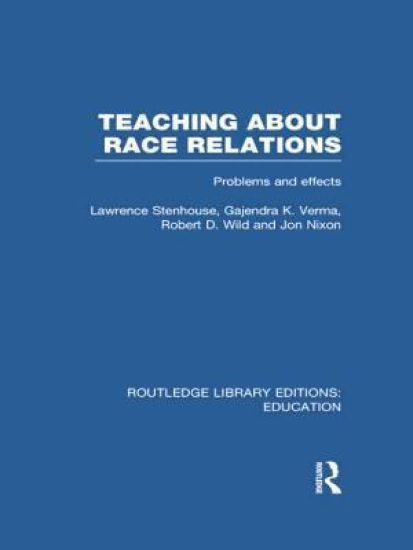
Teaching About Race Relations (RLE Edu J)

Teaching About Race Relations (RLE Edu J)

Lawrence Stenhouse; Gajendra Verma; Robert Wild; Jon Nixon

Routledge
2014
nidottu
This is the report of two linked research projects: the SSRC Project on Problems and Effects of Teaching about Race Relations, and the Calouste Gulbenkian Foundation Project on Teaching About Race Relations through Drama. Its aim is to help teachers who will face race as a theme, whether it arises in the normal course of their subject teaching or is introduced as a separate topic. The project worked with three groups of teachers, each of which adopted a different approach, and the results of the testing programme are given alongside a series of case studies of classroom teaching. The book includes a summary of the findings of the research, express as hypotheses and an account of the teacher-dissemination of the project’s work; it concludes with reflections by the director of the project and a participant teacher.
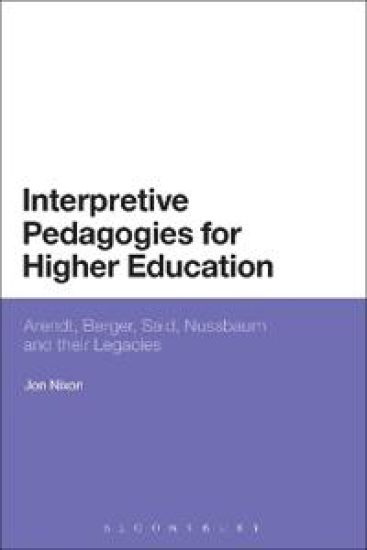
Interpretive Pedagogies for Higher Education
Interpretive Pedagogies for Higher Education focuses on providing a humanistic perspective on pedagogy by relating it to the interpretive practices of particular public educators: thinkers and writers whose work has had an immeasurable impact on how we understand and interpret the world and how our understandings and interpretations act on that world.Jon Nixon focuses on the work of four public intellectuals each of whom reaches out to a wide public readership and develops our understanding regarding the nature of interpretation in the everyday world: Hannah Arendt's work on 'representative thinking', John Berger's injunction to 'hold everything dear', Edward Said's notion of 'democratic criticism', and Martha Nussbaum's studies in the intelligence of feeling. These thinkers provide valuable perspectives on the nature and purpose of interpretation in everyday life. The implications of these perspectives for the development of a transformative pedagogy - and for the renewal of an educated public - are examined in relation to the current contexts of higher education within a knowledge society.
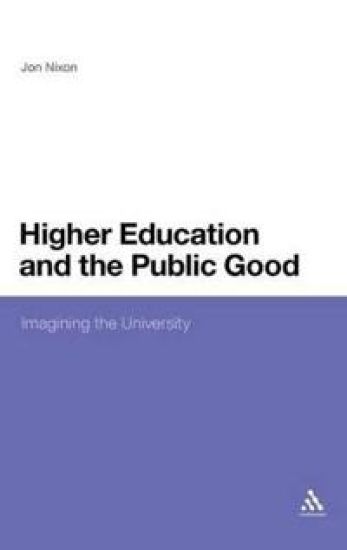
Higher Education and the Public Good

Higher Education and the Public Good

Jon Nixon

Continuum Publishing Corporation
2012
nidottu
What constitutes the public good in a highly individualistic, consumerist and privatized society?The global financial crisis of 2008 revealed the extent to which the public realm had been eroded over the last thirty years and the inroads that privatization and commercialization have made into the higher education sector. This book explores the institutional and sector-wide implications of the financial crisis for higher education and the lessons to be learnt from that crisis and its aftermath for the university sector as a whole.Jon Nixon argues that the university now has to be re-imagined as a social, civic and cosmopolitan good that is central to the well-being of civil society and its citizens. Key chapters focus on capability, reasoning and purposefulness as the common resources of higher education. There is an urgent need for sector-wide planning and collaboration, the development of a public culture across institutions, and a broadening of the higher education curriculum.Higher Education and the Public Good points a way forward to the new and emergent civic and cosmopolitan spaces of learning.
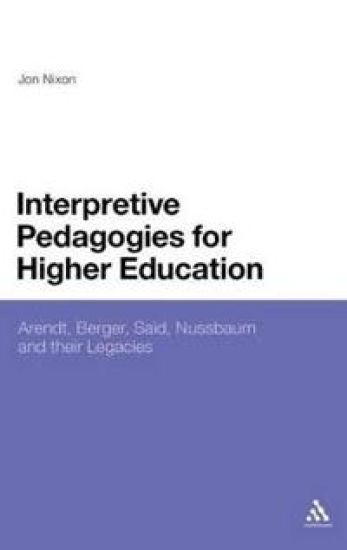
Interpretive Pedagogies for Higher Education

Interpretive Pedagogies for Higher Education

Jon Nixon

Continuum Publishing Corporation
2012
sidottu
"Interpretive Pedagogies for Higher Education focuses on providing a humanistic perspective on pedagogy by relating it to the interpretive practices of particular public educators: thinkers and writers whose work has had an immeasurable impact on how we understand and interpret the world and how our understandings and interpretations act on that world. Jon Nixon focuses on the work of four public intellectuals each of whom reaches out to a wide public readership and develops our understanding regarding the nature of interpretation in the everyday world: Hannah Arendt's work on representative thinking', John Berger's injunction to hold everything dear', Edward Said's notion of democratic criticism', and Martha Nussbaum's studies in the intelligence of feeling. These thinkers provide valuable perspectives on the nature and purpose of interpretation in everyday life. The implications of these perspectives for the development of a transformative pedagogy and for the renewal of an educated public are examined in relation to the current contexts of higher education within a knowledge society."
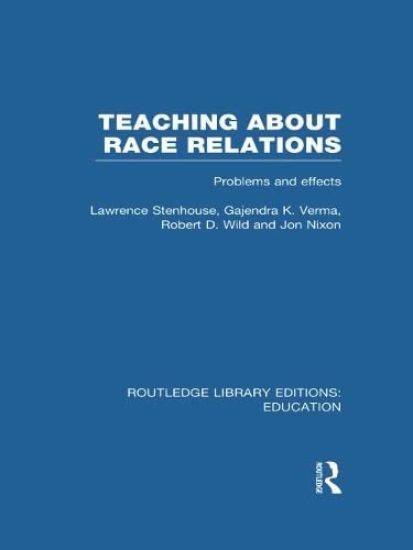
Teaching About Race Relations (RLE Edu J)

Teaching About Race Relations (RLE Edu J)

Lawrence Stenhouse; Gajendra Verma; Robert Wild; Jon Nixon

Routledge
2011
sidottu
This is the report of two linked research projects: the SSRC Project on Problems and Effects of Teaching about Race Relations, and the Calouste Gulbenkian Foundation Project on Teaching About Race Relations through Drama. Its aim is to help teachers who will face race as a theme, whether it arises in the normal course of their subject teaching or is introduced as a separate topic. The project worked with three groups of teachers, each of which adopted a different approach, and the results of the testing programme are given alongside a series of case studies of classroom teaching. The book includes a summary of the findings of the research, express as hypotheses and an account of the teacher-dissemination of the project’s work; it concludes with reflections by the director of the project and a participant teacher.
Higher Education and the Public Good

Higher Education and the Public Good

Jon Nixon

CONTINUUM PUBLISHING CORPORATION
2011
sidottu
What constitutes the public good in a highly individualistic, consumerist and privatized society? The global financial crisis of 2008 revealed the extent to which the public realm had been eroded over the last thirty years and the inroads that privatization and commercialization have made into the higher education sector. This book explores the institutional and sector-wide implications of the financial crisis for higher education and the lessons to be learnt from that crisis and its aftermath for the university sector as a whole. Jon Nixon argues that the university now has to be re-imagined as a social, civic and cosmopolitan good that is central to the well-being of civil society and its citizens. Key chapters focus on capability, reasoning and purposefulness as the common resources of higher education. There is an urgent need for sector-wide planning and collaboration, the development of a public culture across institutions, and a broadening of the higher education curriculum. Higher Education and the Public Good points a way forward to the new and emergent civic and cosmopolitan spaces of learning.
Towards the Virtuous University
A good university is invariably assumed to be one which is managerially effective in terms of its economic efficiency, and is judged in terms of entrepreneurialism, self-promotion and competitive innovation. This book argues that in the majority of institutions, these goals are being pursued to the exclusion of academic excellence and public service. It proposes that there is a marked lack of intellectual leadership at senior management level within HE institutions and that academic workers must assume responsibility for the moral purposefulness of their institutions. This will not be a retreat into the old values of an elitist 'ivory tower', but a rejection of the current deeply stratified university system which prematurely selects students for differentiated institutional streams.
Towards the Virtuous University
A good university is invariably assumed to be one which is managerially effective in terms of its economic efficiency, and is judged in terms of entrepreneurialism, self-promotion and competitive innovation. This book argues that in the majority of institutions, these goals are being pursued to the exclusion of academic excellence and public service. It proposes that there is a marked lack of intellectual leadership at senior management level within HE institutions and that academic workers must assume responsibility for the moral purposefulness of their institutions. This will not be a retreat into the old values of an elitist 'ivory tower', but a rejection of the current deeply stratified university system which prematurely selects students for differentiated institutional streams.