Kirjojen hintavertailu. Mukana 12 335 463 kirjaa ja 12 kauppaa.

Kirjailija

Jon Robson

Kirjat ja teokset yhdessä paikassa: 5 kirjaa, julkaisuja vuosilta 2016-2025, suosituimpien joukossa Aesthetic Knowledge. Vertaile teosten hintoja ja tarkista saatavuus suomalaisista kirjakaupoista.

5 kirjaa

Kirjojen julkaisuhaarukka 2016-2025.

Aesthetic Knowledge

Aesthetic Knowledge

Jon Robson

Cambridge University Press
2025
sidottu
How do we arrive at aesthetic knowledge? This might seem an odd question for philosophers to ask. Some will take its answer to be obvious: we learn about the aesthetic qualities of paintings by looking at them, of musical works by listening to them, and so on. Others will take the question to be misguided, how can there be aesthetic knowledge when aesthetics is merely 'a matter of taste'? Finally, aesthetic knowledge itself might seem singularly unimportant. We don't engage with beautiful artworks to learn that they're beautiful but, rather, to appreciate that beauty. This Element argues that each of these objections is misplaced. Aesthetic knowledge is both valuable and attainable, but canonical philosophical (and folk) views of how we attain it are mistaken. The Element surveys some recent arguments against the reliability of aesthetic perception and in favour of other, more social, sources of aesthetic knowledge.
Aesthetic Knowledge

Aesthetic Knowledge

Jon Robson

Cambridge University Press
2025
pokkari
How do we arrive at aesthetic knowledge? This might seem an odd question for philosophers to ask. Some will take its answer to be obvious: we learn about the aesthetic qualities of paintings by looking at them, of musical works by listening to them, and so on. Others will take the question to be misguided, how can there be aesthetic knowledge when aesthetics is merely 'a matter of taste'? Finally, aesthetic knowledge itself might seem singularly unimportant. We don't engage with beautiful artworks to learn that they're beautiful but, rather, to appreciate that beauty. This Element argues that each of these objections is misplaced. Aesthetic knowledge is both valuable and attainable, but canonical philosophical (and folk) views of how we attain it are mistaken. The Element surveys some recent arguments against the reliability of aesthetic perception and in favour of other, more social, sources of aesthetic knowledge.
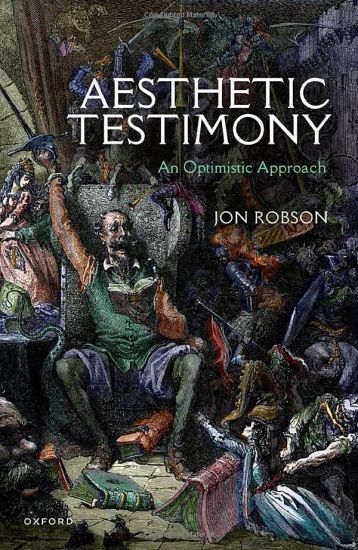
Aesthetic Testimony

Aesthetic Testimony

Jon Robson

Oxford University Press
2022
sidottu
Aesthetic judgements that are formed on the basis of testimony are commonly held to be defective, illegitimate, or otherwise problematic. This book assesses the debate surrounding aesthetic testimony and argues for the surprising conclusion that this widespread view is mistaken. Aesthetic testimony is in no way inferior as a source of judgement when compared to either first-hand aesthetic judgement or testimony concerning non-aesthetic matters. Alongside establishing this position (an extreme form of 'optimism' concerning aesthetic testimony), Jon Robson also responds to the most prominent arguments for the opposing view ('pessimism' concerning aesthetic testimony). Along the way, it also re-examines our understanding of the norms which govern both judgement and assertion in aesthetics.
A Critical Introduction to the Metaphysics of Time

A Critical Introduction to the Metaphysics of Time

Benjamin Curtis; Jon Robson

Bloomsbury Academic
2016
sidottu
What is the nature of time? Does it flow? Do the past and future exist? Drawing connections between historical and present-day questions, A Critical Introduction to the Metaphysics of Time provides an up-to-date guide to one of the most central and debated topics in contemporary metaphysics.Introducing the views and arguments of Parmenides, Plato, Aristotle, Descartes, Newton and Leibniz, this accessible introduction covers the history of the philosophy of time from the Pre-Socratics to the beginning of the 20th Century. The historical survey presents the necessary background to understanding more recent developments, including McTaggart’s 1908 argument for the unreality of time, the open future, the perdurance/endurance debate, the possibility of time travel, and the relevance of current physics to the philosophy of time.Informed by cutting-edge philosophical research, A Critical Introduction to the Metaphysics of Time evaluates influential historical arguments in the context of contemporary developments. For students looking to gain insights into how ideas within the philosophy of time have developed and better understand recent arguments, this is the ideal starting point.
A Critical Introduction to the Metaphysics of Time

A Critical Introduction to the Metaphysics of Time

Benjamin Curtis; Jon Robson

Bloomsbury Academic
2016
nidottu
What is the nature of time? Does it flow? Do the past and future exist? Drawing connections between historical and present-day questions, A Critical Introduction to the Metaphysics of Time provides an up-to-date guide to one of the most central and debated topics in contemporary metaphysics.Introducing the views and arguments of Parmenides, Plato, Aristotle, Descartes, Newton and Leibniz, this accessible introduction covers the history of the philosophy of time from the Pre-Socratics to the beginning of the 20th Century. The historical survey presents the necessary background to understanding more recent developments, including McTaggart’s 1908 argument for the unreality of time, the open future, the perdurance/endurance debate, the possibility of time travel, and the relevance of current physics to the philosophy of time.Informed by cutting-edge philosophical research, A Critical Introduction to the Metaphysics of Time evaluates influential historical arguments in the context of contemporary developments. For students looking to gain insights into how ideas within the philosophy of time have developed and better understand recent arguments, this is the ideal starting point.