Kirjojen hintavertailu. Mukana 12 595 353 kirjaa ja 12 kauppaa.

Kirjailija

Jon Scott

Kirjat ja teokset yhdessä paikassa: 6 kirjaa, julkaisuja vuosilta 2004-2025, suosituimpien joukossa Biological Science. Vertaile teosten hintoja ja tarkista saatavuus suomalaisista kirjakaupoista.

6 kirjaa

Kirjojen julkaisuhaarukka 2004-2025.

Biological Science

Biological Science

Jon Scott; Gus Cameron; Anne Goodenough; Dawn Hawkins; Jenny Koenig; Martin Luck; Despo Papachristodoulou; Alison Snape; Kay Yeoman; Mark Goodwin

Oxford University Press
2022
nidottu
Biological Science: Exploring the Science of Life responds to the key needs of lecturers and their students by placing a clear central narrative, carefully-structured active learning, and confidence with quantitative concepts and scientific enquiry central to its approach. Written by a team of dedicated and passionate academics, and shaped by feedback from over 55 institutions, its straightforward narrative, reinforced by key concept overview videos for every chapter, communicate key ideas clearly: the right information is provided at the right time, and at the right depth. Its pause and think features, self-check quizzes, and graded end of chapter questions, augmented by flashcards of key terms, directly support active learning. The combination of narrative text and learning features promote a rich, active learning experience: read, watch, and do. Its combination of Quantitative Toolkits, Scientific Process panels, and the Life and its Exploration chapters provide more insight and support than any other general biology text; they prepare students to engage with this quantitative and experimental discipline with confidence, and set them on a path for success throughout their future studies. With coverage that spans the full scale of biological science - from molecule to ecosystem - and with an approach that fully supports flexible, self-paced learning, Biological Science: Exploring the Science of Life will set you on a path towards a deeper understanding of the key concepts in biology, and a greater appreciation of biology as a dynamic experimental science. Digital formats and resources Biological Science: Exploring the Science of Life is available for students and institutions to purchase in a variety of formats. The enhanced ebook is enriched with features that offer extra learning support: www.oxfordtextbooks.co.uk/ebooks - Key concepts videos support students from the start of every chapter and as they make their way through every Module. - Self-check questions at the end of each chapter section give students quick and formative feedback, building their confidence and comprehension as they study and revise. - Quantitative skills video screencasts help students to master the foundational skills required by this discipline. - Interactive figures give students the control they need to step through, and gain mastery over, key concepts. - Per-chapter flashcard glossaries help students to recall the key terms and concepts on which further study can be built.
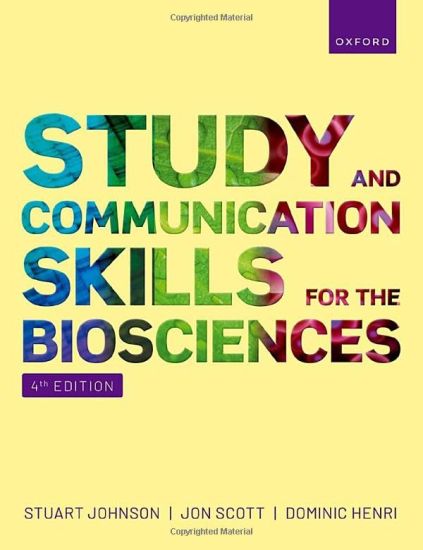
Study and Communication Skills for the Biosciences

Study and Communication Skills for the Biosciences

Stuart Johnson; Jon Scott; Dominic Henri

Oxford University Press
2025
nidottu
The only text to focus on study and communication skills specifically for bioscience students, helping them get the most out of their degree, and develop the skills and experience that will make them more employable after graduation. Written in an encouraging manner using biological examples, this book assists students as they transition to university studies and progress to employment. Readers are guided towards a greater understanding of what they need to do to make the most of resources available, how to approach assessment in a way that recognizes what they need to achieve, and how to reflect on their progress to maximize employability. Key features: Written by two award winning bioscience teachers and a career development specialist with a background in bioscience to offer expert guidance throughout. A particular emphasis on foundational skills that really make a difference to students: 'managing your time well', 'thinking critically', and 'developing yourself'. Biological examples throughout demonstrate the relevance of the skills being discussed to students' programme of study. The authors explain how to communicate ideas effectively across all required assessment formats, and how to prepare for and complete exams whilst maintaining wellbeing to help students succeed in their assessments. The flexible structure enables students to read the chapters in any order, tailoring their reading to the skills most relevant to them. New to this edition: 'What I Wish I Knew Earlier' videos capture bioscience students reflecting on their university experience and sharing their key takeaways to help other students thrive. A fresh structure to the content, with new chapters including Chapter 5 'Getting yourself organized' and Chapter 12 'Key competencies: collaboration and critical thinking', which provide broader coverage and greater support than ever before. A discussion around the use of Generative AI in university provides students with insights into the benefits and drawbacks of this new technology with a focus on academic integrity and best practices. A greater focus on student wellbeing encourages students to balance their responsibilities in and outside of university. Digital formats and online resources: The 4th edition is available for students and institutions to purchase in a variety of formats: the e-book and Science Trove offer a mobile experience and convenient access along with student-created videos, additional poster examples, functionality tools, navigation features and links that offer extra learning support. For more information about e-books, please visit www.oxfordtextbooks.co.uk/ebooks
Study and Communication Skills for the Chemical Sciences

Study and Communication Skills for the Chemical Sciences

Tina Overton; Stuart Johnson; Jon Scott

Oxford University Press
2019
nidottu
Study and Communication Skills for the Chemical Sciences has been carefully designed to help students transition seamlessly from school to university, make the most of their education, and ultimately use their degree to enhance their employability. The accessible and friendly writing style helps to engage students with the subject while frequent chemical examples highlight the relevance of the skills being learned. A comprehensive range of skills are covered, from making the most of practicals, lectures and group work, through to writing and presentation skills, and effective revision for exams. An expanded chapter on employability offers invaluable advice for getting a job in today's competitive market. Written by leading experts in science education, this text is essential reading for any undergraduate chemistry student wishing to succeed at university get the most out of their degree after graduation.
Study and Communication Skills for the Biosciences

Study and Communication Skills for the Biosciences

Stuart Johnson; Jon Scott

Oxford University Press
2019
nidottu
Study and Communication Skills for the Biosciences is tailored specifically to the needs of bioscience students, both at university, and beyond. Written in an engaging and supportive manner, with examples throughout that demonstrate the relevance of topics covered to bioscience degree programmes, the book will assist you with the transition from school to university, with your studies at university, and with your progression to employment after leaving university. New to this edition, the book now includes discussion of how best to use recorded lectures in learning and revision, and how to get the most out of flipped classrooms and interactive lectures.. The chapter on employability has new content on technological change in the workplace, how to perform well in a video interview, and how best to use online networks for career advancement. A new section also explores how to critically review a research paper. A new learning feature, 'Try this for yourself', shows how you can apply the book's principles to your own life and studies. Covering the full range of study and communication skills that you need to study to succeed in your studies, this book is essential reading for any bioscience student who wants to get the most out of their degree.
Gender Differences in Major Federal External Grant Programs

Gender Differences in Major Federal External Grant Programs

Susan D. Hosek; Amy G. Cox; Bonnie Ghosh-Dastidar; Aaron Kofner; Nishal Ramphal; Jon Scott; Sandra H. Berry

RAND
2005
pokkari
Determines whether gender differences exist in federal research grant awards and funding. On the request of the National Science Foundation (NSF), this report analyzes administrative data from fiscal years 2001 through 2003, describing the outcomes of grant applications submitted by women versus men to federal agencies. The report focuses on three federal agencies: the Department of Health and Human Services, in particular, the National Institutes of Health; the NSF; and the U.S. Department of Agriculture.