Kirjojen hintavertailu. Mukana 12 229 941 kirjaa ja 12 kauppaa.

Kirjailija

Jon Williamson

Kirjat ja teokset yhdessä paikassa: 8 kirjaa, julkaisuja vuosilta 2004-2024, suosituimpien joukossa Probabilistic Logics and Probabilistic Networks. Vertaile teosten hintoja ja tarkista saatavuus suomalaisista kirjakaupoista.

8 kirjaa

Kirjojen julkaisuhaarukka 2004-2024.

Evidential Pluralism in the Social Sciences

Evidential Pluralism in the Social Sciences

Yafeng Shan; Jon Williamson

TAYLOR FRANCIS LTD
2024
nidottu
This volume contends that Evidential Pluralism—an account of the epistemology of causation, which maintains that in order to establish a causal claim one needs to establish the existence of a correlation and the existence of a mechanism—can be fruitfully applied to the social sciences. Through case studies in sociology, economics, political science and law, it advances new philosophical foundations for causal enquiry in the social sciences. The book provides an account of how to establish and evaluate causal claims and it offers a new way of thinking about evidence-based policy, basic social science research and mixed methods research. As such, it will appeal to scholars with interests in social science research and methodology, the philosophy of science and evidence-based policy.The Open Access version of this book, available at http://www.taylorfrancis.com, has been made available under a Creative Commons [Attribution-Non Commercial-No Derivatives (CC-BY-NC-ND)] 4.0 license.
Evidential Pluralism in the Social Sciences

Evidential Pluralism in the Social Sciences

Yafeng Shan; Jon Williamson

TAYLOR FRANCIS LTD
2023
sidottu
This volume contends that Evidential Pluralism—an account of the epistemology of causation, which maintains that in order to establish a causal claim one needs to establish the existence of a correlation and the existence of a mechanism—can be fruitfully applied to the social sciences. Through case studies in sociology, economics, political science and law, it advances new philosophical foundations for causal enquiry in the social sciences. The book provides an account of how to establish and evaluate causal claims and it offers a new way of thinking about evidence-based policy, basic social science research and mixed methods research. As such, it will appeal to scholars with interests in social science research and methodology, the philosophy of science and evidence-based policy.The Open Access version of this book, available at http://www.taylorfrancis.com, has been made available under a Creative Commons [Attribution-Non Commercial-No Derivatives (CC-BY-NC-ND)] 4.0 license.
Evaluating Evidence of Mechanisms in Medicine

Evaluating Evidence of Mechanisms in Medicine

Veli-Pekka Parkkinen; Christian Wallmann; Michael Wilde; Brendan Clarke; Phyllis Illari; Michael P Kelly; Charles Norell; Federica Russo; Beth Shaw; Jon Williamson

Springer International Publishing AG
2018
nidottu
This book is open access under a CC BY license. This book is the first to develop explicit methods for evaluating evidence of mechanisms in the field of medicine. It explains why it can be important to make this evidence explicit, and describes how to take such evidence into account in the evidence appraisal process. In addition, it develops procedures for seeking evidence of mechanisms, for evaluating evidence of mechanisms, and for combining this evaluation with evidence of association in order to yield an overall assessment of effectiveness. Evidence-based medicine seeks to achieve improved health outcomes by making evidence explicit and by developing explicit methods for evaluating it. To date, evidence-based medicine has largely focused on evidence of association produced by clinical studies. As such, it has tended to overlook evidence of pathophysiological mechanisms and evidence of the mechanisms of action of interventions. The bookoffers a useful guide for all those whose work involves evaluating evidence in the health sciences, including those who need to determine the effectiveness of health interventions and those who need to ascertain the effects of environmental exposures.
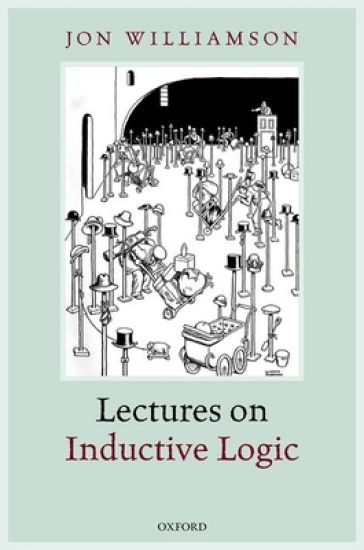
Lectures on Inductive Logic

Lectures on Inductive Logic

Jon Williamson

Oxford University Press
2017
sidottu
Logic is a field studied mainly by researchers and students of philosophy, mathematics and computing. Inductive logic seeks to determine the extent to which the premisses of an argument entail its conclusion, aiming to provide a theory of how one should reason in the face of uncertainty. It has applications to decision making and artificial intelligence, as well as how scientists should reason when not in possession of the full facts. In this book, Jon Williamson embarks on a quest to find a general, reasonable, applicable inductive logic (GRAIL), all the while examining why pioneers such as Ludwig Wittgenstein and Rudolf Carnap did not entirely succeed in this task. Along the way he presents a general framework for the field, and reaches a new inductive logic, which builds upon recent developments in Bayesian epistemology (a theory about how strongly one should believe the various propositions that one can express). The book explores this logic in detail, discusses some key criticisms, and considers how it might be justified. Is this truly the GRAIL? Although the book presents new research, this material is well suited to being delivered as a series of lectures to students of philosophy, mathematics, or computing and doubles as an introduction to the field of inductive logic
Probabilistic Logics and Probabilistic Networks

Probabilistic Logics and Probabilistic Networks

Rolf Haenni; Jan-Willem Romeijn; Gregory Wheeler; Jon Williamson

Springer
2013
nidottu
While probabilistic logics in principle might be applied to solve a range of problems, in practice they are rarely applied - perhaps because they seem disparate, complicated, and computationally intractable. This programmatic book argues that several approaches to probabilistic logic fit into a simple unifying framework in which logically complex evidence is used to associate probability intervals or probabilities with sentences. Specifically, Part I shows that there is a natural way to present a question posed in probabilistic logic, and that various inferential procedures provide semantics for that question, while Part II shows that there is the potential to develop computationally feasible methods to mesh with this framework. The book is intended for researchers in philosophy, logic, computer science and statistics. A familiarity with mathematical concepts and notation is presumed, but no advanced knowledge of logic or probability theory is required.
Probabilistic Logics and Probabilistic Networks

Probabilistic Logics and Probabilistic Networks

Rolf Haenni; Jan-Willem Romeijn; Gregory Wheeler; Jon Williamson

Springer
2010
sidottu
While probabilistic logics in principle might be applied to solve a range of problems, in practice they are rarely applied - perhaps because they seem disparate, complicated, and computationally intractable. This programmatic book argues that several approaches to probabilistic logic fit into a simple unifying framework in which logically complex evidence is used to associate probability intervals or probabilities with sentences. Specifically, Part I shows that there is a natural way to present a question posed in probabilistic logic, and that various inferential procedures provide semantics for that question, while Part II shows that there is the potential to develop computationally feasible methods to mesh with this framework. The book is intended for researchers in philosophy, logic, computer science and statistics. A familiarity with mathematical concepts and notation is presumed, but no advanced knowledge of logic or probability theory is required.
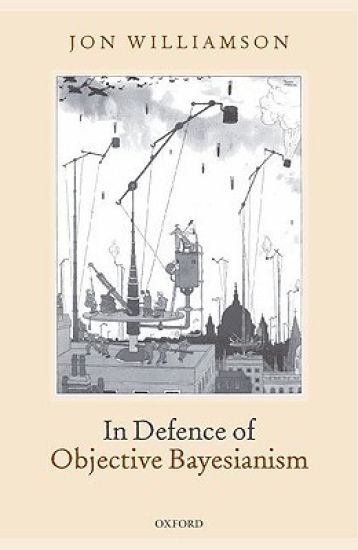
In Defence of Objective Bayesianism

In Defence of Objective Bayesianism

Jon Williamson

Oxford University Press
2010
sidottu
How strongly should you believe the various propositions that you can express? That is the key question facing Bayesian epistemology. Subjective Bayesians hold that it is largely (though not entirely) up to the agent as to which degrees of belief to adopt. Objective Bayesians, on the other hand, maintain that appropriate degrees of belief are largely (though not entirely) determined by the agent's evidence. This book states and defends a version of objective Bayesian epistemology. According to this version, objective Bayesianism is characterized by three norms: · Probability - degrees of belief should be probabilities · Calibration - they should be calibrated with evidence · Equivocation - they should otherwise equivocate between basic outcomes Objective Bayesianism has been challenged on a number of different fronts. For example, some claim it is poorly motivated, or fails to handle qualitative evidence, or yields counter-intuitive degrees of belief after updating, or suffers from a failure to learn from experience. It has also been accused of being computationally intractable, susceptible to paradox, language dependent, and of not being objective enough. Especially suitable for graduates or researchers in philosophy of science, foundations of statistics and artificial intelligence, the book argues that these criticisms can be met and that objective Bayesianism is a promising theory with an exciting agenda for further research.
Bayesian Nets and Causality: Philosophical and Computational Foundations
Bayesian nets are widely used in artificial intelligence as a calculus for causal reasoning, enabling machines to make predictions, perform diagnoses, take decisions and even to discover causal relationships. But many philosophers have criticised and ultimately rejected the central assumption on which such work is based - the Causal Markov Condition. So should Bayesian nets be abandoned? What explains their success in artificial intelligence? This book argues that the Causal Markov Condition holds as a default rule: it often holds but may need to be repealed in the face of counterexamples. Thus Bayesian nets are the right tool to use by default but naively applying them can lead to problems. The book develops a systematic account of causal reasoning and shows how Bayesian nets can be coherently employed to automate the reasoning processes of an artificial agent. The resulting framework for causal reasoning involves not only new algorithms but also new conceptual foundations. Probability and causality are treated as mental notions - part of an agent's belief state. Yet probability and causality are also objective - different agents with the same background knowledge ought to adopt the same or similar probabilistic and causal beliefs. This book, aimed at researchers and graduate students in computer science, mathematics and philosophy, provides a general introduction to these philosophical views as well as an exposition of the computational techniques that they motivate.