Kirjailija
Jonathan Bennett
Kirjat ja teokset yhdessä paikassa: 22 kirjaa, julkaisuja vuosilta 1966-2016, suosituimpien joukossa Here Is My Street, This Tree I Planted. Vertaile teosten hintoja ja tarkista saatavuus suomalaisista kirjakaupoista.
22 kirjaa
Kirjojen julkaisuhaarukka 1966-2016.
Jonathan Bennett's analysis of the second half of Kant's Critique of Pure Reason, in which Kant concerns himself with topics such as substance, the nature of the self, the cosmos, freedom and the existence of God, continues to be an engaging and accessible exploration of Kant's major work. Presented in a fresh twenty-first-century series livery, and including a specially commissioned preface written by Karl Ameriks, illuminating its enduring importance and relevance to philosophical enquiry, this influential work has been revived for a new generation of readers.
This engaging and instructive analysis of the first half of Kant's Critique of Pure Reason continues to be valuable to both practiced Kant scholars and newcomers. Jonathan Bennett examines the arguments and themes of Kant's work in relation to those of the works of philosophers old and new, including Locke, Leibniz, Berkeley, Hume, Wittgenstein, Ryle, Ayler, Quine, Warnock, and others. Presented in a fresh twenty-first-century series livery, and including a specially commissioned preface written by James Van Cleve, illuminating its continuing importance and relevance to philosophical enquiry, this influential work is available for a new generation of readers.
Lose Weight And Be Healthy Now: Forty Science-Based Weight Loss Tips to Transform Your Life
Jonathan Bennett; David Bennett
Theta Hill Press
2015
nidottu
If you are looking for a book with faddish gimmicks that don't work or "easy answers," then look elsewhere. Instead, this book provides forty chapters of research-based tips and tricks to help you make lasting, long-term lifestyle changes, to look and feel better. This book, from the authors of Be Popular Now: How Any Man Can Become Confident, Attractive, And Successful (And Have Fun Doing It) and Say It Like You Mean It: How To Use Affirmations And Declarations To Create The Life You Want, not only explores the science of weight loss, but the authors translate the science into practical tips and advice. They also weave their own weight loss stories into the tips, including their many setbacks, to inspire the reader to stay on the path, even when it gets tough. In this book, you'll learn: - While most supplements don't promote weight loss, a recent study found that this chemical decreases body fat while increasing muscle mass. - Doing this simple thing first thing in the morning (and before meals) can help you lose almost ten pounds. - Why you shouldn't eat a bagel or cereal for breakfast, because you'll be hungrier the rest of the day. Instead, studies show you should eat this, to not only feel fuller, but lose weight. - Everyone has this inexpensive and enjoyable tool at their disposal, but did you realize it can make your workouts both more intense and last longer? - Consuming 30 grams of this nutrient a day (Americans average 15 grams) results in weight loss, without making any other changes. - Americans are getting less and less of this, which is causing serious health problems, including obesity. So, what are you waiting for? Lose weight and be healthy now
The Teen Popularity Handbook: Make Friends, Get Dates, And Become Bully-Proof
David Bennett; Jonathan Bennett
Theta Hill Press
2014
nidottu
Be Popular Now: How Any Man Can Become Confident, Attractive and Successful (And Have Fun Doing It)
David Bennett; Jonathan Bennett
Theta Hill Press
2013
nidottu
Say It Like You Mean It!: How to Use Affirmations and Declarations To Create the Life You Want
Jonathan Bennett; Joshua Wagner; David Bennett
Theta Storm Press
2011
nidottu
This book introduces the OSM project, its aims and objectives, and its history, then guides you through the process of gathering, editing, and using OpenStreetMap data using a series of real-world examples. This book is the perfect aid for geographic-information professionals interested in using OpenStreetMap in their work and web designers and developers who want to include mapping in their sites, and want a distinctive style. It is for you if you have a need to use maps and geographic data for work or leisure, and want accurate, up-to-date maps showing the information you're interested in, without details you don't need. If you want to use maps for navigation and want more or less detail than traditional printed maps give this book is perfect for you.
What comes to people's minds when they think of security? Is there a relationship between global security threats and local, everyday events that influence our feeling of security? Drawing from telephone interviews of 1'000 Swiss citizens, this work attempts to provide a missing link between the spheres of personal and public security. Based on empirical data and using quantitative statistical methods such as correspondence analysis and logistic regression, security is conceived through the statements of common citizens. What emerges is a fascinating portrait of the different notions of security in contemporary Switzerland.
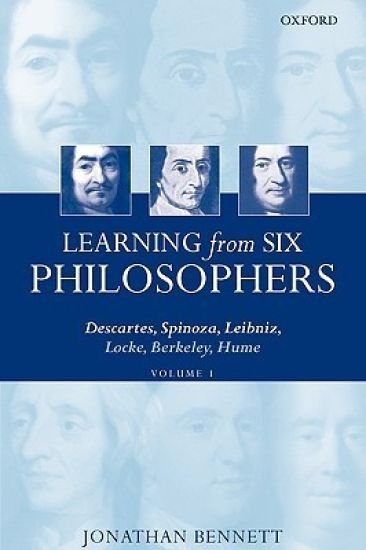
Jonathan Bennett engages with the thought of six great thinkers of the early modern period: Descartes, Spinoza, Leibniz, Locke, Berkeley, Hume. While not neglecting the historical setting of each, his chief focus is on the words they wrote. What problem is being tackled? How exactly is the solution meant to work? Does it succeed? If not, why not? What can we learn from its success or its failure? These questions reflect Bennett's dedication to engaging with philosophy as philosophy, not as museum exhibit, and they require a close and demanding attention to textual details; these being two features that characterize all Bennett's work on early modern philosophy. For newcomers to the early modern scene, this clearly written work is an excellent introduction to it. Those already in the know can learn how to argue with the great philosophers of the past, treating them as colleagues, antagonists, students, teachers. Volume 1: In this volume Jonathan Bennett examines the views of Descartes, Spinoza, and Leibniz on matter and space, the foundations of physics, atomism and alternatives to it, causation, knowledge of necessary truths, how mind relates to body, the nature and significance of human desires, our perception of the material world, and other topics. While exhibiting and celebrating the wonderful breadth, depth, and boldness of the thinking of these philosophers, Bennett also tracks them into the details, where the life is, evaluating their doctrines and arguments on their own merits and in relation to current philosophical problems and interests.
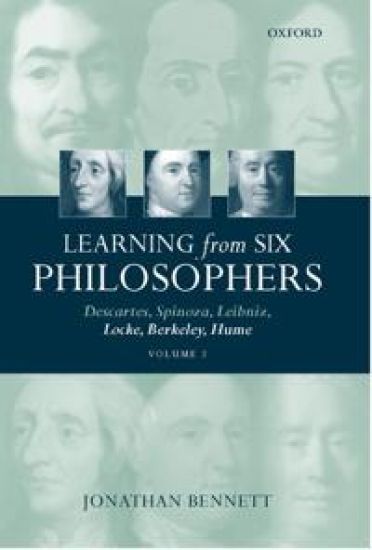
Jonathan Bennett engages with the thought of six great thinkers of the early modern period: Descartes, Spinoza, Leibniz, Locke, Berkeley, Hume. While not neglecting the historical setting of each, his chief focus is on the words they wrote. What problem is being tackled? How exactly is the solution meant to work? Does it succeed? If not, why not? What can we learn from its success or its failure? These questions reflect Bennett's dedication to engaging with philosophy as philosophy, not as museum exhibit, and they require a close and demanding attention to textual details; these being two features that characterize all Bennett's work on early modern philosophy. For newcomers to the early modern scene, this clearly written work is an excellent introduction to it. Those already in the know can learn how to argue with the great philosophers of the past, treating them as colleagues, antagonists, students, teachers. Volume 2: In this volume Jonathan Bennett examines the views of Locke, Berkeley, and Hume on thought and sensation, meaning, language, classification, innate ideas and knowledge, our knowledge of necessary truths (bringing in Descartes and Leibniz as well), the basis for our belief that we live in a world of material things, causation, the fundamental difference between colours and shapes, the passage of time and our ability to live through it. While finding much to criticize, Bennett shows that we can learn much about these and other topics under the guidance and inspiration of the energy, courage, and insight of these three great British philosophers.
Conditional sentences are among the most intriguing and puzzling features of language: analysis of their meaning and function has important implications for, and uses in, many areas of philosophy. Jonathan Bennett, one of the world's leading experts, distils many years' work and teaching into this Philosophical Guide to Conditionals, the fullest and most authoritative treatment of the subject. The literature on conditionals is difficult - needlessly so. Bennett's treatment is meticulously careful and luminously clear. He presents and evaluates in detail various approaches to the understanding of 'indicative' conditionals (like 'If Shakespeare didn't write Hamlet, some aristocrat did') and 'subjunctive' conditionals (like 'If rabbits had not been deliberately introduced into New Zealand, there would be none there today'); and he offers his own view, which will be recognized as a major original contribution to the subject. Journeying through this intellectual territory brings one into contact with the metaphysics of possible worlds, probability and belief-change, probability and logic, the pragmatics of conversation, determinism, ambiguity, vagueness, the law of excluded middle, facts versus events, and more. One might perhaps learn more philosophy from a thorough study of conditionals than from any other kind of work. Bennett's Guide is an ideal introduction for undergraduates with a philosophical grounding, and will also be a rich source of illumination and stimulation for graduate students and professional philosophers.
Jonathan Bennett engages with the thought of six great thinkers of the early modern period: Descartes, Spinoza, Leibniz, Locke, Berkeley, Hume. While not neglecting the historical setting of each, his chief focus is on the words they wrote. What problem is being tackled? How exactly is the solution meant to work? Does it succeed? If not, why not? What can we learn from its success or its failure? These questions reflect Bennett's dedication to engaging with philosophy as philosophy, not as museum exhibit, and they require a close and demanding attention to textual details; these being two features that characterize all Bennett's work on early modern philosophy. For newcomers to the early modern scene, this clearly written work is an excellent introduction to it. Those already in the know can learn how to argue with the great philosophers of the past, treating them as colleagues, antagonists, students, teachers.
The Act Itself offers a deeper understanding of what is going on in our own moral thoughts about human behaviour. Many of the descriptions of behaviour on which our moral thoughts are based are confused; others may be free of confusion, but still we are not clear in our minds about what thoughts they are. That is would hurt her, it would be disloyal, it wouldn't be done with that intention, it would be dangerous, it would involve allowing harm but not producing it--thoughts like these support our moral judgements and thus guide our lives. In so far as we do not deeply understand them, this is a kind of servitude. As Locke said, 'He is the most enslaved who is so in his understanding.' Jonathan Bennett presents conceptual analysis as a means to getting more control of our thoughts and thus of our lives.
This is a study of events and their place in our language and thought. The author discusses what kind of item an event is, how the language of events works and how these two themes are interrelated. He argues that most of the supposedly metaphysical literature on events is really about semantics of their names, and that the true metaphysic of events - known by Leibniz and rediscovered by Jaegwon Kim - has not been universally accepted because it has been obscured by a false semantic theory.
Expounds, compares, and criticises Spinoza's theses.
First published in 1976, this book presents a view of language as a matter of systematic communicative behaviour. Professor Bennett discusses the problems involved in topics such as teleology, belief and intention, form and content, meaning, convention, and syntactic structure, whilst underlining the importance of behaviour in both human and non-human forms of communication. For the major points of reference in Bennett's discussions, a select bibliography is included, which roots his thesis in a broader corpus of linguistic and philosophical study. This book will be of interest to the student and scholar as well as to the general enthusiast of the philosophy of language.
Jonathan Bennett here examines the second half of the Critique of Pure Reason, the Dialectic, where Kant is concerned with problems about substance, the nature of the self, the cosmos, freedom and the existence of God. In this study of the Dialectic in English, the author aims to make accessible and intelligible to students this complex and extremely important part of Kant's great work. There are also extended comparative discussions of related work by some of the most influential of Kant's predecessors, in particular Descartes and Leibniz. As in his earlier book, Professor Bennett offers not passive exegesis but critical assessment; he approaches Kant from the standpoint of contemporary analytical philosophy, identifying those arguments and issues of most continuing interest, and engaging with Kant in discussion of them. His purpose throughout is 'not history with a special subject-matter, but philosophy with a special technique'.