Kirjojen hintavertailu. Mukana 12 595 353 kirjaa ja 12 kauppaa.

Kirjailija

Jonathan D. H. Smith

Kirjat ja teokset yhdessä paikassa: 5 kirjaa, julkaisuja vuosilta 1999-2024, suosituimpien joukossa Modes. Vertaile teosten hintoja ja tarkista saatavuus suomalaisista kirjakaupoista.

Mukana myös kirjoitusasut: Jonathan D H Smith

5 kirjaa

Kirjojen julkaisuhaarukka 1999-2024.

Introduction to Abstract Algebra

Introduction to Abstract Algebra

Jonathan D. H. Smith

TAYLOR FRANCIS LTD
2024
nidottu
Introduction to Abstract Algebra, Second Edition presents abstract algebra as the main tool underlying discrete mathematics and the digital world. It avoids the usual groups first/rings first dilemma by introducing semigroups and monoids, the multiplicative structures of rings, along with groups.This new edition of a widely adopted textbook covers applications from biology, science, and engineering. It offers numerous updates based on feedback from first edition adopters, as well as improved and simplified proofs of a number of important theorems. Many new exercises have been added, while new study projects examine skewfields, quaternions, and octonions.The first three chapters of the book show how functional composition, cycle notation for permutations, and matrix notation for linear functions provide techniques for practical computation. These three chapters provide a quick introduction to algebra, sufficient to exhibit irrational numbers or to gain a taste of cryptography.Chapters four through seven cover abstract groups and monoids, orthogonal groups, stochastic matrices, Lagrange’s theorem, groups of units of monoids, homomorphisms, rings, and integral domains. The first seven chapters provide basic coverage of abstract algebra, suitable for a one-semester or two-quarter course.Each chapter includes exercises of varying levels of difficulty, chapter notes that point out variations in notation and approach, and study projects that cover an array of applications and developments of the theory.The final chapters deal with slightly more advanced topics, suitable for a second-semester or third-quarter course. These chapters delve deeper into the theory of rings, fields, and groups. They discuss modules, including vector spaces and abelian groups, group theory, and quasigroups.This textbook is suitable for use in an undergraduate course on abstract algebra for mathematics, computer science, and education majors, along with students from other STEM fields.
Introduction to Abstract Algebra

Introduction to Abstract Algebra

Jonathan D. H. Smith

Productivity Press
2015
sidottu
Introduction to Abstract Algebra, Second Edition presents abstract algebra as the main tool underlying discrete mathematics and the digital world. It avoids the usual groups first/rings first dilemma by introducing semigroups and monoids, the multiplicative structures of rings, along with groups.This new edition of a widely adopted textbook covers applications from biology, science, and engineering. It offers numerous updates based on feedback from first edition adopters, as well as improved and simplified proofs of a number of important theorems. Many new exercises have been added, while new study projects examine skewfields, quaternions, and octonions.The first three chapters of the book show how functional composition, cycle notation for permutations, and matrix notation for linear functions provide techniques for practical computation. These three chapters provide a quick introduction to algebra, sufficient to exhibit irrational numbers or to gain a taste of cryptography.Chapters four through seven cover abstract groups and monoids, orthogonal groups, stochastic matrices, Lagrange’s theorem, groups of units of monoids, homomorphisms, rings, and integral domains. The first seven chapters provide basic coverage of abstract algebra, suitable for a one-semester or two-quarter course.Each chapter includes exercises of varying levels of difficulty, chapter notes that point out variations in notation and approach, and study projects that cover an array of applications and developments of the theory.The final chapters deal with slightly more advanced topics, suitable for a second-semester or third-quarter course. These chapters delve deeper into the theory of rings, fields, and groups. They discuss modules, including vector spaces and abelian groups, group theory, and quasigroups.This textbook is suitable for use in an undergraduate course on abstract algebra for mathematics, computer science, and education majors, along with students from other STEM fields.
An Introduction to Quasigroups and Their Representations
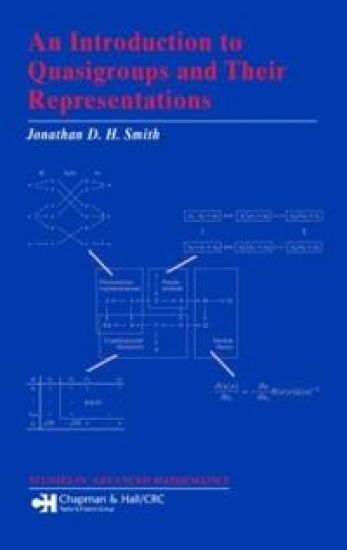
Collecting results scattered throughout the literature into one source, An Introduction to Quasigroups and Their Representations shows how representation theories for groups are capable of extending to general quasigroups and illustrates the added depth and richness that result from this extension. To fully understand representation theory, the first three chapters provide a foundation in the theory of quasigroups and loops, covering special classes, the combinatorial multiplication group, universal stabilizers, and quasigroup analogues of abelian groups. Subsequent chapters deal with the three main branches of representation theory-permutation representations of quasigroups, combinatorial character theory, and quasigroup module theory. Each chapter includes exercises and examples to demonstrate how the theories discussed relate to practical applications. The book concludes with appendices that summarize some essential topics from category theory, universal algebra, and coalgebras. Long overshadowed by general group theory, quasigroups have become increasingly important in combinatorics, cryptography, algebra, and physics. Covering key research problems, An Introduction to Quasigroups and Their Representations proves that you can apply group representation theories to quasigroups as well.
Modes

Modes

Anna B Romanowska; Jonathan D H Smith

World Scientific Publishing Co Pte Ltd
2002
sidottu
This book is an introduction to the theory and application of modes — structures that capture the common underlying algebra of convex sets, affine spaces and certain ordered sets. Modes appear in many branches of mathematics, particularly geometry and combinatorics, and have been used in computer science, economics, physics, and biology. The initial stage of the theory was set out in the authors' research monograph Modal Theory (published in 1985). The present book provides a more complete theory, the result of research conducted during the subsequent 15 years. It contains a clear introduction to selected topics from universal algebra, category theory and model theory, and the foundations of the theory of modes, as well as more advanced topics leading to the forefront of current research in the field.The authors have included a wide range of exercises, usually placed at the end of the section, and indexed alphabetically. Some exercises are simply designed to familiarize readers with the notation and concepts. Others are more difficult, extending the content of the sections in which they appear, and providing a foretaste of further research.
Post-Modern Algebra

Post-Modern Algebra

Jonathan D. H. Smith; Anna B. Romanowska

John Wiley Sons Inc
1999
sidottu
Advanced algebra in the service of contemporary mathematical research— a unique introduction. This volume takes an altogether new approach to advanced algebra. Its intriguing title, inspired by the term postmodernism, denotes a departure from van der Waerden's Modern Algebra—a book that has dominated the field for nearly seventy years. Post-Modern Algebra offers a truly up-to-date alternative to the standard approach, explaining topics from an applications-based perspective rather than by abstract principles alone. The book broadens the field of study to include algebraic structures and methods used in current and emerging mathematical research, and describes the powerful yet subtle techniques of universal algebra and category theory. Classical algebraic areas of groups, rings, fields, and vector spaces are bolstered by such topics as ordered sets, monoids, monoid actions, quasigroups, loops, lattices, Boolean algebras, categories, and Heyting algebras. The text features: *A clear and concise treatment at an introductory level, tested in university courses. *A wealth of exercises illustrating concepts and their practical application. *Effective techniques for solving research problems in the real world. *Flexibility of presentation, making it easy to tailor material to specific needs. *Help with elementary proofs and algebraic notations for students of varying abilities. Post-Modern Algebra is an excellent primary or supplementary text for graduate-level algebra courses. It is also an extremely useful resource for professionals and researchers in many areas who must tackle abstract, linear, or universal algebra in the course of their work.