Kirjojen hintavertailu. Mukana 12 459 402 kirjaa ja 12 kauppaa.

Kirjailija

Jonathan D. Phillips

Kirjat ja teokset yhdessä paikassa: 3 kirjaa, julkaisuja vuosilta 2021-2025, suosituimpien joukossa Abiotic Selection in Earth Surface Systems. Vertaile teosten hintoja ja tarkista saatavuus suomalaisista kirjakaupoista.

3 kirjaa

Kirjojen julkaisuhaarukka 2021-2025.

Abiotic Selection in Earth Surface Systems

Abiotic Selection in Earth Surface Systems

Jonathan D. Phillips

Springer International Publishing AG
2025
sidottu
This book is about abiotic selection in Earth surface systems. It demonstrates that seemingly purposeful or goal-oriented phenomena in Earth's processes actually emerge from selection dynamics. While many think of selection in the context of biological evolution, it extends to abiotic processes crucial in understanding Earth's function and evolution. The author delineates four forms of geophysical selection: gradient, resistance, network, and thermodynamic. These selections manifest in various natural systems, from fluid flows shaping landscapes to the efficient transport of mass and energy. The book acknowledges the interplay of geophysical and ecological processes, employing them as pedagogical tools. Structured with an introduction to abiotic selection and its context, the book delves into the application of key principles—such as thermodynamics and flow dynamics—to Earth surface systems. Each subsequent chapter examines one of the four types of selection, featuring diverse real-world examples from climate dynamics to oceanography. Geared toward researchers, graduate students, and practitioners in fields such as geophysics, geology, geography, hydrology, and ecosystem sciences, it also appeals to those interested in evolutionary thinking beyond traditional life sciences.

Mysterious Ways

Mysterious Ways

Jonathan D. Phillips

OXFORD UNIVERSITY PRESS INC
2025
sidottu
General scientific laws guide and constrain how landscapes evolve, but because local geographical and historical contingencies are so important, there are infinite possible evolutionary pathways and outcomes. Nevertheless, certain patterns, structures, and relationships recur repeatedly that tend to maximize efficiency. But no laws determine that this should happen, and landscapes have no goals or intentionality. How does nature keep producing relationships, structures, and patterns that maximize efficiency? Those are the "mysterious ways " this book explains. Drawing from a broad range of geoscience, bioscience, and other sciences, Mysterious Ways speaks to the stories we tell about how our world came to be, how it changes, and our place in it. The book makes a case for evolution and selection as general phenomena in nature. It shows how evolution and selection operate at the level of landscapes, and how landforms, soils, hydrology, and biota coevolve as they mutually adapt to climate and other environmental changes. It looks at phenomena like the transformation of tropical forests to savannas, karsts to deserts, and riverbed formation as outcomes of tendencies for more efficient, stable, and durable patterns, structures, and relationships to form, grow, replicate, and persist.
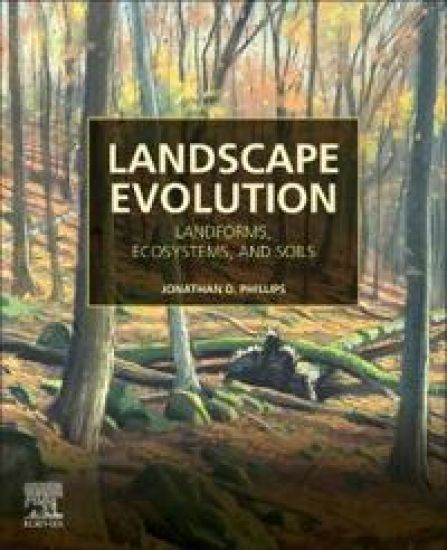
Landscape Evolution

Landscape Evolution

Jonathan D. Phillips

Elsevier Science Publishing Co Inc
2021
nidottu
Landscape Evolution: Landforms, Ecosystems and Soils asks us to think holistically, to look for the interactions between the Earth’s component surface systems, to consider how universal laws and historical and geographical contingency work together, and to ponder the implications of nonlinear dynamics in landscapes, ecosystems, and soils. Development, evolution, landforms, topography, soils, ecosystems, and hydrological systems are inextricably intertwined. While empirical studies increasingly incorporate these interactions, theories and conceptual frameworks addressing landforms, soils, and ecosystems are pursued largely independently. This is partly due to different academic disciplines, traditions, and lexicons involved, and partly due to the disparate time scales sometimes encountered. Landscape Evolution explicitly synthesizes and integrates these theories and threads of inquiry, arguing that all are guided by a general principle of efficiency selection. A key theme is that evolutionary trends are probabilistic, emergent outcomes of efficiency selection rather than purported goal functions. This interdisciplinary reference will be useful for academic and research scientists across the Earth sciences.