Kirjojen hintavertailu. Mukana 12 595 353 kirjaa ja 12 kauppaa.

Kirjailija

Jonathan Goldberg

Kirjat ja teokset yhdessä paikassa: 24 kirjaa, julkaisuja vuosilta 1990-2022, suosituimpien joukossa Come As You Are, After Eve Kosofsky Sedgwick. Vertaile teosten hintoja ja tarkista saatavuus suomalaisista kirjakaupoista.

24 kirjaa

Kirjojen julkaisuhaarukka 1990-2022.

Being of Two Minds

Being of Two Minds

Jonathan Goldberg

FORDHAM UNIVERSITY PRESS
2022
pokkari
Being of Two Minds examines the place that early modern literature held in Modernist literary criticism. For T. S. Eliot, Virginia Woolf, and William Empson, the early modern period helps model a literary future. At stake in their engagements across time were ontological questions about literature and its ability to mediate between the one and the many, the particular and the general, life and death, the past and the present. If reading and writing literature enables the mind to be in two places at once, creative experience serves as a way to participate in an expanded field of consciousness alongside mortality. Goldberg reads the readings that these modernists performed on texts that Eliot claimed for the canon like the metaphysical poets and Jacobean dramatists, but also Shakespeare, Milton, Montaigne, and Margaret Cavendish. Ontological concerns are reflected in Eliot's engagement with Aristotle's theory of the soul and Empson's Buddhism. These arguments about being affect minds and bodies and call into question sexual normativity: Eliot glances at a sodomitical male-male mode of literary transmission; Woolf produces a Judith Shakespeare to model androgynous being; Empson refuses to distinguish activity from passivity to rewrite gender difference. The work of one of our leading literary and cultural critics, Being of Two Minds spans centuries to show how the most compelling and surprising ideas about mind, experience, and existence not only move between early modernity, high modernism, and our own moment, but are also constituted through that very movement between times and minds.
Being of Two Minds

Being of Two Minds

Jonathan Goldberg

FORDHAM UNIVERSITY PRESS
2022
sidottu
Being of Two Minds examines the place that early modern literature held in Modernist literary criticism. For T. S. Eliot, Virginia Woolf, and William Empson, the early modern period helps model a literary future. At stake in their engagements across time were ontological questions about literature and its ability to mediate between the one and the many, the particular and the general, life and death, the past and the present. If reading and writing literature enables the mind to be in two places at once, creative experience serves as a way to participate in an expanded field of consciousness alongside mortality. Goldberg reads the readings that these modernists performed on texts that Eliot claimed for the canon like the metaphysical poets and Jacobean dramatists, but also Shakespeare, Milton, Montaigne, and Margaret Cavendish. Ontological concerns are reflected in Eliot's engagement with Aristotle's theory of the soul and Empson's Buddhism. These arguments about being affect minds and bodies and call into question sexual normativity: Eliot glances at a sodomitical male-male mode of literary transmission; Woolf produces a Judith Shakespeare to model androgynous being; Empson refuses to distinguish activity from passivity to rewrite gender difference. The work of one of our leading literary and cultural critics, Being of Two Minds spans centuries to show how the most compelling and surprising ideas about mind, experience, and existence not only move between early modernity, high modernism, and our own moment, but are also constituted through that very movement between times and minds.

Come As You Are, After Eve Kosofsky Sedgwick

Come As You Are, After Eve Kosofsky Sedgwick

Ever Kosofsky Sedgwick; Jonathan Goldberg

Punctum Books
2021
nidottu
This book brings together two pieces of writing. In the first, "After Eve Kosofsky Sedgwick," Jonathan Goldberg assesses her legacy, prompted mainly by writing about Sedgwick's work that has appeared in the years since her death in April 2009. Writing by Lauren Berlant, Jane Gallop, Katy Hawkins, Scott Herring, Lana Lin, and Philomina Tsoukala are among those considered as he explores questions of queer temporality and the breaching of ontological divides. Main concerns include the relationship of Sedgwick's later work in Proust, fiber, and Buddhism to her fundamental contribution to queer theory, and the axes of identification across difference that motivated her work and attachment to it."Come As You Are," the other piece of writing, is a previously unpublished talk Sedgwick gave in 1999-2000. It represents a significant bridge between her earlier and later work, sharing with her book Tendencies the ambition to discover the "something" that makes queer inextinguishable. In this piece, Sedgwick does that by contemplating her own mortality alongside her creative engagement with Buddhist thought, especially the in-between states named bardos and her newfound energy for making things. These were represented in a show of her fabric art, "Floating Columns/In the Bardo," that accompanied her talk, a number of images of which are included in this book. They feature floating figures suspended in the realization of death. They are objects produced by Sedgwick, made of fabric; they come from her, yet are discontinuous with her, occupying a mode of existence that exceeds the span of human life and the confines of individual identity. They could be put beside the queer transitive identifications across difference that Goldberg's essay explores.Jonathan Goldberg is Arts and Sciences Distinguished Professor Emeritus at Emory University. His most recent publications include Sappho ]fragments (punctum 2018), and Saint Marks: Words, Images, and What Persists (Fordham, 2019). He is the editor of The Weather in Proust, the posthumous publication of Eve Kosofsky Sedgwick, whose transformative books include Epistemology of the Closet, A Dialogue on Love, and Touching Feeling.
Saint Marks

Saint Marks

Jonathan Goldberg

Fordham University Press
2018
pokkari
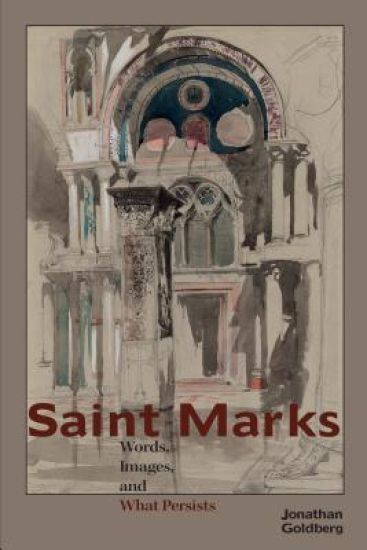
Saint Marks invokes and pluralizes the figure of Mark in order to explore relations between painting and writing. Emphasizing that the saint is not a singular biographical individual in the various biblical and hagiographic texts that involve someone so named, the book takes as its ultimate concern the kinds of material life that outlive the human subject. From the incommensurate, anachronic instances in which Saint Mark can be located—among them, as Evangelist or as patron saint of Venice—the book traces Mark's afterlives within art, sacred texts, and literature in conversation with such art historians and philosophers as Aby Warburg, Giorgio Agamben, Georges Didi-Huberman, T. J. Clark, Adrian Stokes, and Jean-Luc Nancy. Goldberg begins in sixteenth-century Venice, with a series of paintings by Gentile and Giovanni Bellini, Tintoretto, and others, that have virtually nothing to do with biblical texts. He turns then to the legacy of John Ruskin's Stones of Venice and through it to questions about what painting does as painting. A final chapter turns to ancient texts, considering the Gospel of St. Mark together with its double, the so-called Secret Gospel that has occasioned controversy for its homoerotic implications. The posthumous persistence of a life is what the gospel named Mark calls the Kingdom of God. Saints have posthumous lives; but so too do paintings and texts. This major interdisciplinary study by one of our most astute cultural critics extends what might have been a purely theological subject to embrace questions central to cultural practice from the ancient world to the present.
Saint Marks

Saint Marks

Jonathan Goldberg

FORDHAM UNIVERSITY PRESS
2018
sidottu
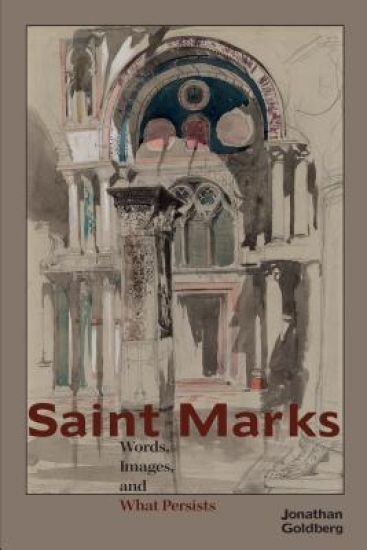
Saint Marks invokes and pluralizes the figure of Mark in order to explore relations between painting and writing. Emphasizing that the saint is not a singular biographical individual in the various biblical and hagiographic texts that involve someone so named, the book takes as its ultimate concern the kinds of material life that outlive the human subject. From the incommensurate, anachronic instances in which Saint Mark can be located—among them, as Evangelist or as patron saint of Venice—the book traces Mark's afterlives within art, sacred texts, and literature in conversation with such art historians and philosophers as Aby Warburg, Giorgio Agamben, Georges Didi-Huberman, T. J. Clark, Adrian Stokes, and Jean-Luc Nancy. Goldberg begins in sixteenth-century Venice, with a series of paintings by Gentile and Giovanni Bellini, Tintoretto, and others, that have virtually nothing to do with biblical texts. He turns then to the legacy of John Ruskin's Stones of Venice and through it to questions about what painting does as painting. A final chapter turns to ancient texts, considering the Gospel of St. Mark together with its double, the so-called Secret Gospel that has occasioned controversy for its homoerotic implications. The posthumous persistence of a life is what the gospel named Mark calls the Kingdom of God. Saints have posthumous lives; but so too do paintings and texts. This major interdisciplinary study by one of our most astute cultural critics extends what might have been a purely theological subject to embrace questions central to cultural practice from the ancient world to the present.
Melodrama

Melodrama

Jonathan Goldberg

Duke University Press
2016
sidottu
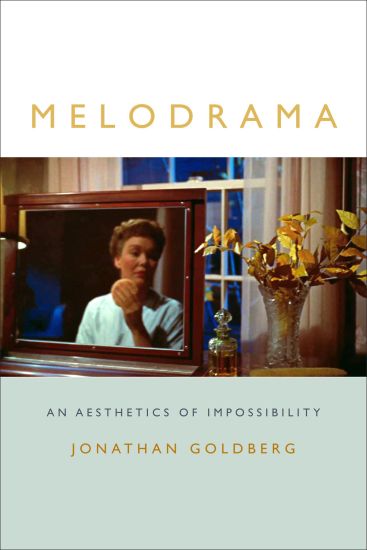
Offering a new queer theorization of melodrama, Jonathan Goldberg explores the ways melodramatic film and literature provide an aesthetics of impossibility. Focused on the notion of what Douglas Sirk termed the "impossible situation" in melodrama, such as impasses in sexual relations that are not simply reflections of social taboo and prohibitions, Goldberg pursues films by Rainer Werner Fassbinder and Todd Haynes that respond to Sirk's prompt. His analysis hones in on melodrama's original definition--a form combining music and drama--as he explores the use of melodrama in Beethoven's opera Fidelio, films by Alfred Hitchcock, and fiction by Willa Cather and Patricia Highsmith, including her Ripley novels. Goldberg illuminates how music and sound provide queer ways to promote identifications that exceed the bounds of the identity categories meant to regulate social life. The interaction of musical, dramatic, and visual elements gives melodrama its indeterminacy, making it resistant to normative forms of value and a powerful tool for creating new potentials.
Melodrama

Melodrama

Jonathan Goldberg

Duke University Press
2016
pokkari
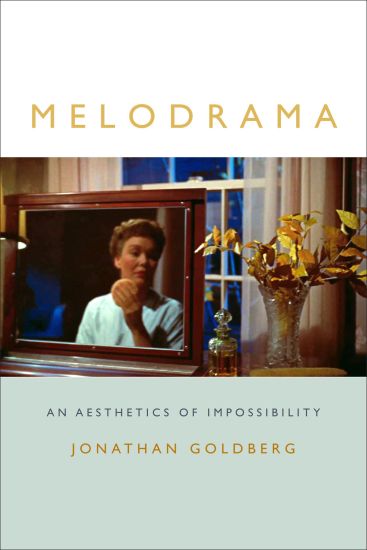
Offering a new queer theorization of melodrama, Jonathan Goldberg explores the ways melodramatic film and literature provide an aesthetics of impossibility. Focused on the notion of what Douglas Sirk termed the "impossible situation" in melodrama, such as impasses in sexual relations that are not simply reflections of social taboo and prohibitions, Goldberg pursues films by Rainer Werner Fassbinder and Todd Haynes that respond to Sirk's prompt. His analysis hones in on melodrama's original definition--a form combining music and drama--as he explores the use of melodrama in Beethoven's opera Fidelio, films by Alfred Hitchcock, and fiction by Willa Cather and Patricia Highsmith, including her Ripley novels. Goldberg illuminates how music and sound provide queer ways to promote identifications that exceed the bounds of the identity categories meant to regulate social life. The interaction of musical, dramatic, and visual elements gives melodrama its indeterminacy, making it resistant to normative forms of value and a powerful tool for creating new potentials.
This Distracted Globe

This Distracted Globe

Jonathan Goldberg; Karen Newman

Fordham University Press
2016
pokkari
Worldmaking takes many forms in early modern literature and thus challenges any single interpretive approach. The essays in this collection investigate the material stuff of the world in Spenser, Cary, and Marlowe; the sociable bonds of authorship, sexuality, and sovereignty in Shakespeare and others; and the universal status of spirit, gender, and empire in the worlds of Vaughan, Donne, and the dastan (tale) of Chouboli, a Rajasthani princess. Together, these essays make the case that to address what it takes to make a world in the early modern period requires the kinds of thinking exemplified by theory.
This Distracted Globe

This Distracted Globe

Jonathan Goldberg; Karen Newman

FORDHAM UNIVERSITY PRESS
2016
sidottu
Worldmaking takes many forms in early modern literature and thus challenges any single interpretive approach. The essays in this collection investigate the material stuff of the world in Spenser, Cary, and Marlowe; the sociable bonds of authorship, sexuality, and sovereignty in Shakespeare and others; and the universal status of spirit, gender, and empire in the worlds of Vaughan, Donne, and the dastan (tale) of Chouboli, a Rajasthani princess. Together, these essays make the case that to address what it takes to make a world in the early modern period requires the kinds of thinking exemplified by theory.
Voice Terminal Echo (Routledge Revivals)

Voice Terminal Echo (Routledge Revivals)

Jonathan Goldberg

Routledge
2016
nidottu
First published in 1986, this title examines a set of English Renaissance texts by Shakespeare, Spenser, Herbert, Marvell and Milton, within the theoretic framework of postmodern thought. Following an opening chapter that argues for the value of this conjunction as a way of understanding literary history, subsequent chapters draw upon Jacques Derrida’s deconstruction of photocentrism and Jacques Lacan’s analysis of the agency of the letter to offer fully theorized readings. Throughout, there is a sustained concern with the transformations of such Ovidian figures as Narcissus and Echo, Perseus and Medusa, Orpheus and Eurydice, and with the echo effects of Virgilian pastoral, as paradigms for the interplay of voice and writing.
Voice Terminal Echo (Routledge Revivals)

Voice Terminal Echo (Routledge Revivals)

Jonathan Goldberg

Routledge
2014
sidottu
First published in 1986, this title examines a set of English Renaissance texts by Shakespeare, Spenser, Herbert, Marvell and Milton, within the theoretic framework of postmodern thought. Following an opening chapter that argues for the value of this conjunction as a way of understanding literary history, subsequent chapters draw upon Jacques Derrida’s deconstruction of photocentrism and Jacques Lacan’s analysis of the agency of the letter to offer fully theorized readings. Throughout, there is a sustained concern with the transformations of such Ovidian figures as Narcissus and Echo, Perseus and Medusa, Orpheus and Eurydice, and with the echo effects of Virgilian pastoral, as paradigms for the interplay of voice and writing.
Strangers On A Train

Strangers On A Train

Jonathan Goldberg

Arsenal Pulp Press
2013
nidottu
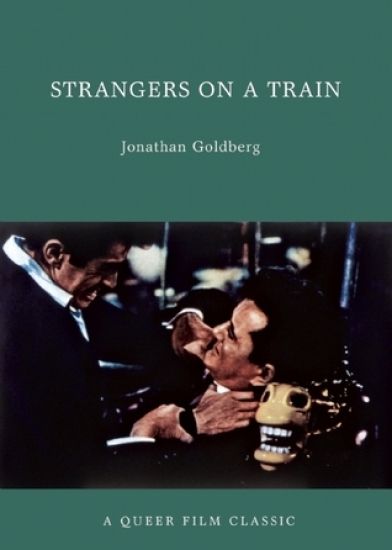
Alfred Hitchcock's 1951 thriller based on the novel of the same name by Patricia Highsmith ("The Talented Mr. Ripley") is about two men who meet on a train: one is a man of high social standing who wishes to divorce his unfaithful wife; the other is an enigmatic bachelor with an overbearing father. Together they enter into a murder plot that binds them to one another, with fatal consequences. This Queer Film Classic delves into the homoerotic energy of the film, especially between the two male characters (played by Farley Granger and Robert Walker). It builds on the question of the sexuality the film puts on view, not to ask whether either character is gay so much as to explore the queer relations between sexuality and murder and the strong antisocial impulses those relations represent. The book also includes a look at the making of the film and the critical controversies over Hitchcock's representations of male homosexuality. QUEER FILM CLASSICS is a critically acclaimed film book series that launched in 2009. It features twenty-one of the most important and influential films about and/or by LGBTQ people, made in eight different countries between 1950 and 2005, and written by leading LGBTQ film scholars and critics. Jonathan Goldberg is a professor at Emory University, where he directs the Studies in Sexualities program. He is the author of many books and editor of Eve Kosofsky Sedgwick's posthumous 2012 book "The Weather in Proust."
Sodometries

Sodometries

Jonathan Goldberg

Fordham University Press
2010
pokkari
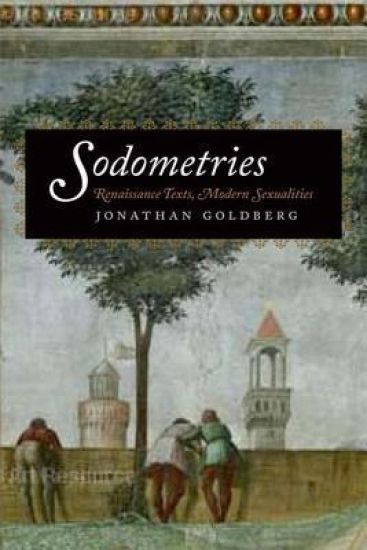
This book is about representations of sodomy. While most of the texts it considers are literary-works by Shakespeare, Marlowe, Spenser, among others-it is framed by political considerations, notably the 1986 U.S. Supreme Court decision in Bowers v. Hardwick that denied any constitutional act to private consensual acts that the court termed 'homosexual sodomy' and the rhetoric attaching sodomy to Saddam Hussein in the initial U.S. war in Iraq. The book takes as axiomatic Foucault's description of sodomy as 'that utterly confused category.' Without collapsing questions of historical difference, it works to articulate relations between the early modern period and our own, between a time before the homo/heterosexual divide and the modern regimes that assume it. In this book, sodometries (a Renaissance word for 'sodomy' chosen for its nonce-word suggestiveness) are sites of complications around definitions of sex and gender. Because 'sodomy' is not a term capable of singular definition, representations of sodomy are never direct. Sodomy exists only relationally. Three social domains for textual production are explored in this book: the sixteenth-century English court as the location of high literariness; the theater, especially as a site for controversy around cross-dressing; the New World as the place where the slaughter of native populations (and, in New England, of Englishmen as well) was carried out in the name of ridding the hemisphere of sodomites. These lethal impulses are read as foundational for a U.S. imaginary still operative in many powerful quarters. The analyses of literary texts engage the most advanced work in early modern literary criticism (that done by feminist and New Historicist critics) and proposes a queer perspective that necessarily complicates and enriches such inquiries. Besides offering detailed readings of literary texts not often read in terms of the history of sexuality (Shakespeare's history plays, for example), the book also examines narratives of the conquest and colonization of the Americas.
The Seeds of Things

The Seeds of Things

Jonathan Goldberg

Fordham University Press
2009
pokkari
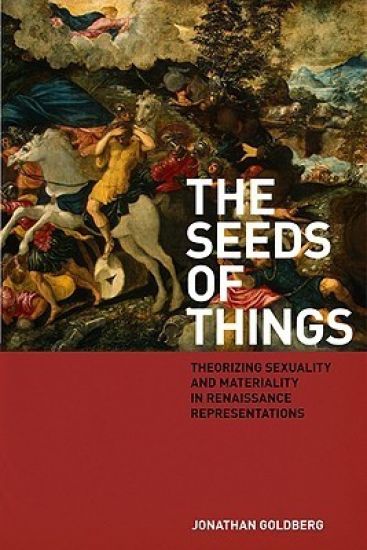
The title of this book translates one of the many ways in which Lucretius names the basic matter from which the world is made in De rerum natura. In Lucretius, and in the strain of thought followed in this study, matter is always in motion, always differing from itself and yet always also made of the same stuff. From the pious Lucy Hutchinson's all but complete translation of the Roman epic poem to Margaret Cavendish's repudiation of atomism (but not of its fundamental problematic of sameness and difference), a central concern of this book is how a thoroughgoing materialism can be read alongside other strains in the thought of the early modern period, particularly Christianity. A chapter moves from Milton's monism to his angels and their insistent corporeality. Milton's angels have sex, and, throughout, this study emphasizes the consequences for thinking about sexuality offered by Lucretian materialism. Sameness of matter is not simply a question of same-sex sex, and the relations of atoms in Cavendish and Hutchinson are replicated in the terms in which they imagine marriages of partners who are also their doubles. Likewise, Spenser's knights in the 1590 Faerie Queene pursue the virtues of Holiness, Temperance, and Chastity in quests that take the reader on a path of askesis of the kind that Lucretius recommends and that Foucault studied in the final volumes of his history of sexuality. Although English literature is the book's main concern, it first contemplates relations between Lucretian matter and Pauline flesh by way of Tintoretto's painting The Conversion of St. Paul. Theoretical issues raised in the work of Agamben and Badiou, among others, lead to a chapter that takes up the role that Lucretius has played in theory, from Bergson and Marx to Foucault and Deleuze. This study should be of concern to students of religion, philosophy, gender, and sexuality, especially as they impinge on questions of representation.
The Seeds of Things

The Seeds of Things

Jonathan Goldberg

Fordham University Press
2009
sidottu
The title of this book translates one of the many ways in which Lucretius names the basic matter from which the world is made in De rerum natura. In Lucretius, and in the strain of thought followed in this study, matter is always in motion, always differing from itself and yet always also made of the same stuff. From the pious Lucy Hutchinson’s all but complete translation of the Roman epic poem to Margaret Cavendish’s repudiation of atomism (but not of its fundamental problematic of sameness and difference), a central concern of this book is how a thoroughgoing materialism can be read alongside other strains in the thought of the early modern period, particularly Christianity. A chapter moves from Milton’s monism to his angels and their insistent corporeality. Milton’s angels have sex, and, throughout, this study emphasizes the consequences for thinking about sexuality offered by Lucretian materialism. Sameness of matter is not simply a question of same-sex sex, and the relations of atoms in Cavendish and Hutchinson are replicated in the terms in which they imagine marriages of partners who are also their doubles. Likewise, Spenser’s knights in the 1590 Faerie Queene pursue the virtues of Holiness, Temperance, and Chastity in quests that take the reader on a path of askesis of the kind that Lucretius recommends and that Foucault studied in the final volumes of his history of sexuality. Although English literature is the book’s main concern, it first contemplates relations between Lucretian matter and Pauline flesh by way of Tintoretto’s painting The Conversion of St. Paul. Theoretical issues raised in the work of Agamben and Badiou, among others, lead to a chapter that takes up the role that Lucretius has played in theory, from Bergson and Marx to Foucault and Deleuze. This study should be of concern to students of religion, philosophy, gender, and sexuality, especially as they impinge on questions of representation.
Tempest In The Caribbean

Tempest In The Caribbean

Jonathan Goldberg

University of Minnesota Press
2003
nidottu
Shakespeare's The Tempest has long been claimed by colonials and postcolonial thinkers alike as the dramatic work that most enables them to confront their entangled history, recognized as early modernity's most extensive engagement with the vexing issues of colonialism--race, dispossession, language, European displacement and occupation, disregard for native culture. Tempest in the Caribbean reads some of the "classic" anticolonial texts--by Aime Cesaire, Roberto Fernandez Retamar, George Lamming, and Frantz Fanon, for instance--through the lens of feminist and queer analysis exemplified by the theoretical essays of Sylvia Wynter and the work of Michelle Cliff. Extending the Tempest plot, Goldberg considers recent works by Caribbean authors and social theorists, among them Patricia Powell, Jamaica Kincaid, and Hilton Als. These rewritings, he suggests, and the lived conditions to which they testify, present alternatives to the masculinist and heterosexual bias of the legacy that has been derived from The Tempest. By placing gender and sexuality at the center of the debate about the uses of Shakespeare for anticolonial purposes, Goldberg's work points to new possibilities that might be articulated through the nexus of race and sexuality. Place sexuality at the center of Caribbean responses to Shakespeare's play.
Shakespeare's Hand

Shakespeare's Hand

Jonathan Goldberg

University of Minnesota Press
2002
nidottu
A provocative exploration of the relationship between gender, history, and Shakespeare’s plays.Over the past fifteen years, Jonathan Goldberg’s wide-ranging essays have been among the most sophisticated, influential, and controversial writing about Shakespeare. He challenges the critical orthodoxy, provoking scholars to reassess both their own assumptions and those underpinning the field of Shakespeare studies. Collected in one volume for the first time, these essays offer a sustained, energetic, and rigorous examination of issues of gender and sexuality that pervade Shakespeare’s plays, as well as a road map of the shifts during the past two decades in our understanding of English literature’s most canonical figure.Central to these essays are concerns about textuality as considered from a number of vantage points, including deconstructionist, psychoanalytic, and historicist. Goldberg studies most of Shakespeare’s plays, giving particular emphasis to Henry IV, Parts 1 and 2, and to Romeo and Juliet; he focuses throughout on the relationship between the text as material object and the reality created or reflected by that text. Among the issues he considers are the textual instability of Shakespeare’s plays and the historical instabilities of gender and sexuality depicted in those plays, the construction of gender and the dehumanization implicit in treating characters as a textual production, the function of letters and other documents within the Shakespearean texts, and the correlation of sexual politics and textual desire. Tracing a path from characters in the scriptive sense to their embodiment in characters marked by gender and sexuality, Shakespeare's Hand provides a brilliant set of inquiries into the production, critical reception, and conditions of Shakespearean texts.
Willa Cather and Others

Willa Cather and Others

Jonathan Goldberg

Duke University Press
2001
pokkari
After many years as one of the premier scholars of English Renaissance literature, Jonathan Goldberg turns his attention to the work of American novelist Willa Cather. With a focus on Cather’s artistic principle of “the thing not named,” Willa Cather and Others illuminates the contradictions and complexities inherent in notions of identity and shows how her fiction transforms the very categories-regarding gender, sexuality, race, and class-around which most recent Cather scholarship has focused.The “others” referred to in the title are women, for the most part Cather’s contemporaries, whose artistic projects allow for points of comparison with Cather. They include the Wagnerian diva Olive Fremstad, renowned for her category-defying voice; Blair Niles, an ethnographer and novelist of jazz-age Harlem and the prisons of New Guinea; Laura Gilpin, photographer of the American Southwest; and Pat Barker, whose Regeneration trilogy places World War I writers-and questions of sexuality and gender-at its center. In the process of studying these women and their work, Goldberg forms innovative new insights into a wide range of Cather’s celebrated works, from O Pioneers! and My Ántonia to her later books The Song of the Lark, One of Ours, The Professor’s House, Death Comes for the Archbishop, and Sapphira and the Slave Girl.By applying his unique talent to the study of Cather’s literary genius, Jonathan Goldberg makes a significant and new contribution to the study of American literature and queer studies.
Willa Cather and Others

Willa Cather and Others

Jonathan Goldberg

Duke University Press
2001
sidottu
Focusing on American novelist Willa Cather's artistic principle of "the thing not named," this study shows how her fiction transforms the very categories - regarding gender, sexuality, race, and class - around which most Cather scholarship has focused.