Kirjojen hintavertailu. Mukana 12 595 353 kirjaa ja 12 kauppaa.

Kirjailija

Jonathan Grudin

Kirjat ja teokset yhdessä paikassa: 2 kirjaa, julkaisuja vuosilta 2017-2022, suosituimpien joukossa Human-Computer Integration. Vertaile teosten hintoja ja tarkista saatavuus suomalaisista kirjakaupoista.

2 kirjaa

Kirjojen julkaisuhaarukka 2017-2022.

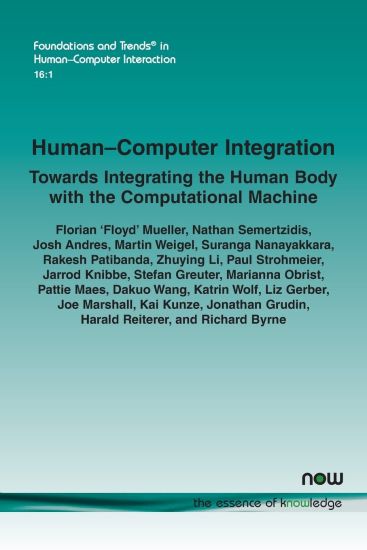
Human-Computer Integration

Human-Computer Integration

Florian ‘Floyd’ Mueller; Nathan Semertzidis; Josh Andres; Martin Weigel; Suranga Nanayakkara; Rakesh Patibanda; Zhuying Li; Paul Strohmeier; Jarrod Knibbe; Stefan Greuter; Marianna Obrist; Pattie Maes; Dakuo Wang; Katrin Wolf; Liz Gerber; Joe Marshall; Kai Kunze; Jonathan Grudin; Harald Reiterer; Richard Byrne

Now Publishers Inc
2022
nidottu
Human-Computer Integration (HInt) is an emerging paradigm in the human-computer interaction (HCI) field. Its goal is to integrate the human body and the computational machine. Because HInt is not an isolated area of research, the authors draw upon discussions from related perspectives, including cybernetics, augmentation, cyborgs, and wearables. While these prior works provide a basis for HInt, and some of their associated challenges also apply to HInt, the authors focus on articulating the HInt challenges that are of particular relevance to HCI.The monograph makes three contributions: First, the authors apply two key dimensions from psychology – bodily agency and bodily ownership – to enhance our understanding of HInt systems. Second, they use these two dimensions to provide new perspectives on user integration experiences and to develop an integration systems design space. Third, they use the design space and its two dimensions to articulate HInt’s key challenges and group these challenges into four areas: design, society, identity, and technology. Ultimately, the work aims to facilitate a more structured investigation into human body and computational machine integration.
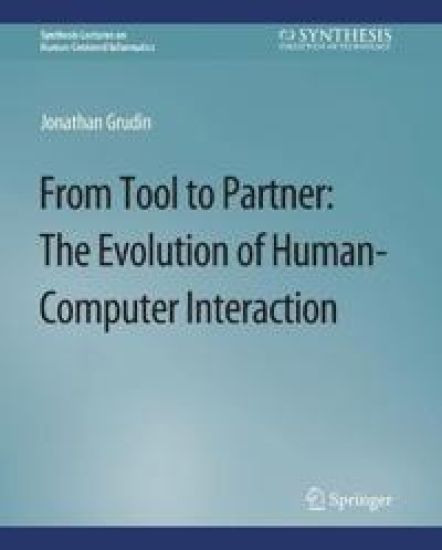
From Tool to Partner

From Tool to Partner

JONATHAN GRUDIN

Springer International Publishing AG
2017
nidottu
This is the first comprehensive history of human-computer interaction (HCI). Whether you are a user-experience professional or an academic researcher, whether you identify with computer science,human factors, information systems, information science, design, or communication, you can discover how your experiences fit into the expanding field of HCI. You can determine where to look for relevant information in other fields—and where you won't find it.This book describes the different fields that have participated in improving our digital tools.It is organized chronologically, describing major developments across fields in each period. Computer use has changed radically, but many underlying forces are constant. Technology has changed rapidly, human nature very little. An irresistible force meets an immovable object. The exponential rate of technological change gives us little time to react before technology moves on. Patterns and trajectories described in this book provide yourbest chance to anticipate what could come next.We have reached a turning point. Tools that we built for ourselves to use are increasingly influencing how we use them, in ways that are planned and sometimes unplanned. The book ends with issues worthy of consideration as we explore the new world that we and our digital partners are shaping.