Kirjojen hintavertailu. Mukana 12 314 274 kirjaa ja 12 kauppaa.
Kirjailija
Jonathan M. Borwein
Kirjat ja teokset yhdessä paikassa: 11 kirjaa, julkaisuja vuosilta 1998-2018, suosituimpien joukossa Pi: The Next Generation. Vertaile teosten hintoja ja tarkista saatavuus suomalaisista kirjakaupoista.
This book contains a compendium of 25 papers published since the 1970s dealing with pi and associated topics of mathematics and computer science. The collection begins with a Foreword by Bruce Berndt. Each contribution is preceded by a brief summary of its content as well as a short key word list indicating how the content relates to others in the collection. The volume includes articles on actual computations of pi, articles on mathematical questions related to pi (e.g., “Is pi normal?”), articles presenting new and often amazing techniques for computing digits of pi (e.g., the “BBP” algorithm for pi, which permits one to compute an arbitrary binary digit of pi without needing to compute any of the digits that came before), papers presenting important fundamental mathematical results relating to pi, and papers presenting new, high-tech techniques for analyzing pi (i.e., new graphical techniques that permit one to visually see if pi and other numbers are “normal”). This volume is a companion to Pi: A Source Book whose third edition released in 2004. The present collection begins with 2 papers from 1976, published by Eugene Salamin and Richard Brent, which describe “quadratically convergent” algorithms for pi and other basic mathematical functions, derived from some mathematical work of Gauss. Bailey and Borwein hold that these two papers constitute the beginning of the modern era of computational mathematics. This time period (1970s) also corresponds with the introduction of high-performance computer systems (supercomputers), which since that time have increased relentlessly in power, by approximately a factor of 100,000,000, advancing roughly at the same rate as Moore’s Law of semiconductor technology. This book may be of interest to a wide range of mathematical readers; some articles cover more advanced research questions suitable for active researchers in the field, but several are highly accessible to undergraduate mathematics students.
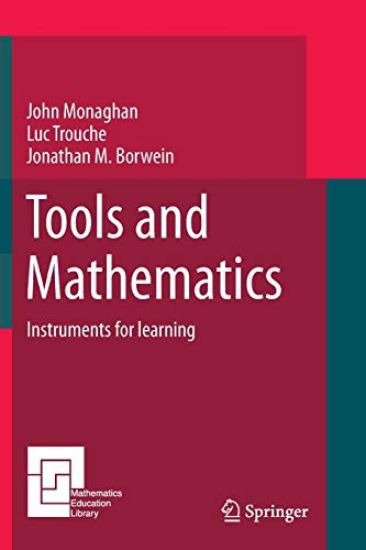
This book is an exploration of tools and mathematics and issues in mathematics education related to tool use. The book has five parts. The first part reflects on doing a mathematical task with different tools, followed by a mathematician's account of tool use in his work. The second considers prehistory and history: tools in the development from ape to human; tools and mathematics in the ancient world; tools for calculating; and tools in mathematics instruction. The third part opens with a broad review of technology and intellectual trends, circa 1970, and continues with three case studies of approaches in mathematics education and the place of tools in these approaches. The fourth part considers issues related to mathematics instructions: curriculum, assessment and policy; the calculator debate; mathematics in the real world; and teachers' use of technology. The final part looks to the future: task and tool design and new forms of activity via connectivity and computer games.
Thirty years ago mathematical, as opposed to applied numerical, computation was difficult to perform and so relatively little used. Three threads changed that: the emergence of the personal computer; the discovery of fiber-optics and the consequent development of the modern internet; and the building of the Three “M’s” Maple, Mathematica and Matlab. We intend to persuade that Maple and other like tools are worth knowing assuming only that one wishes to be a mathematician, a mathematics educator, a computer scientist, an engineer or scientist, or anyone else who wishes/needs to use mathematics better. We also hope to explain how to become an `experimental mathematician' while learning to be better at proving things. To accomplish this our material is divided into three main chapters followed by a postscript. These cover elementary number theory, calculus of one and several variables, introductory linear algebra, and visualization and interactive geometric computation.
Thirty years ago mathematical, as opposed to applied numerical, computation was difficult to perform and so relatively little used. Three threads changed that: the emergence of the personal computer; the discovery of fiber-optics and the consequent development of the modern internet; and the building of the Three “M’s” Maple, Mathematica and Matlab.We intend to persuade that Mathematica and other similar tools are worth knowing, assuming only that one wishes to be a mathematician, a mathematics educator, a computer scientist, an engineer or scientist, or anyone else who wishes/needs to use mathematics better. We also hope to explain how to become an "experimental mathematician" while learning to be better at proving things. To accomplish this our material is divided into three main chapters followed by a postscript. These cover elementary number theory, calculus of one and several variables, introductory linear algebra, and visualization and interactive geometric computation.
This book is an exploration of tools and mathematics and issues in mathematics education related to tool use. The book has five parts. The first part reflects on doing a mathematical task with different tools, followed by a mathematician's account of tool use in his work. The second considers prehistory and history: tools in the development from ape to human; tools and mathematics in the ancient world; tools for calculating; and tools in mathematics instruction. The third part opens with a broad review of technology and intellectual trends, circa 1970, and continues with three case studies of approaches in mathematics education and the place of tools in these approaches. The fourth part considers issues related to mathematics instructions: curriculum, assessment and policy; the calculator debate; mathematics in the real world; and teachers' use of technology. The final part looks to the future: task and tool design and new forms of activity via connectivity and computer games.
Thirty years ago mathematical, as opposed to applied numerical, computation was difficult to perform and so relatively little used. Three threads changed that: the emergence of the personal computer; the discovery of fiber-optics and the consequent development of the modern internet; and the building of the Three “M’s” Maple, Mathematica and Matlab.We intend to persuade that Mathematica and other similar tools are worth knowing, assuming only that one wishes to be a mathematician, a mathematics educator, a computer scientist, an engineer or scientist, or anyone else who wishes/needs to use mathematics better. We also hope to explain how to become an "experimental mathematician" while learning to be better at proving things. To accomplish this our material is divided into three main chapters followed by a postscript. These cover elementary number theory, calculus of one and several variables, introductory linear algebra, and visualization and interactive geometric computation.
Thirty years ago mathematical, as opposed to applied numerical, computation was difficult to perform and so relatively little used. Three threads changed that: the emergence of the personal computer; the discovery of fiber-optics and the consequent development of the modern internet; and the building of the Three “M’s” Maple, Mathematica and Matlab. We intend to persuade that Maple and other like tools are worth knowing assuming only that one wishes to be a mathematician, a mathematics educator, a computer scientist, an engineer or scientist, or anyone else who wishes/needs to use mathematics better. We also hope to explain how to become an `experimental mathematician' while learning to be better at proving things. To accomplish this our material is divided into three main chapters followed by a postscript. These cover elementary number theory, calculus of one and several variables, introductory linear algebra, and visualization and interactive geometric computation.
Like differentiability, convexity is a natural and powerful property of functions that plays a significant role in many areas of mathematics, both pure and applied. It ties together notions from topology, algebra, geometry and analysis, and is an important tool in optimization, mathematical programming and game theory. This book, which is the product of a collaboration of over 15 years, is unique in that it focuses on convex functions themselves, rather than on convex analysis. The authors explore the various classes and their characteristics and applications, treating convex functions in both Euclidean and Banach spaces. The book can either be read sequentially for a graduate course, or dipped into by researchers and practitioners. Each chapter contains a variety of specific examples, and over 600 exercises are included, ranging in difficulty from early graduate to research level.
New mathematical insights and rigorous results are often gained through extensive experimentation using numerical examples or graphical images and analyzing them. Today computer experiments are an integral part of doing mathematics. This allows for a more systematic approach to conducting and replicating experiments. The authors address the role of experimental research in the statement of new hypotheses and the discovery of new results that chart the road to future developments. Following the lead of Mathematics by Experiment: Plausible Reasoning in the 21st Century this book gives numerous additional case studies of experimental mathematics in action, ranging from sequences, series, products, integrals, Fourier series, zeta functions, partitions, primes and polynomials. Some advanced numerical techniques are also presented. To get a taste of the material presented in both books view the condensed version.
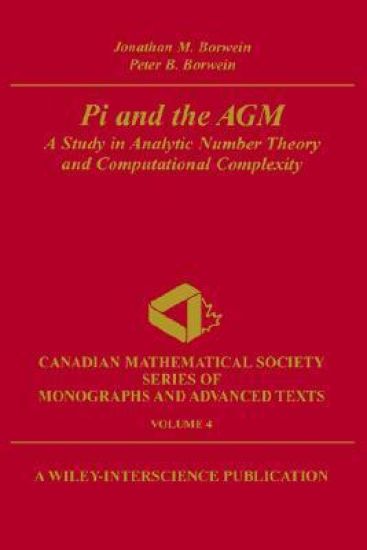
Critical Acclaim for Pi and the AGM:"Fortunately we have the Borwein's beautiful book . . . explores in the first five chapters the glorious world so dear to Ramanujan . . . would be a marvelous text book for a graduate course."Bulletin of the American Mathematical Society"What am I to say about this quilt of a book? One is reminded of Debussy who, on being asked by his harmony teacher to explain what rules he was following as he improvised at the piano, replied, "Mon plaisir." The authors are cultured mathematicians. They have selected what has amused and intrigued them in the hope that it will do the same for us. Frankly, I cannot think of a more provocative and generous recipe for writing a book . . . (it) is cleanly, even beautifully written, and attractively printed and composed. The book is unique. I cannot think of any other book in print which contains more than a smidgen of the material these authors have included.SIAM Review"If this subject begins to sound more interesting than it did in the last newspaper article on 130 million digits of Pi, I have partly succeeded. To succeed completely I will have gotten you interested enough to read the delightful and important book by the Borweins."American Mathematical Monthly"The authors are to be commended for their careful presentation of much of the content of Ramanujan's famous paper, 'Modular Equations and Approximations to Pi'. This material has not heretofore appeared in book form. However, more importantly, Ramanujan provided no proofs for many of the claims that he made, and so the authors provided many of the missing details . . . The Borweins, indeed have helped us find the right roads."Mathematics of Computation