Kirjojen hintavertailu. Mukana 12 595 353 kirjaa ja 12 kauppaa.
Kirjailija
Jonathan Rose
Kirjat ja teokset yhdessä paikassa: 21 kirjaa, julkaisuja vuosilta 1992-2025, suosituimpien joukossa Deliberative Mini-Publics. Vertaile teosten hintoja ja tarkista saatavuus suomalaisista kirjakaupoista.
Nicole Curato; David Farrell; Brigitte Geissel; Kimmo Grönlund; Patricia Mockler; Jean-Benoit Pilet; Alan Renwick; Jonathan Rose; Maija Setälä; Jane Suiter
Bringing together ten leading researchers in the field of deliberative democracy, this important book examines the features of a Deliberative Mini-Public (DMP) and considers how DMPs link into democratic systems. It examines the core design features of DMPs and their role in the broader policy process and takes stock of the characteristics that distinguish them from other forms of citizen participation. In doing so, the book offers valuable insights into the contributions that DMPs can make not only to the policy process, but also to the broader agenda of revitalising democracy in contemporary times.
Gayle DeLong was a well-known activist in the autism community, the ‘Warrior Mom’ of two autistic daughters. She worked closely with Robert F. Kennedy, Jr. on vaccine injury issues. This book is a record (based largely on her diaries) of her happy marriage to Jonathan Rose. Love in the Age of Autism does not sugarcoat the stresses and heartbreak of raising autistic children: it is more honest about that than most other books on the subject. But it is also an inspiring love story, which can help autism parents find profound joys in spite of all the pains. It offers practical advice and models for sharing the burdens and pleasures of life, based on a strong sense of family values. This book frankly (and with an earthy sense of humour) illustrates how autism parents can continue to enjoy passionate, monogamous physical love – and it explains how to provide sex education for autistic girls. The tale that Gayle and Jonathan tell is intensely romantic and life-affirming.
This is a landmark intellectual history of Britain’s working classes from the preindustrial era to the twentieth century. Drawing on workers’ memoirs, social surveys, library registers, and more, Jonathan Rose uncovers which books people read, how they educated themselves, and what they knew. A new preface addresses the continuing relevance of the book amidst the upheavals of the present day. “An astonishing book.”—Ian Sansom, The Guardian “A passionate work of history. . . . Rose has written a work of staggering ambition.”—Daniel Akst, Wall Street Journal Winner of the SHARP Book History Prize, the American Philosophical Society’s Jacques Barzun Prize, and the British Council Prize cowinner of the Longman-History Today Book of the Year Prize for 2001; named one of the finest books of 2001 by The Economist.
The task for this studio was to design a new mixed-use building across from the Apollo Theatre on 125th Street in Harlem. The developer Jonathan Rose, with New York-based architects Sara Caples and Everardo Jefferson challenged their Yale students to design a sustainable mixed-use residential and cultural building, with housing for retired jazz musicians, restaurants, and media spaces, on the last city- owned parcel. The studio questioned issues of cultural representation versus the mutability of the site's ethnic anchorings. It requires the designer to consider each space from the user's perspective. And it demands high standards of sustainable design, headed towards net zero, that support a more satisfying occupant experience, with maximal use of controlled daylight and natural ventilation. The book features interviews with those on the studio juries including Robert A. M. Stern, Alexander Garvin, and Vincent Chang.
This is the first book covering those who abused and misused the legal system in medieval England and the initial attempts of the Anglo-American legal system to deal with these forms of legal corruption. Maintenance, in the sense of intermeddling in another person's litigation, was a source of repeated complaint in medieval England. This book reveals for the first time what actually transpired in the resultant litigation. Extensive study of the primary sources shows that the statutes prohibiting maintenance did not achieve their objectives because legal proceedings were rarely brought against those targeted by the statutes: the great and the powerful. Illegal maintenance was less extensive than frequently asserted because medieval judges recognized a number of valid justifications for intermeddling in litigation. Further, the book casts doubt on the effectiveness of the statutory regulation of livery. This is a treasure trove for legal historians, literature scholars, lawyers, and academic libraries.
The 18th century was a wealth of knowledge, exploration and rapidly growing technology and expanding record-keeping made possible by advances in the printing press. In its determination to preserve the century of revolution, Gale initiated a revolution of its own: digitization of epic proportions to preserve these invaluable works in the largest archive of its kind. Now for the first time these high-quality digital copies of original 18th century manuscripts are available in print, making them highly accessible to libraries, undergraduate students, and independent scholars.The Age of Enlightenment profoundly enriched religious and philosophical understanding and continues to influence present-day thinking. Works collected here include masterpieces by David Hume, Immanuel Kant, and Jean-Jacques Rousseau, as well as religious sermons and moral debates on the issues of the day, such as the slave trade. The Age of Reason saw conflict between Protestantism and Catholicism transformed into one between faith and logic -- a debate that continues in the twenty-first century.++++The below data was compiled from various identification fields in the bibliographic record of this title. This data is provided as an additional tool in helping to insure edition identification: ++++British LibraryT185983York: printed by Grace White, 1718. 51, 1]p.; 4
The Literary Agenda is a series of short polemical monographs about the importance of literature and of reading in the wider world and about the state of literary education inside schools and universities. The category of 'the literary' has always been contentious. What is clear, however, is how increasingly it is dismissed or is unrecognised as a way of thinking or an arena for thought. It is sceptically challenged from within, for example, by the sometimes rival claims of cultural history, contextualized explanation, or media studies. It is shaken from without by even greater pressures: by economic exigency and the severe social attitudes that can follow from it; by technological change that may leave the traditional forms of serious human communication looking merely antiquated. For just these reasons this is the right time for renewal, to start reinvigorated work into the meaning and value of literary reading. For the Internet and digitial generation, the most basic human right is the freedom to read. The Web has indeed brought about a rapid and far-reaching revolution in reading, making a limitless global pool of literature and information available to anyone with a computer. At the same time, however, the threats of censorship, surveillance, and mass manipulation through the media have grown apace. Some of the most important political battles of the twenty-first century have been fought--and will be fought--over the right to read. Will it be adequately protected by constitutional guarantees and freedom of information laws? Or will it be restricted by very wealthy individuals and very powerful institutions? And given increasingly sophisticated methods of publicity and propaganda, how much of what we read can we believe? This book surveys the history of independent sceptical reading, from antiquity to the present. It tells the stories of heroic efforts at self-education by disadvantaged people in all parts of the world. It analyzes successful reading promotion campaigns throughout history (concluding with Oprah Winfrey) and explains why they succeeded. It also explores some disturbing current trends, such as the reported decay of attentive reading, the disappearance of investigative journalism, 'fake news', the growth of censorship, and the pervasive influence of advertisers and publicists on the media--even on scientific publishing. For anyone who uses libraries and Internet to find out what the hell is going on, this book is a guide, an inspiration, and a warning.
This is the first book covering those who abused and misused the legal system in medieval England and the initial attempts of the Anglo-American legal system to deal with these forms of legal corruption. Maintenance, in the sense of intermeddling in another person's litigation, was a source of repeated complaint in medieval England. This book reveals for the first time what actually transpired in the resultant litigation. Extensive study of the primary sources shows that the statutes prohibiting maintenance did not achieve their objectives because legal proceedings were rarely brought against those targeted by the statutes: the great and the powerful. Illegal maintenance was less extensive than frequently asserted because medieval judges recognized a number of valid justifications for intermeddling in litigation. Further, the book casts doubt on the effectiveness of the statutory regulation of livery. This is a treasure trove for legal historians, literature scholars, lawyers, and academic libraries.
A transformative portrait of Churchill, whose love of history, theater, and reading was inextricably linked to his life as a statesman This strikingly original book introduces a Winston Churchill we have not known before. Award-winning author Jonathan Rose explores in tandem Churchill’s careers as statesman and author, revealing the profound influence of literature and theater on Churchill’s personal, carefully composed grand story and on the decisions he made throughout his political life. Rose provides in this expansive literary biography an analysis of Churchill’s writings and their reception (he won the Nobel Prize for Literature in 1953 and was a best-selling author), and a chronicle of his dealings with publishers, editors, literary agents, and censors. The book also identifies an array of authors who shaped Churchill’s own writings and politics: George Bernard Shaw, H. G. Wells, Margaret Mitchell, George Orwell, Oscar Wilde, and many more. Rose investigates the effect of Churchill’s passion for theater on his approach to reportage, memoirs, and historical works. Perhaps most remarkably, Rose reveals the unmistakable influence of Churchill’s reading on every important episode of his public life, including his championship of social reform, plans for the Gallipoli invasion, command during the Blitz, crusade for Zionism, and efforts to prevent a nuclear arms race. In a fascinating conclusion, Rose traces the significance of Churchill’s writings to later generations of politicians, among them President John F. Kennedy as he struggled to extricate the U.S. from the Cuban Missile Crisis.
Field-programmable gate arrays (FPGAs), which are pre-fabricated, programmable digital integrated circuits (ICs), provide easy access to state-of-the-art integrated circuit process technology, and in doing so, democratize this technology of our time. This book is about comparing the qualities of FPGA – their speed performance, area and power consumption, against custom-fabricated ICs, and exploring ways of mitigating their de ciencies. This work began as a question that many have asked, and few had the resources to answer – how much worse is an FPGA compared to a custom-designed chip? As we dealt with that question, we found that it was far more dif cult to answer than we anticipated, but that the results were rich basic insights on fundamental understandings of FPGA architecture. It also encouraged us to nd ways to leverage those insights to seek ways to make FPGA technology better, which is what the second half of the book is about. While the question “How much worse is an FPGA than an ASIC?” has been a constant sub-theme of all research on FPGAs, it was posed most directly, some time around May 2004, by Professor Abbas El Gamal from Stanford University to us – he was working on a 3D FPGA, and was wondering if any real measurements had been made in this kind of comparison. Shortly thereafter we took it up and tried to answer in a serious way.
The urgent demand for housing after World War I fueled a boom in residential construction that led to historic peaks in home ownership. Foreclosures at the time were rare, and when they did happen, lenders could quickly recoup their losses by selling into a strong market. But no mortgage system is equipped to deal with credit problems on the scale of the Great Depression. As foreclosures quintupled, it became clear that the mortgage system of the 1920s was not up to the task, and borrowers, lenders, and real estate professionals sought action at the federal level. Well Worth Saving tells the story of the disastrous housing market during the Great Depression and the extent to which an immensely popular New Deal relief program, the Home Owners' Loan Corporation (HOLC), was able to stem foreclosures by buying distressed mortgages from lenders and refinancing them. Drawing on historical records and modern statistical tools, Price Fishback, Jonathan Rose, and Kenneth Snowden investigate important unanswered questions to provide an unparalleled view of the mortgage loan industry throughout the 1920s and early '30s. Combining this with the stories of those involved, the book offers a clear understanding of the HOLC within the context of the housing market in which it operated, including an examination of how the incentives and behaviors at play throughout the crisis influenced the effectiveness of policy. More than eighty years after the start of the Great Depression, when politicians have called for similar programs to quell the current mortgage crisis, this accessible account of the Home Owners' Loan Corporation holds invaluable lessons for our own time.
Since their introduction in 1984, Field-Programmable Gate Arrays (FPGAs) have become one of the most popular implementation media for digital circuits and have grown into a $2 billion per year industry. As process geometries have shrunk into the deep-submicron region, the logic capacity of FPGAs has greatly increased, making FPGAs a viable implementation alternative for larger and larger designs. To make the best use of these new deep-submicron processes, one must re-design one's FPGAs and Computer- Aided Design (CAD) tools. Architecture and CAD for Deep-Submicron FPGAs addresses several key issues in the design of high-performance FPGA architectures and CAD tools, with particular emphasis on issues that are important for FPGAs implemented in deep-submicron processes. Three factors combine to determine the performance of an FPGA: the quality of the CAD tools used to map circuits into the FPGA, the quality of the FPGA architecture, and the electrical (i.e. transistor-level) design of the FPGA. Architecture and CAD for Deep-Submicron FPGAs examines all three of these issues in concert. In order to investigate the quality of different FPGA architectures, one needs CAD tools capable of automatically implementing circuits in each FPGA architecture of interest. Once a circuit has been implemented in an FPGA architecture, one next needs accurate area and delay models to evaluate the quality (speed achieved, area required) of the circuit implementation in the FPGA architecture under test. This book therefore has three major foci: the development of a high-quality and highly flexible CAD infrastructure, the creation of accurate area and delay models for FPGAs, and the study of several important FPGA architectural issues. Architecture and CAD for Deep-Submicron FPGAs is an essential reference for researchers, professionals and students interested in FPGAs.
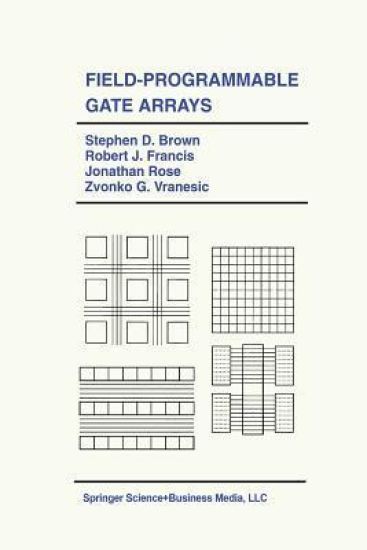
Field-Programmable Gate Arrays (FPGAs) have emerged as an attractive means of implementing logic circuits, providing instant manufacturing turnaround and negligible prototype costs. They hold the promise of replacing much of the VLSI market now held by mask-programmed gate arrays. FPGAs offer an affordable solution for customized VLSI, over a wide variety of applications, and have also opened up new possibilities in designing reconfigurable digital systems. Field-Programmable Gate Arrays discusses the most important aspects of FPGAs in a textbook manner. It provides the reader with a focused view of the key issues, using a consistent notation and style of presentation. It provides detailed descriptions of commercially available FPGAs and an in-depth treatment of the FPGA architecture and CAD issues that are the subjects of current research. The material presented is of interest to a variety of readers, including those who are not familiar with FPGA technology, but wish to be introduced to it, as well as those who already have an understanding of FPGAs, but who are interested in learning about the research directions that are of current interest.
Three unprecedented large-scale democratic experiments have recently taken place. Citizen assemblies on electoral reform were conducted in British Columbia, the Netherlands, and Ontario. Groups of randomly selected ordinary citizens were asked to independently design the next electoral system. In each case, the participants spent almost an entire year learning about electoral systems, consulting the public, deliberating, debating, and ultimately deciding what specific institution should be adopted. When Citizens Decide uses these unique cases to examine claims about citizens' capacity for democratic deliberation and active engagement in policy-making. It offers empirical insight into numerous debates and provides answers to a series of key questions: 1) Are ordinary citizens able to decide about a complex issue? Are their decisions reasonable? 2) Who takes part in such proceedings? Are they dominated by people dissatisfied by the status quo? 3) Do some citizens play a more prominent role than others? Are decisions driven by the most vocal or most informed members? 4) Did the participants decide by themselves? Were they influenced by staff, political parties, interest groups, or the public hearings? 5) Does participation in a deliberative process foster citizenship? Did participants become more trusting, tolerant, open-minded, civic-minded, interested in politics, and active in politics? 6) How do the other political actors react? Can the electorate accept policy proposals made by a group of ordinary citizens? The analyses rely upon various types of evidence about both the inner workings of the assemblies and the reactions toward them outside: multi-wave panel surveys of assembly members, content analysis of newspaper coverage, and public opinion survey data. The lessons drawn from this research are relevant to those interested in political participation, public opinion, deliberation, public policy, and democracy. Comparative Politics is a series for students, teachers, and researchers of political science that deals with contemporary government and politics. Global in scope, books in the series are characterised by a stress on comparative analysis and strong methodological rigour. The series is published in association with the European Consortium for Political Research. For more information visit: www.essex.ac.uk/ecpr. The Comparative Politics Series is edited by Professor David M. Farrell, School of Politics and International Relations, University College Dublin, Kenneth Carty, Professor of Political Science, University of British Columbia, and Professor Dirk Berg-Schlosser, Institute of Political Science, Philipps University, Marburg.
Field-programmable gate arrays (FPGAs), which are pre-fabricated, programmable digital integrated circuits (ICs), provide easy access to state-of-the-art integrated circuit process technology, and in doing so, democratize this technology of our time. This book is about comparing the qualities of FPGA – their speed performance, area and power consumption, against custom-fabricated ICs, and exploring ways of mitigating their de ciencies. This work began as a question that many have asked, and few had the resources to answer – how much worse is an FPGA compared to a custom-designed chip? As we dealt with that question, we found that it was far more dif cult to answer than we anticipated, but that the results were rich basic insights on fundamental understandings of FPGA architecture. It also encouraged us to nd ways to leverage those insights to seek ways to make FPGA technology better, which is what the second half of the book is about. While the question “How much worse is an FPGA than an ASIC?” has been a constant sub-theme of all research on FPGAs, it was posed most directly, some time around May 2004, by Professor Abbas El Gamal from Stanford University to us – he was working on a 3D FPGA, and was wondering if any real measurements had been made in this kind of comparison. Shortly thereafter we took it up and tried to answer in a serious way.
Field-Programmable Gate Arrays (FPGAs) have become one of the key digital circuit implementation media over the last decade. A crucial part of their creation lies in their architecture, which governs the nature of their programmable logic functionality and their programmable interconnect. FPGA architecture has a dramatic effect on the quality of the final device's speed performance, area efficiency and power consumption.FPGA Architecture reviews the historical development of programmable logic devices, the fundamental programming technologies that the programmability is built on, and then describes the basic understandings gleaned from research on architectures. It starts with a brief overview of programmable logic to provide a context for the subsequent sections which review the history of programmable logic, and the underlying programming technologies. The following sections define the terminology of FPGA architecture, and then describe foundations and trends of logic block architecture and routing architecture including a discussion of power management techniques and related circuit design issues.A brief overview of the input/output structures and architectural questions in FPGAs is then presented followed by an explicit comparison between FPGAs and competing ASIC standard cell technology. It concludes with a review of some of the design challenges facing FPGAs and a look at emerging architectures for FPGAs.This is an invaluable reference for engineers and computer scientists. It is also an excellent primer for senior or graduate-level students in electrical engineering or computer science.
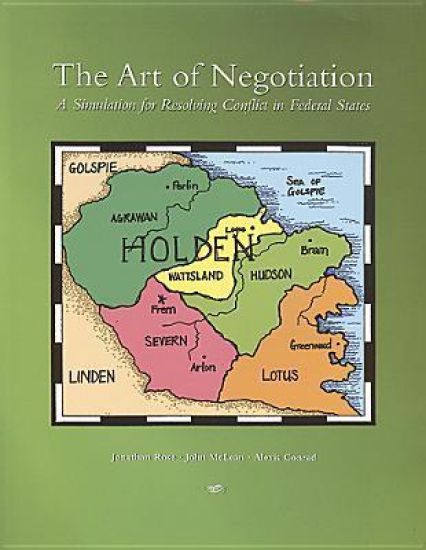
How do leaders in a federation make important decisions? Whose interests should be paramount: those of the state or the federal government? What are the costs and benefits of symmetrical and asymmetrical federalism? These are some of the questions explored in The Art of Negotiation. This book sets up a game or simulation intended to help students understand the role of negotiation in intergovernmental relations. The setting is the fictional country of Holden. Participants role-play first ministers and other ministers at an intergovernmental conference. They learn how federal states manage such issues as the competing and conflicting demands of cultural and linguistic protection for minorities, the appropriate distribution of economic wealth among its states, and the accommodations that need to be made when a country engages in more liberalized trade with its neighbours. Though "Holden" is not real, the problems discussed in this book are ones faced by virtually all federal countries: issues of language, fiscal equality, cultural protection of minorities, and the appropriate balance of power between central and provincial or state governments.
Rose uses excerpts from advertising campaigns and government documents obtained through access to information legislation and archival data, much of which has been recently declassified and never before published, in this first comprehensive book-length investigation of state advertising. While its focus is on Canada, the book will be of interest to researchers of communications, politics, or advertising in any nation whose government advertises.
Since their introduction in 1984, Field-Programmable Gate Arrays (FPGAs) have become one of the most popular implementation media for digital circuits and have grown into a $2 billion per year industry. As process geometries have shrunk into the deep-submicron region, the logic capacity of FPGAs has greatly increased, making FPGAs a viable implementation alternative for larger and larger designs. To make the best use of these new deep-submicron processes, one must re-design one's FPGAs and Computer- Aided Design (CAD) tools. Architecture and CAD for Deep-Submicron FPGAs addresses several key issues in the design of high-performance FPGA architectures and CAD tools, with particular emphasis on issues that are important for FPGAs implemented in deep-submicron processes. Three factors combine to determine the performance of an FPGA: the quality of the CAD tools used to map circuits into the FPGA, the quality of the FPGA architecture, and the electrical (i.e. transistor-level) design of the FPGA. Architecture and CAD for Deep-Submicron FPGAs examines all three of these issues in concert. In order to investigate the quality of different FPGA architectures, one needs CAD tools capable of automatically implementing circuits in each FPGA architecture of interest. Once a circuit has been implemented in an FPGA architecture, one next needs accurate area and delay models to evaluate the quality (speed achieved, area required) of the circuit implementation in the FPGA architecture under test. This book therefore has three major foci: the development of a high-quality and highly flexible CAD infrastructure, the creation of accurate area and delay models for FPGAs, and the study of several important FPGA architectural issues. Architecture and CAD for Deep-Submicron FPGAs is an essential reference for researchers, professionals and students interested in FPGAs.