Kirjojen hintavertailu. Mukana 12 302 735 kirjaa ja 12 kauppaa.

Kirjailija

Jonathan S. Davies

Kirjat ja teokset yhdessä paikassa: 6 kirjaa, julkaisuja vuosilta 2011-2023, suosituimpien joukossa New Developments in Urban Governance. Vertaile teosten hintoja ja tarkista saatavuus suomalaisista kirjakaupoista.

6 kirjaa

Kirjojen julkaisuhaarukka 2011-2023.

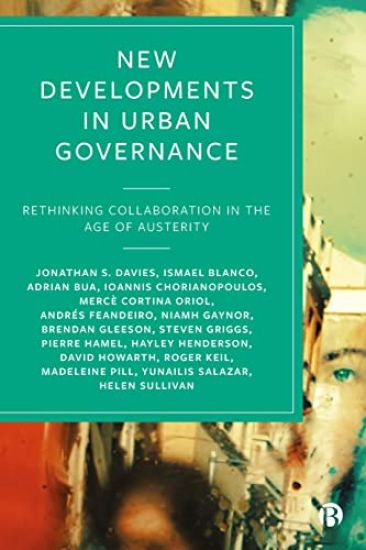
New Developments in Urban Governance

New Developments in Urban Governance

Jonathan S. Davies; Ismael Blanco; Adrian Bua; Ioannis Chorianopoulos; Mercè Cortina-Oriol; Andrés Feandeiro; Niamh Gaynor; Brendan Gleeson; Steven Griggs; Pierre Hamel; Hayley Henderson; David Howarth; Roger Keil; Madeleine Pill; Yunailis Salazar; Helen Sullivan

Bristol University Press
2023
nidottu
This book presents the findings of a major Economic and Social Research Council (ESRC) project into urban austerity governance in eight cities across the world (Athens, Baltimore, Barcelona, Melbourne, Dublin, Leicester, Montréal and Nantes). It offers comparative reflections on the myriad experiences of collaborative governance and its limitations. An international collaborative from across the social sciences, the book discusses ways that citizens, activists and local states collaborate and come into conflict in attempting to build just cities. It examines the development of egalitarian collaborative governance strategies, provides innovative ideas and tools to extend emancipatory governance practices and shows hopeful possibilities for cities beyond austerity and neoliberalism.
New Developments in Urban Governance

New Developments in Urban Governance

Jonathan S. Davies; Ismael Blanco; Adrian Bua; Ioannis Chorianopoulos; Mercè Cortina-Oriol; Andrés Feandeiro; Niamh Gaynor; Brendan Gleeson; Steven Griggs; Pierre Hamel; Hayley Henderson; David Howarth; Roger Keil; Madeleine Pill; Yunailis Salazar; Helen Sullivan

Bristol University Press
2022
sidottu
This book presents the findings of a major Economic and Social Research Council (ESRC) project into urban austerity governance in eight cities across the world (Athens, Baltimore, Barcelona, Melbourne, Dublin, Leicester, Montréal and Nantes). It offers comparative reflections on the myriad experiences of collaborative governance and its limitations. An international collaborative from across the social sciences, the book discusses ways that citizens, activists and local states collaborate and come into conflict in attempting to build just cities. It examines the development of egalitarian collaborative governance strategies, provides innovative ideas and tools to extend emancipatory governance practices and shows hopeful possibilities for cities beyond austerity and neoliberalism.

Partnerships and Regimes

Partnerships and Regimes

Jonathan S. Davies

Routledge
2019
nidottu
This title was first published in 2001. During the 1990s, urban regeneration partnerships proliferated in the UK. It is now commonplace for many individuals and organizations, including businesses, community groups, the voluntary sector and other public sector bodies, to co-operate with local authorities in a wide range of activities. Interest in partnerships between local government and local businesses has been given added momentum by the increasing popularity of urban regime theory as a tool for understanding urban politics in the UK. Regime theory is an American neo-pluralist account of urban politics which is concerned with local collaborative dynamics and processes, particularly those between local government and business leaders. It focuses on one facet of local governance, the relationship between the local authority and the business sector in regeneration activities.
Partnerships and Regimes

Partnerships and Regimes

Jonathan S. Davies

Routledge
2017
sidottu
This title was first published in 2001. During the 1990s, urban regeneration partnerships proliferated in the UK. It is now commonplace for many individuals and organizations, including businesses, community groups, the voluntary sector and other public sector bodies, to co-operate with local authorities in a wide range of activities. Interest in partnerships between local government and local businesses has been given added momentum by the increasing popularity of urban regime theory as a tool for understanding urban politics in the UK. Regime theory is an American neo-pluralist account of urban politics which is concerned with local collaborative dynamics and processes, particularly those between local government and business leaders. It focuses on one facet of local governance, the relationship between the local authority and the business sector in regeneration activities.
Challenging governance theory

Challenging governance theory

Jonathan S. Davies

Policy Press
2011
sidottu
Theories heralding the rise of network governance have dominated for a generation. Yet, empirical research suggests that claims for the transformative potential of networks are exaggerated. This topical and timely book takes a critical look at contemporary governance theory, elaborating a Gramscian alternative. It argues that, although the ideology of networks has been a vital element in the neoliberal hegemonic project, there are major structural impediments to accomplishing it. While networking remains important, the hierarchical and coercive state is vital for the maintenance of social order and integral to the institutions of contemporary governance. Reconsidering it from Marxist and Gramscian perspectives, the book argues that the hegemonic ideology of networks is utopian and rejects the claim that there has been a transformation from 'government' to 'governance'. This important book has international appeal and will be essential reading for scholars and students of governance, public policy, human geography, public management, social policy and sociology.
Challenging governance theory

Challenging governance theory

Jonathan S. Davies

Policy Press
2011
nidottu
Theories heralding the rise of network governance have dominated for a generation. Yet, empirical research suggests that claims for the transformative potential of networks are exaggerated. This topical and timely book takes a critical look at contemporary governance theory, elaborating a Gramscian alternative. It argues that, although the ideology of networks has been a vital element in the neoliberal hegemonic project, there are major structural impediments to accomplishing it. While networking remains important, the hierarchical and coercive state is vital for the maintenance of social order and integral to the institutions of contemporary governance. Reconsidering it from Marxist and Gramscian perspectives, the book argues that the hegemonic ideology of networks is utopian and rejects the claim that there has been a transformation from 'government' to 'governance'. This important book has international appeal and will be essential reading for scholars and students of governance, public policy, human geography, public management, social policy and sociology.