Kirjojen hintavertailu. Mukana 12 466 687 kirjaa ja 12 kauppaa.

Kirjailija

Jörg Bewersdorff

Kirjat ja teokset yhdessä paikassa: 8 kirjaa, julkaisuja vuosilta 2018-2026, suosituimpien joukossa RSA- und Elliptic-Curve-Kryptographie. Vertaile teosten hintoja ja tarkista saatavuus suomalaisista kirjakaupoista.

Mukana myös kirjoitusasut: Jorg Bewersdorff

8 kirjaa

Kirjojen julkaisuhaarukka 2018-2026.

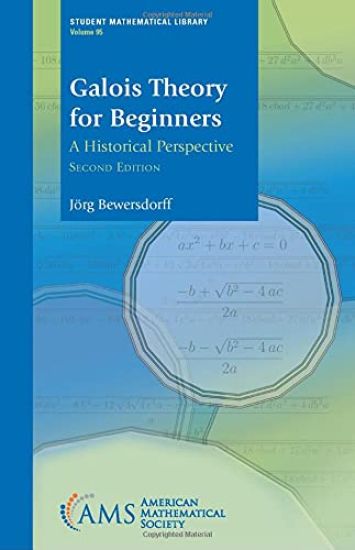
Galois Theory for Beginners

Galois Theory for Beginners

Jorg Bewersdorff

AMERICAN MATHEMATICAL SOCIETY
2021
nidottu
Galois theory is the culmination of a centuries-long search for a solution to the classical problem of solving algebraic equations by radicals. In this book, Bewersdorff follows the historical development of the theory, emphasizing concrete examples along the way. As a result, many mathematical abstractions are now seen as the natural consequence of particular investigations.Few prerequisites are needed beyond general college mathematics, since the necessary ideas and properties of groups and fields are provided as needed. Results in Galois theory are formulated first in a concrete, elementary way, then in the modern form. Each chapter begins with a simple question that gives the reader an idea of the nature and difficulty of what lies ahead. The applications of the theory to geometric constructions, including the ancient problems of squaring the circle, duplicating the cube, and trisecting the angle, and the construction of regular $n$-gons are also presented.This new edition contains an additional chapter as well as twenty facsimiles of milestones of classical algebra. It is suitable for undergraduates and graduate students, as well as teachers and mathematicians seeking a historical and stimulating perspective on the field.
Statistik – wie und warum sie funktioniert

Statistik – wie und warum sie funktioniert

Jörg Bewersdorff

Springer Fachmedien Wiesbaden
2021
nidottu
Dieses Buch ist eine leicht verständliche Einführung in die Statistik, die typische Schlussweisen der Mathematischen Statistik exemplarisch erläutert: Warum kann aus den Ergebnissen einer Stichprobenuntersuchung auf die Gesamtheit geschlossen werden? Welche Ungenauigkeiten und Unsicherheiten sind dabei möglich? Wie und warum können zufallsbedingte Abweichungen mit mathematischen Methoden analysiert werden?Aufgaben und Schaubilder verdeutlichen die möglichst weitgehend verbal beschriebenen Gedankengänge. Weitere didaktische Besonderheiten sind:Viele motivierende EinleitungenErläuterungen der Resultate: was ist wichtig und warumDer mathematische Formalismus ist weitgehend in Ausblicke ausgelagertDie Möglichkeit, nur Teile zu lesen (und trotzdem halbwegs zu verstehen)Der InhaltEinführung: Ein klassischer HypothesentestDie Mathematik des Zufalls: Ein Überblick über die mathematische WahrscheinlichkeitsrechnungMethoden der Mathematischen StatistikEinführung in RFür die 2. Auflage wurde das Buch aktualisiert und um Musterlösungen bzw. Lösungshinweise zu den meisten Aufgaben sowie um eine Einführung in das kostenlose Programm R ergänzt, mit dem sich viele Berechnungen stark vereinfachen lassen.
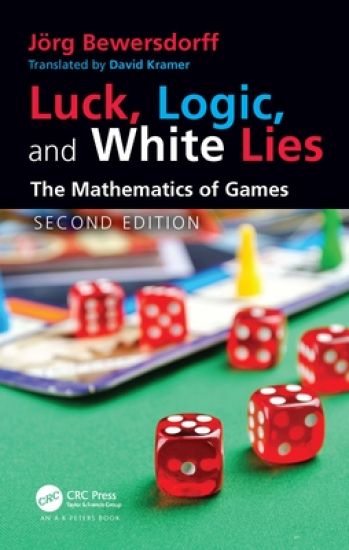
Luck, Logic, and White Lies

Luck, Logic, and White Lies

Jörg Bewersdorff

CRC Press
2021
nidottu
Praise for the First Edition"Luck, Logic, and White Lies teaches readers of all backgrounds about the insight mathematical knowledge can bring and is highly recommended reading among avid game players, both to better understand the game itself and to improve one’s skills."– Midwest Book Review"The best book I've found for someone new to game math is Luck, Logic and White Lies by Jörg Bewersdorff. It introduces the reader to a vast mathematical literature, and does so in an enormously clear manner. . ."– Alfred Wallace, Musings, Ramblings, and Things Left Unsaid"The aim is to introduce the mathematics that will allow analysis of the problem or game. This is done in gentle stages, from chapter to chapter, so as to reach as broad an audience as possible . . . Anyone who likes games and has a taste for analytical thinking will enjoy this book."– Peter Fillmore, CMS NotesLuck, Logic, and White Lies: The Mathematics of Games, Second Edition considers a specific problem—generally a game or game fragment and introduces the related mathematical methods. It contains a section on the historical development of the theories of games of chance, and combinatorial and strategic games.This new edition features new and much refreshed chapters, including an all-new Part IV on the problem of how to measure skill in games. Readers are also introduced to new references and techniques developed since the previous edition.Features Provides a uniquely historical perspective on the mathematical underpinnings of a comprehensive list of games Suitable for a broad audience of differing mathematical levels. Anyone with a passion for games, game theory, and mathematics will enjoy this book, whether they be students, academics, or game enthusiasts Covers a wide selection of topics at a level that can be appreciated on a historical, recreational, and mathematical level.Jörg Bewersdorff (1958) studied mathematics from 1975 to 1982 at the University of Bonn and earned his PhD in 1985. In the same year, he started his career as game developer and mathematician. He served as the general manager of the subsidiaries of Gauselmann AG for more than two decades where he developed electronic gaming machines, automatic payment machines, and coin-operated Internet terminals.Dr. Bewersdorff has authored several books on Galois theory (translated in English and Korean), mathematical statistics, and object-oriented programming with JavaScript.*Here is the list of Errata for the second edition of Luck, Logic, and White Lies: The Mathematics of Games: http://bewersdorff-online.de/LLWL-errata.pdf
Luck, Logic, and White Lies

Luck, Logic, and White Lies

Jörg Bewersdorff

CRC Press
2021
sidottu
Praise for the First Edition"Luck, Logic, and White Lies teaches readers of all backgrounds about the insight mathematical knowledge can bring and is highly recommended reading among avid game players, both to better understand the game itself and to improve one’s skills."– Midwest Book Review"The best book I've found for someone new to game math is Luck, Logic and White Lies by Jörg Bewersdorff. It introduces the reader to a vast mathematical literature, and does so in an enormously clear manner. . ."– Alfred Wallace, Musings, Ramblings, and Things Left Unsaid"The aim is to introduce the mathematics that will allow analysis of the problem or game. This is done in gentle stages, from chapter to chapter, so as to reach as broad an audience as possible . . . Anyone who likes games and has a taste for analytical thinking will enjoy this book."– Peter Fillmore, CMS NotesLuck, Logic, and White Lies: The Mathematics of Games, Second Edition considers a specific problem—generally a game or game fragment and introduces the related mathematical methods. It contains a section on the historical development of the theories of games of chance, and combinatorial and strategic games.This new edition features new and much refreshed chapters, including an all-new Part IV on the problem of how to measure skill in games. Readers are also introduced to new references and techniques developed since the previous edition.Features Provides a uniquely historical perspective on the mathematical underpinnings of a comprehensive list of games Suitable for a broad audience of differing mathematical levels. Anyone with a passion for games, game theory, and mathematics will enjoy this book, whether they be students, academics, or game enthusiasts Covers a wide selection of topics at a level that can be appreciated on a historical, recreational, and mathematical level.Jörg Bewersdorff (1958) studied mathematics from 1975 to 1982 at the University of Bonn and earned his PhD in 1985. In the same year, he started his career as game developer and mathematician. He served as the general manager of the subsidiaries of Gauselmann AG for more than two decades where he developed electronic gaming machines, automatic payment machines, and coin-operated Internet terminals.Dr. Bewersdorff has authored several books on Galois theory (translated in English and Korean), mathematical statistics, and object-oriented programming with JavaScript.*Here is the list of Errata for the second edition of Luck, Logic, and White Lies: The Mathematics of Games: http://bewersdorff-online.de/LLWL-errata.pdf
Algebra für Einsteiger

Algebra für Einsteiger

Jörg Bewersdorff

Springer Spektrum
2019
nidottu
Dieses Buch ist eine leicht verständliche Einführung in die Algebra, die den historischen und konkreten Aspekt in den Vordergrund rückt. Der rote Faden ist eines der klassischen und fundamentalen Probleme der Algebra: Bereits vor 4000 Jahren wurden quadratische Gleichungen gelöst. Im 16. Jahrhundert fand man allgemeine Lösungsformeln für Gleichungen dritten und vierten Grades, aber entsprechende Bemühungen für Gleichungen fünften Grades schlugen fehl. Nach fast dreihundertjähriger Suche führte dies schließlich zur Begründung der so genannten Galois-Theorie: Mit ihrer Hilfe kann festgestellt werden, ob eine Gleichung mittels geschachtelter Wurzelausdrücke lösbar ist. Das Buch liefert eine gute Motivation für die moderne Galois-Theorie, die den Studierenden oft so abstrakt und schwer erscheint.Gemäß der Intention des Buchs, auch die Geschichte der Algebra zu berücksichtigen, wurden in dieser Neuauflage diverse Faksimiles ergänzt. Begleitend zu den Faksimiles wurde insbesondere das erste Kapitel erheblich erweitert, so dass die maßgeblichen kulturhistorischen Kontexte der Epochen bis Cardano deutlicher werden. Schließlich wurden zum Kapitel über Artins Beweis des Hauptsatzes der Galois-Theorie einige Anmerkungen zum historischen und mathematischen Hintergrund hinzugefügt.
Glück, Logik und Bluff

Glück, Logik und Bluff

Jörg Bewersdorff

Springer Spektrum
2018
nidottu
Wollen Sie wissen, welche Gewinnaussichten Ihnen ein Spiel bietet? Und wie Sie dafür am besten spielen sollten?Antworten liefern je nach Spieltyp unterschiedliche mathematische Konzepte: Die Wahrscheinlichkeitstheorie erlaubt die Berechnung von Gewinnchancen in Glücksspielen. Wie ein Schachcomputer funktioniert und welchen Grenzen seine Algorithmen unterliegen, davon handelt die Theorie der kombinatorischen Spiele. Ganz andere Optimierungsansätze, nämlich solche aus der mathematischen Spieltheorie, sind gefragt, wenn Kartenspieler ihre Entscheidungen in Unkenntnis der Karten ihrer Mitspieler treffen müssen.Die drei genannten Theorien werden anhand konkreter (Bei-)Spiele erörtert, darunter Roulette, Lotto, Monopoly, Risiko, Black Jack, das Leiterspiel, Schach, Mühle, Go-Moku, Nim, Backgammon, Go, Mastermind, Memory, Poker, Baccarat und „Let’s Make a Deal“ (Ziegenproblem). Trotz der populären Darstellung, die mathematisches Interesse aber kaum Vorkenntnisse voraussetzt,sind die Methoden so konkret beschrieben, dass eine entsprechende Programmierung oder eine Übertragung auf andere Fälle möglich ist. Ergänzend finden sich Hinweise auf die historische Entwicklung sowie viele Referenzen zur Fachliteratur inklusive der Rechtsliteratur zur Abgrenzung von Glücks- und Geschicklichkeitsspielen.
Objektorientierte Programmierung mit JavaScript

Objektorientierte Programmierung mit JavaScript

Jörg Bewersdorff

Springer Vieweg
2018
nidottu
Wie bringt man einen Computer – ob Desktop-PC, Webserver oder Smartphone – dazu, eine gewünschte Sequenz von Arbeitsschritten automatisch zu vollziehen? Das Buch erklärt Lesern, wie sich auch ohne Vorkenntnisse möglichst schnell erste Programme mithilfe objektorientierter Ansätze erstellen lassen. Benötigt wird dafür lediglich ein Computer mit Internet-Browser und Texteditor.Im Mittelpunkt des Buchs steht JavaScript, eine Programmiersprache, die in HTML-Dokumente eingebettet und dann im Browser ausgeführt wird. Besonderes Augenmerk legt der Autor auf die systematische Darstellung der Objektorientierung bei JavaScript. Die den Internetseiten zugrundeliegende Dokumentenbeschreibungssprache HTML wird nur soweit erläutert, wie es für das Verständnis der behandelten JavaScript-Thematiken notwendig ist. Sämtliche im Buch erläuterten Beispiele können auf der Homepage des Autors heruntergeladen werden.Das Buch vermittelt darüber hinaus Grundlagen zur Informationstechnologie und ihrer Geschichte – graphisch abgesetzt in Infoboxen oder in den Fußnoten. Diese Ausführungen laden zum vertiefenden Weiterlesen ein, können aber auch ausgelassen werden. So richtet sich der Band einerseits an Programmier-Einsteiger, die mit JavaScript und Web-Technologien arbeiten wollen, andererseits aber auch an Schüler und Studierende, die an Informatik-Einführungsveranstaltungen teilnehmen.Die zweite Auflage des Buchs trägt der rasanten Weiterentwicklung von JavaScript als Programmiersprache Rechnung. Zu den Neuerungen zählt beispielsweise die Spezifikation eines Befehls, mit dem Objekte einfacher und übersichtlicher deklariert werden können. Diese und andere wurden in die Neuauflage eingearbeitet.