Kirjojen hintavertailu. Mukana 12 595 353 kirjaa ja 12 kauppaa.

Kirjailija

Jorge de Brito

Kirjat ja teokset yhdessä paikassa: 13 kirjaa, julkaisuja vuosilta 2003-2023, suosituimpien joukossa Maintainability of Building Envelope Elements. Vertaile teosten hintoja ja tarkista saatavuus suomalaisista kirjakaupoista.

13 kirjaa

Kirjojen julkaisuhaarukka 2003-2023.

Maintainability of Building Envelope Elements

Maintainability of Building Envelope Elements

Cláudia Ferreira; Ana Silva; Jorge de Brito; Inês Flores-Colen

Springer International Publishing AG
2023
nidottu
This book introduces a maintenance model that will assist decision-makers in their choice of building maintenance policies. The model is stochastic and condition-based that analyses the impact of different maintenance strategies on the durability and performance of different buildings envelope elements (facades, windows, and roofs). As non-structural elements, the maintenance of buildings envelope can be disregarded stakeholders. However, as first barrier to the external environment, these elements are critical to buildings' overall performance and are expected to meet aesthetic, comfort, safety, and durability requirements. The methodology presented is innovative. The maintenance model is based on a Petri net formalism and includes degradation, inspection, maintenance, and renewal processes. The model provides key information, such as: i) the impact of different maintenance strategies on the service life and durability of the building components; ii) the impact of maintenance on their performance over time; iii) the life cycle costs; and iv) the impact of maintenance on the buildings' use. The book will be of use to a variety of professionals in the construction sector.
Maintainability of Building Envelope Elements

Maintainability of Building Envelope Elements

Cláudia Ferreira; Ana Silva; Jorge de Brito; Inês Flores-Colen

Springer International Publishing AG
2022
sidottu
This book introduces a maintenance model that will assist decision-makers in their choice of building maintenance policies. The model is stochastic and condition-based that analyses the impact of different maintenance strategies on the durability and performance of different buildings envelope elements (facades, windows, and roofs). As non-structural elements, the maintenance of buildings envelope can be disregarded stakeholders. However, as first barrier to the external environment, these elements are critical to buildings' overall performance and are expected to meet aesthetic, comfort, safety, and durability requirements. The methodology presented is innovative. The maintenance model is based on a Petri net formalism and includes degradation, inspection, maintenance, and renewal processes. The model provides key information, such as: i) the impact of different maintenance strategies on the service life and durability of the building components; ii) the impact of maintenance on their performance over time; iii) the life cycle costs; and iv) the impact of maintenance on the buildings' use. The book will be of use to a variety of professionals in the construction sector.
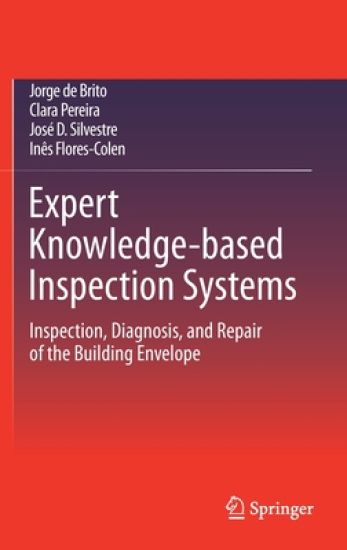
Expert Knowledge-based Inspection Systems

Expert Knowledge-based Inspection Systems

Jorge de Brito; Clara Pereira; José D. Silvestre; Inês Flores-Colen

Springer Nature Switzerland AG
2021
nidottu
This book provides a novel approach to building pathology in current buildings. Drawing on the available literature, hands-on experience and fieldwork inspections, it presents a systematic perspective on the pathology of the building envelope. The book addresses natural stone claddings, adhesive ceramic tiling, renders, painted surfaces, External Thermal Insulation Composite Systems (ETICS), architectural concrete surfaces, windows and doors framing, and claddings for pitched and flat roofs. In addition to highlighting selected materials and construction elements, the book proposes a global classification system for defects and their probable causes, together with in situ diagnosis methods and repair techniques. It also identifies the relationships between defects and causes, diagnosis methods and repair techniques, and the interdependence between different defects, presenting these relations in the form of correlation matrices. Support files with detailed information and aninspection form are also provided. Selected case studies are presented to illustrate the value of a guidance system in fieldwork. Given its scope, the book offers a valuable guide, particularly for researchers, building inspectors, civil engineers, architects and maintenance planners.
Expert Knowledge-based Inspection Systems

Expert Knowledge-based Inspection Systems

Jorge de Brito; Clara Pereira; José D. Silvestre; Inês Flores-Colen

Springer Nature Switzerland AG
2020
sidottu
This book provides a novel approach to building pathology in current buildings. Drawing on the available literature, hands-on experience and fieldwork inspections, it presents a systematic perspective on the pathology of the building envelope. The book addresses natural stone claddings, adhesive ceramic tiling, renders, painted surfaces, External Thermal Insulation Composite Systems (ETICS), architectural concrete surfaces, windows and doors framing, and claddings for pitched and flat roofs. In addition to highlighting selected materials and construction elements, the book proposes a global classification system for defects and their probable causes, together with in situ diagnosis methods and repair techniques. It also identifies the relationships between defects and causes, diagnosis methods and repair techniques, and the interdependence between different defects, presenting these relations in the form of correlation matrices. Support files with detailed information and aninspection form are also provided. Selected case studies are presented to illustrate the value of a guidance system in fieldwork. Given its scope, the book offers a valuable guide, particularly for researchers, building inspectors, civil engineers, architects and maintenance planners.
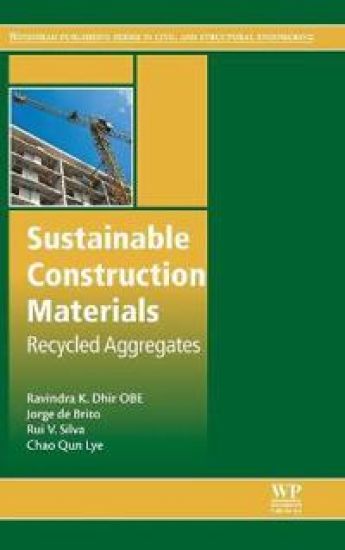
Sustainable Construction Materials

Sustainable Construction Materials

Ravindra K. Dhir OBE; Jorge de Brito; Rui V. Silva; Chao Qun Lye

Woodhead Publishing Ltd
2019
sidottu
Sustainable Construction Materials: Recycled Aggregate focuses on the massive systematic need that is necessary to encourage the uptake of recycled and secondary materials (RSM) in the construction industry. This book is the fifth and the last of the series on sustainable construction materials and like the previous four, it is also different to the norm. Its uniqueness lies in using the newly developed, Analytical Systemisation Method, in building the data-matrix sourced from 1413 publications, contributed by 2213 authors from 965 institutions in 67 countries, from 1977 to 2018, on the subject of recycled aggregate as a construction material, and systematically analysing, evaluating and modelling this information for use of the material as an aggregate concrete and mortar, geotechnics and road pavement applications. Environmental issues, case studies and standards are also discussed. The work establishes what is already known and can be used to further progress the use of sustainable construction materials. It can also help to avoid repetitive research and save valuable resources. The book is structured in an incisive and easy to digest manner and is particularly suited for researchers, academics, design engineers, specifiers, contractors, and government bodies dealing with construction works.
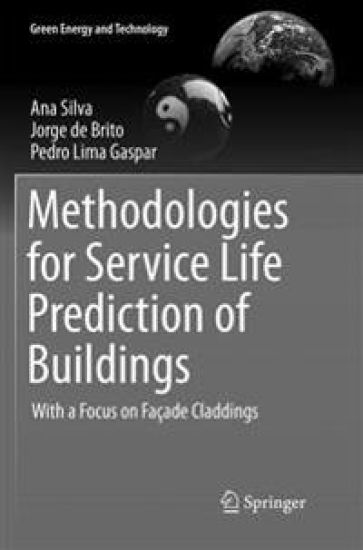
Methodologies for Service Life Prediction of Buildings

Methodologies for Service Life Prediction of Buildings

Ana Silva; Jorge de Brito; Pedro Lima Gaspar

Springer International Publishing AG
2018
nidottu
Presenting an analysis of different approaches for predicting the service life of buildings, this monograph discusses various statistical tools and mathematical models, some of which have rarely been applied to the field. It explores methods including deterministic, factorial, stochastic and computational models and applies these to façade claddings. The models allow (i) identification of patterns of degradation, (ii) estimation of service life, (iii) analysis of loss of performance using probability functions, and (iv) estimation of service life using a probability distribution. The final chapter discusses the differences between the different methodologies and their advantages and limitations. The authors also argue that a better understanding of the service life of buildings results in more efficient building maintenance and reduced environmental costs. It not only provides an invaluable resource to students, researchers and industry professionals interested in service life prediction and sustainable construction, but is also of interest to environmental and materials scientists.
Sustainable Construction Materials

Sustainable Construction Materials

Ravindra K. Dhir OBE; Jorge de Brito; Gurmel S. Ghataora; Chao Qun Lye

Woodhead Publishing Ltd
2018
sidottu
This book is the fourth, in the series of five, on sustainable construction materials and like the previous three, it is also different to the norm. Its uniqueness lies in using the newly developed, Analytical Systemisation Method, in building the data-matrix sourced from 751 publications, contributed by 1402 authors from 513 institutions in 51 countries, from 1970 to 2017, on the subject of processed waste glass (glass cullet) as a construction material, and systematically analysing, evaluating and modelling this information for use of glass cullet as cement, aggregate or filler in concrete, ceramics, geotechnics and road pavement applications. Environmental issues, case studies and standards are also discussed. The work establishes what is already known and can be used to further progress the use of sustainable construction materials. It can also help to avoid repetitive research and save valuable resources. The book is structured in an incisive and easy to digest manner and is particularly suited for researchers, academics, design engineers, specifiers, contractors, and government bodies dealing with construction works.
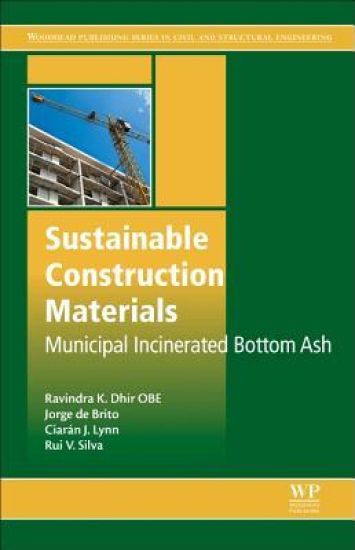
Sustainable Construction Materials

Sustainable Construction Materials

Ravindra K. Dhir OBE; Jorge de Brito; Ciaran J. Lynn; Rui V. Silva

Woodhead Publishing Ltd
2017
sidottu
Sustainable Construction Materials: Municipal Incinerated Bottom Ash discusses the global use of virgin aggregates and CO2 polluter Portland cement. Given the global sustainability agenda, much of the demand for these two sets of materials can be substantially reduced through the appropriate use of waste materials, thereby conserving natural resources, energy and CO2 emissions. Realistically, this change can only be realized and sustained through engineering ingenuity and new concepts in design. Although a great deal of research has been published over the last 50 years, it remains fragmented and ineffective. This book develops a single global knowledge-base, encouraging greater use of selected waste streams. The focus of massive systematic reviews is to encourage the uptake of recycled secondary materials (RSM) by the construction industry and guide researchers to recognize what is already known regarding waste.
Sustainable Construction Materials

Sustainable Construction Materials

Ravindra K. Dhir OBE; Jorge de Brito; Raman Mangabhai; Chao Qun Lye

Woodhead Publishing Ltd
2016
sidottu
Sustainable Construction Materials: Copper Slag, as part of a series of five, the book aims to promote the use of sustainable construction materials. It is different to the norm and its uniqueness lies in developing a data matrix sourced from 400 publications, contributed by 712 authors from 337 institutions in 40 countries from 1964 to 2015, on the subject of copper slag as a construction material, and systematically, analysisng, evaluating and modelling this information for use in cement, concrete, geotechnics and road pavement applications. Related environmental issues, case studies and standards are also discussed. The work establishes what is already known and can be used. It would also help to avoid repetitive research and save valuable resources, which can instead be directed towards new research to progress the use of sustainable construction materials. The book is structured in an incisive and easy to digest manner. As an excellent reference source, the book is particularly suited for researchers, academics, design engineers, specifiers, contractors, developers and certifying and regulatory authorities, seeking to promote sustainability within the construction sector.
Methodologies for Service Life Prediction of Buildings

Methodologies for Service Life Prediction of Buildings

Ana Silva; Jorge de Brito; Pedro Lima Gaspar

Springer International Publishing AG
2016
sidottu
Presenting an analysis of different approaches for predicting the service life of buildings, this monograph discusses various statistical tools and mathematical models, some of which have rarely been applied to the field. It explores methods including deterministic, factorial, stochastic and computational models and applies these to façade claddings. The models allow (i) identification of patterns of degradation, (ii) estimation of service life, (iii) analysis of loss of performance using probability functions, and (iv) estimation of service life using a probability distribution. The final chapter discusses the differences between the different methodologies and their advantages and limitations. The authors also argue that a better understanding of the service life of buildings results in more efficient building maintenance and reduced environmental costs. It not only provides an invaluable resource to students, researchers and industry professionals interested in service life prediction and sustainable construction, but is also of interest to environmental and materials scientists.
Recycled Aggregate in Concrete

Recycled Aggregate in Concrete

Jorge de Brito; Nabajyoti Saikia

Springer London Ltd
2014
nidottu
Concrete is the most used man-made material in the world since its invention. The widespread use of this material has led to continuous developments such as ultra-high strength concrete and self-compacting concrete. Recycled Aggregate in Concrete: Use of Industrial, Construction and Demolition Waste focuses on the recent development which the use of various types of recycled waste materials as aggregate in the production of various types of concrete.By drawing together information and data from various fields and sources, Recycled Aggregate in Concrete: Use of Industrial, Construction and Demolition Waste provides full coverage of this subject. Divided into two parts, a compilation of varied literature data related to the use of various types of industrial waste as aggregates in concrete is followed by a discussion of the use of construction and demolition waste as aggregate in concrete. The properties of the aggregates and their effect on various concrete properties are presented, and the quantitative procedure to estimate the properties of concrete containing construction and demolition waste as aggregates is explained. Current codes and practices developed in various countries to use construction and demolition waste as aggregates in concrete and issues related to the sustainability of cement and concrete production are also discussed.The comprehensive information presented in Recycled Aggregate in Concrete: Use of Industrial, Construction and Demolition Waste will be helpful to graduate students, researchers and concrete technologists. The collected data will also be an essential reference for practicing engineers who face problems concerning the use of these materials in concrete production.
Recycled Aggregate in Concrete

Recycled Aggregate in Concrete

Jorge de Brito; Nabajyoti Saikia

Springer London Ltd
2012
sidottu
Concrete is the most used man-made material in the world since its invention. The widespread use of this material has led to continuous developments such as ultra-high strength concrete and self-compacting concrete. Recycled Aggregate in Concrete: Use of Industrial, Construction and Demolition Waste focuses on the recent development which the use of various types of recycled waste materials as aggregate in the production of various types of concrete.By drawing together information and data from various fields and sources, Recycled Aggregate in Concrete: Use of Industrial, Construction and Demolition Waste provides full coverage of this subject. Divided into two parts, a compilation of varied literature data related to the use of various types of industrial waste as aggregates in concrete is followed by a discussion of the use of construction and demolition waste as aggregate in concrete. The properties of the aggregates and their effect on various concrete properties are presented, and the quantitative procedure to estimate the properties of concrete containing construction and demolition waste as aggregates is explained. Current codes and practices developed in various countries to use construction and demolition waste as aggregates in concrete and issues related to the sustainability of cement and concrete production are also discussed.The comprehensive information presented in Recycled Aggregate in Concrete: Use of Industrial, Construction and Demolition Waste will be helpful to graduate students, researchers and concrete technologists. The collected data will also be an essential reference for practicing engineers who face problems concerning the use of these materials in concrete production.