Kirjojen hintavertailu. Mukana 12 571 936 kirjaa ja 12 kauppaa.

Kirjailija

Jorge L. Delyra

Kirjat ja teokset yhdessä paikassa: 4 kirjaa, julkaisuja vuodelta 2019, suosituimpien joukossa Complex Calculus: Mathematical Methods for Physics and Engineering - Volume 1. Vertaile teosten hintoja ja tarkista saatavuus suomalaisista kirjakaupoista.

4 kirjaa

Fourier Transforms: Mathematical Methods for Physics and Engineering - Volume 2
There is a longstanding conflict between extension and depth in the teaching of mathematics to physics students. This text intends to present an approach that tries to track what could be called the middle way'' in this conflict. It is the result of several years of experience of the author teaching the mathematical physics courses at the Physics Institute of the University of S o Paulo. The text is organized in the form of relatively short chapters, each appropriate for exposition in one lecture. Each chapter includes a list of proposed problems, which have varied levels of difficulty, including practice problems, problems that complete and extend the material presented in the text, and some longer and more difficult problems, which are presented as challenges to the students. There are complete solutions available, detailed and commented, to all the problems proposed, which are presented in separate volumes. This volume is dedicated to Fourier transforms. This term is used here in a wider sense, including finite Fourier transforms, defined on a finite and discrete lattice, Fourier series, defined on a finite domain within the continuum, and the usual Fourier transforms, defined on the infinite continuum. This constitutes an elementary introduction to what is called, in its more abstract form, harmonic analysis. By means of the device of starting from the finite and discrete version of the formalism, which is done in the spirit of the definition of the Riemann integral, we are able to present in a clear way the basic structure of this whole formalism, while avoiding any need to face on this first moment the difficult convergence questions that arise when one takes the continuum limit. Once in the continuum, the convergence issues are addressed and put in proper perspective through the use of a low-pass filter, which is defined and developed in a fairly precise way. In the last two chapters the whole structure of the Fourier theory of real functions is derived ab initio'' once again, this time directly in the continuum, starting from the theory of analytic functions. There we present something that works like a universal summation rule, which applies to all Fourier series, and which allows us to recover any integrable real function from the set of its Fourier coefficients, even when the Fourier series itself diverges.

Solutions for Fourier Transforms: Mathematical Methods for Physics and Engineering - Volume 2s
There is a longstanding conflict between extension and depth in the teaching of mathematics to physics students. This text intends to present an approach that tries to track what could be called the middle way'' in this conflict. It is the result of several years of experience of the author teaching the mathematical physics courses at the Physics Institute of the University of S o Paulo. The text is organized in the form of relatively short chapters, each appropriate for exposition in one lecture. Each chapter of the text includes a list of proposed problems, which have varied levels of difficulty, including practice problems, problems that complete and extend the material presented in the text, and some longer and more difficult problems, which are presented as challenges to the students. This is Volume 2S, and is the companion volume to Volume 2, which is dedicated to the Fourier transforms. It includes all the 79 problems proposed in the text, with complete solutions, which are detailed and commented. The solutions are organized according to the 12 chapters of the corresponding volume of the text.
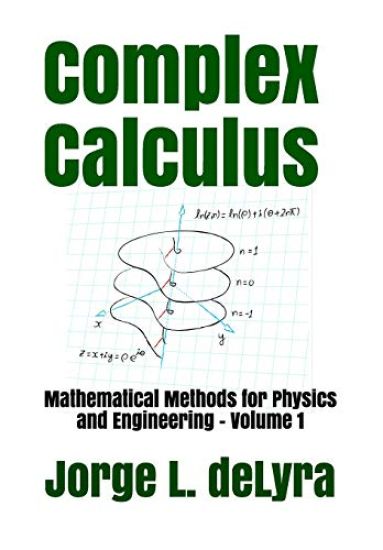
Complex Calculus: Mathematical Methods for Physics and Engineering - Volume 1
There is a longstanding conflict between extension and depth in the teaching of mathematics to physics students. This text intends to present an approach that tries to track what could be called the middle way'' in this conflict. It is the result of several years of experience of the author teaching the mathematical physics courses at the Physics Institute of the University of S o Paulo. The text is organized in the form of relatively short chapters, each appropriate for exposition in one lecture. Each chapter includes a list of proposed problems, which have varied levels of difficulty, including practice problems, problems that complete and extend the material presented in the text, and some longer and more difficult problems, which are presented as challenges to the students. There are complete solutions available, detailed and commented, to all the problems proposed, which are presented in separate volumes. This volume is dedicated to the complex calculus. This is a more practical and less abstract version of complex analysis and of the study of analytic functions. This does not mean that there are no proofs in the text, since all the fundamental theorems are proved with a good level of rigor. The text starts from the very beginning, with the definition of complex numbers, and proceeds up to the study of integrals on the complex plane and on Riemann surfaces. The facts and theorems established here will be used routinely in all the subsequent volumes of this series of books. The development is based on an analogy with vector fields and with electrostatics, emphasizing interpretations and proofs that have a geometrical character. The approach is algorithmic and emphasizes the representation of functions by series, with detailed discussion of the convergence issues.
Solutions for Complex Calculus: Mathematical Methods for Physics and Engineering - Volume 1s
There is a longstanding conflict between extension and depth in the teaching of mathematics to physics students. This text intends to present an approach that tries to track what could be called the middle way'' in this conflict. It is the result of several years of experience of the author teaching the mathematical physics courses at the Physics Institute of the University of S o Paulo. The text is organized in the form of relatively short chapters, each appropriate for exposition in one lecture. Each chapter of the text includes a list of proposed problems, which have varied levels of difficulty, including practice problems, problems that complete and extend the material presented in the text, and some longer and more difficult problems, which are presented as challenges to the students. This is Volume 1S, and is the companion volume to Volume 1, which is dedicated to the complex calculus. It includes all the 117 problems proposed in the text, with complete solutions, which are detailed and commented. The solutions are organized according to the 16 chapters of the corresponding volume of the text.