Kirjojen hintavertailu. Mukana 12 595 353 kirjaa ja 12 kauppaa.

Kirjailija

José Capmany

Kirjat ja teokset yhdessä paikassa: 2 kirjaa, julkaisuja vuosilta 2020-2024, suosituimpien joukossa Programmable Integrated Photonics. Vertaile teosten hintoja ja tarkista saatavuus suomalaisista kirjakaupoista.

2 kirjaa

Kirjojen julkaisuhaarukka 2020-2024.

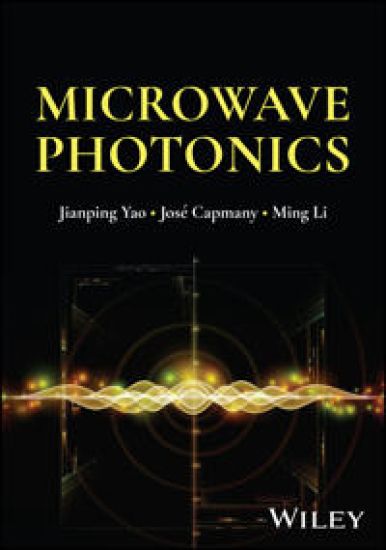
Microwave Photonics

Microwave Photonics

Jianping Yao; José Capmany; Ming Li

JOHN WILEY SONS INC
2024
sidottu
Overview of techniques in the field of microwave photonics, including recent developments in quantum microwave photonics and integrated microwave photonics Microwave Photonics offers a comprehensive overview of the microwave photonic techniques developed in the last 30 years, covering topics such as photonics generation of microwave signals, photonics processing of microwave signals, photonics distribution of microwave signals, photonic generation and distribution of UWB signals, photonics generation and processing of arbitrary microwave waveforms, photonic true time delay beamforming for phased array antennas, photonics-assisted instantaneous microwave frequency measurement, quantum microwave photonics, analog-to-digital conversion and more. The text is supported by a companion website for instructors, including learning objectives and questions/problems to further enhance student learning. Written by key researchers in the field, Microwave Photonics includes information on: Group-velocity dispersion and nonlinear effects in fibers, light coherence in light sources, phase and intensity modulators, photodetectors, and fiber Bragg gratings Injection locking, phase lock loops, external modulation, opto-electronic oscillators, and array waveguide gratings Photonic microwave delay-line filters with negative and complex coefficients and non-uniformly spaced photonic microwave delay-line filters Double- and single-sideband modulation, radio over fiber networks, and microwave photonics to coherent communication systems UWB generation, coding, and distribution over fiber, and instantaneous microwave frequency measurement via power monitoring True time delay beamforming Exploring the subject in depth, with expansive coverage of techniques developed in the last 30 years, Microwave Photonics is an essential reference for graduate students and researchers to learn microwave photonic technologies.
Programmable Integrated Photonics

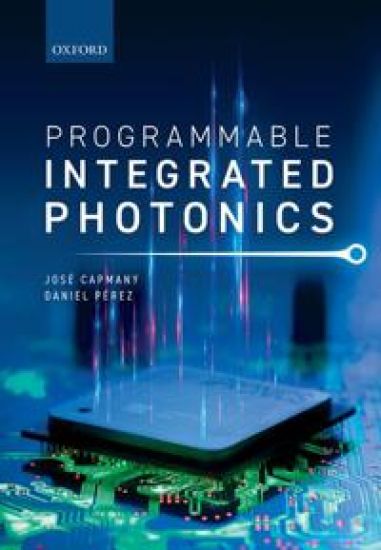
Programmable Integrated Photonics

José Capmany; Daniel Pérez

Oxford University Press
2020
sidottu
This book provides the first comprehensive, up-to-date and self-contained introduction to the emergent field of Programmable Integrated Photonics (PIP). It covers both theoretical and practical aspects, ranging from basic technologies and the building of photonic component blocks, to design alternatives and principles of complex programmable photonic circuits, their limiting factors, techniques for characterization and performance monitoring/control, and their salient applications both in the classical as well as in the quantum information fields. The book concentrates and focuses mainly on the distinctive features of programmable photonics, as compared to more traditional ASPIC approaches. After some years during which the Application Specific Photonic Integrated Circuit (ASPIC) paradigm completely dominated the field of integrated optics, there has been an increasing interest in PIP. The rising interest in PIP is justified by the surge in a number of emerging applications that call for true flexibility and reconfigurability, as well as low-cost, compact, and low-power consuming devices. Programmable Integrated Photonics is a new paradigm that aims at designing common integrated optical hardware configurations, which by suitable programming, can implement a variety of functionalities. These in turn can be exploited as basic operations in many application fields. Programmability enables, by means of external control signals, both chip reconfiguration for multifunction operation, as well as chip stabilization against non-ideal operations due to fluctuations in environmental conditions and fabrication errors. Programming also allows for the activation of parts of the chip, which are not essential for the implementation of a given functionality, but can be of help in reducing noise levels through the diversion of undesired reflections.