Kirjojen hintavertailu. Mukana 12 595 353 kirjaa ja 12 kauppaa.

Kirjailija

Josep Diaz

Kirjat ja teokset yhdessä paikassa: 3 kirjaa, julkaisuja vuosilta 2009-2011, suosituimpien joukossa Structural Complexity II. Vertaile teosten hintoja ja tarkista saatavuus suomalaisista kirjakaupoista.

Mukana myös kirjoitusasut: Josep Díaz

3 kirjaa

Kirjojen julkaisuhaarukka 2009-2011.

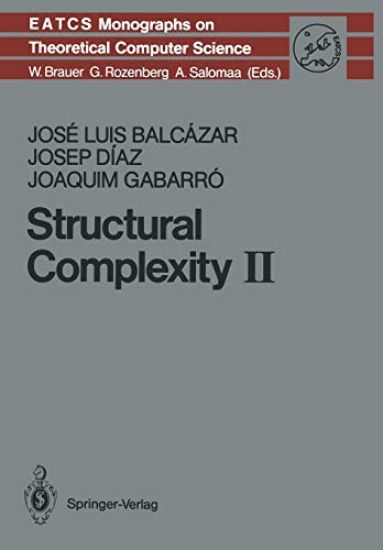
Structural Complexity II

Structural Complexity II

Jose L. Balcazar; Josep Diaz; Joaquim Gabarro

Springer-Verlag Berlin and Heidelberg GmbH Co. K
2011
nidottu
This is the second volume of a two volume collection on Structural Complexity. This volume assumes as a prerequisite knowledge about the topics treated in Volume I, but the present volume itself is nearly self-contained. As in Volume I, each chapter of this book ends with a section entitled "Bibliographical Remarks", in which the relevant references for the chapter are briefly commented upon. These sections might also be of interest to those wanting an overview of the evolution of the field, as well as relevant related results which are not included in the text. Each chapter includes a section of exercises. The reader is encouraged to spend some time on them. Some results presented as exercises are occasionally used later in the text. A reference is provided for the most interesting and for the most useful exercises. Some exercises are marked with a • to indicate that, to the best knowledge of the authors, the solution has a certain degree of difficulty. Many topics from the field of Structural Complexity are not treated in depth, or not treated at all. The authors bear all responsibility for the choice of topics, which has been made based on the interest of the authors on each topic. Many friends and colleagues have made suggestions or corrections. In partic­ ular we would like to express our gratitude to Richard Beigel, Ron Book, Rafael Casas, Jozef Gruska, Uwe Schoning, Pekka Orponen, and Osamu Watanabe.
Structural Complexity I

Structural Complexity I

Jose L. Balcazar; Josep Diaz; Joaquim Gabarro

Springer-Verlag Berlin and Heidelberg GmbH Co. K
2011
nidottu
In the six years since the first edition of this book was published, the field of Structural Complexity has grown quite a bit. However, we are keeping this volume at the same basic level that it had in the first edition, and the only new result incorporated as an appendix is the closure under complementation of nondeterministic space classes, which in the previous edition was posed as an open problem. This result was already included in our Volume II, but we feel that due to the basic nature of the result, it belongs to this volume. There are of course other important results obtained during these last six years. However, as they belong to new areas opened in the field they are outside the scope of this fundamental volume. Other changes in this second edition are the update of some Bibliograph­ ical Remarks and references, correction of many mistakes and typos, and a renumbering of the definitions and results. Experience has shown us that this new numbering is a lot more friendly, and several readers have confirmed this opinion. For the sake of the reader of Volume II, where all references to Volume I follow the old numbering, we have included here a table indicating the new number corresponding to each of the old ones.
Paradigms for Fast Parallel Approximability

Paradigms for Fast Parallel Approximability

Josep Díaz; Maria Serna; Paul Spirakis; Jacobo Torán

Cambridge University Press
2009
pokkari
Various problems in computer science are 'hard', that is NP-complete, and so not realistically computable; thus in order to solve them they have to be approximated. This book is a survey of the basic techniques for approximating combinatorial problems using parallel algorithms. Its core is a collection of techniques that can be used to provide parallel approximations for a wide range of problems (for example, flows, coverings, matchings, travelling salesman problems, graphs), but in order to make the book reasonably self-contained, the authors provide an introductory chapter containing the basic definitions and results. A final chapter deals with problems that cannot be approximated, and the book is ended by an appendix that gives a convenient summary of the problems described in the book. This is an up-to-date reference for research workers in the area of algorithms, but it can also be used for graduate courses in the subject.