Kirjojen hintavertailu. Mukana 12 595 353 kirjaa ja 12 kauppaa.

Kirjailija

Joseph Epstein

Kirjat ja teokset yhdessä paikassa: 26 kirjaa, julkaisuja vuosilta 1989-2024, suosituimpien joukossa Masters of the Games. Vertaile teosten hintoja ja tarkista saatavuus suomalaisista kirjakaupoista.

26 kirjaa

Kirjojen julkaisuhaarukka 1989-2024.

Never Say You've Had a Lucky Life: Especially If You've Had a Lucky Life
A rich and comic portrait of the radical changes in American life and the literary world over the last eighty years. An autobiography usually requires a justification. The great autobiographies--those by Benvenuto Cellini, Jean-Jacques Rousseau, Benjamin Franklin, and Henry Brooks Adams--were justified by their authors living in interesting times, harboring radically new ideas, or participating in great events. Joseph Epstein qualifies on none of these counts. His life has been quiet, lucky in numerous ways, and far from dramatic. But it has also been emblematic of the great changes in our country since World War II. He grew up in a petit-bourgeois, Midwestern milieu, and the city of Chicago looms large in his life. He drew a lucky ticket in the parent lottery and his was a happy boyhood spent on playgrounds and hanging around drug stores. At high school dances, he was the rhumba king and at drive-in movies he was never allowed to go as far with girls as he so ardently desired. At twenty-six, after two years in the army, he found himself married, the father or stepfather of four children, and living in New York on the meager salary of a magazine subeditor. He was ablaze with ambition and fettered by frustration. He broke out by moving to Little Rock, Arkansas, to direct the city's anti-poverty program at the height of the Civil Rights movement. His writing career blossomed, he began teaching at Northwestern University, and, for twenty-five years, edited one of great intellectual magazines. Never Say You've Had a Lucky Life is an intimate look at one life steeped in radical change: from a traditionally moral culture to a therapeutic one, from an era when the extended family was strong to its current diminished status, from print to digital life featuring the war of pixel on print, and on. But for all the seriousness of Epstein's themes, this book is memorable for its comic point of view and the constant reminder of how unpredictable, various, and wondrously rich life can be.

Never Say You've Had a Lucky Life: Especially If You've Had a Lucky Life
A rich and comic portrait of the radical changes in American life and the literary world over the last eighty years. An autobiography usually requires a justification. The great autobiographies--those by Benvenuto Cellini, Jean-Jacques Rousseau, Benjamin Franklin, and Henry Brooks Adams--were justified by their authors living in interesting times, harboring radically new ideas, or participating in great events. Joseph Epstein qualifies on none of these counts. His life has been quiet, lucky in numerous ways, and far from dramatic. But it has also been emblematic of the great changes in our country since World War II. He grew up in a petit-bourgeois, Midwestern milieu, and the city of Chicago looms large in his life. He drew a lucky ticket in the parent lottery and his was a happy boyhood spent on playgrounds and hanging around drug stores. At high school dances, he was the rhumba king and at drive-in movies he was never allowed to go as far with girls as he so ardently desired. At twenty-six, after two years in the army, he found himself married, the father or stepfather of four children, and living in New York on the meager salary of a magazine subeditor. He was ablaze with ambition and fettered by frustration. He broke out by moving to Little Rock, Arkansas, to direct the city's anti-poverty program at the height of the Civil Rights movement. His writing career blossomed, he began teaching at Northwestern University, and, for twenty-five years, edited one of great intellectual magazines. Never Say You've Had a Lucky Life is an intimate look at one life steeped in radical change: from a traditionally moral culture to a therapeutic one, from an era when the extended family was strong to its current diminished status, from print to digital life featuring the war of pixel on print, and on. But for all the seriousness of Epstein's themes, this book is memorable for its comic point of view and the constant reminder of how unpredictable, various, and wondrously rich life can be.
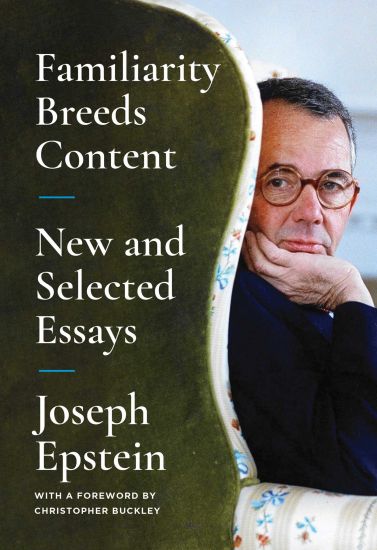
Familiarity Breeds Content: New and Selected Essays
A collection of personal essays from America's most revered essay writer, Joseph Epstein.America's greatest living essayist writes about life and aging and being all too nicely out of it. In these personal pieces, he takes on topics as varied as grieving for a dead son, learning Latin late in life, and the pleasures of living with cats. Epstein gives us a "bonfire of his own vanities," his thoughts about why watching sports is so impossibly seductive, what it is like to be short, and why he misses smoking even decades as a health-obsessed non-smoker. Above all, he writes about the literary life and the endless joys that reading and writing have brought to a self-confessed "lucky man."
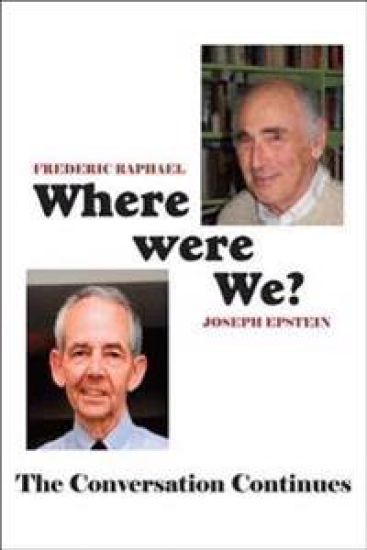
Where Were We? – The Conversation Continues

Where Were We? – The Conversation Continues

Frederic Raphael; Joseph Epstein

ST AUGUSTINE'S PRESS
2018
sidottu
Frederic Raphael, the English novelist, screenwriter, and man of letters, and Joseph Epstein, the American essayist, short-story writer, and literary critic, exchanged e-mails sporadically over the years, usually commenting on each other’s various writings. Then one day in 2009, Raphael wrote to Epstein to suggest that, since they enjoyed a benevolence toward each other unusual among literary men, they begin an exchange of e-mail correspondence on a regular basis. His thought was that, at the end of a year or so, the result might be an interesting book. Epstein, who had long admired Raphael’s writing, agreed. The two men had never met, nor had they even spoken over the phone. Their friendship was conducted entirely online. Each week they exchanged e-mails of roughly 2,000 words. They discovered a great many things about each other they hadn’t previously known. They shared, for example, a common birthplace in Chicago, where Raphael was born, though his family moved to England in 1938, and his education after that was exclusively English. Each man belongs to that dolorous fraternity of those who have buried a child. Their literary tastes vary, though not widely, since both grew up admiring the great modernist writers and both had an enduring love for Greek and Roman culture. Both men share a fundamental agreement about what, in artistic and intellectual realms, is serious. Raphael and Epstein are artists who happen also to be intellectuals. The result is that few subjects are off limits to them. They are of an age when they have long ceased to worry about their reputations. Wherever else they may look, it is not over their shoulders. Candor reinforced by comedy is the reigning note of Where Were We? as it was of Distant Intimacy, their earlier volume of e-mail correspondence. Writing about other writers, actors, politics, the movies, intellectual fashions, the writing life, and much else, both men say precisely what they think, and say it in high style. Readers may or may not agree with their strong views, but they will never find their thoughts other than fascinating.
Scalable VoIP Mobility

Scalable VoIP Mobility

Joseph Epstein

Newnes (an imprint of Butterworth-Heinemann Ltd )
2009
nidottu
Provides practical advice on breaking down the implementation and deployment of voice mobility networks within the office, across the campus, and on the road. Offers a complete primer on enterprise-grade Wi-Fi networking for voice mobility at scale, whether as a single-mode or dual-mode network, including information on the newest 802.11n standard and how these standards directly impact voice mobility. Includes methods of integrating existing or new VoIP networks with 3G+, CDMA 2000, WCDMA, HSPA, and WiMAX cellular networks using fixed/mobile convergence (FMC). This book provides a comprehensive examination of IP-based voice mobility, covering every step in deploying multimodal voice mobility networks. Each segment of the entire voice mobility solution is described with an eye towards the inherent problems of high-scale mobility, from wired infrastructure to end device, across multiple networks and technologies. Voice mobility is introduced and defined at a basic level before the book examines the high-level components of a scalable voice mobility solution. Chapters focus on several types of transport networks in greater depth, including voice quality metrics and testing, high-density enterprise Wi-Fi voice networks, cellular networks, and high-level networking technologies. The security of VoIP networks is also considered. The book explores standalone VoIP networks and finally provides an investigation of the current and upcoming set of fixed/mobile convergence approaches. This book is an invaluable guide for anyone looking towards voice mobility as a solution to real-world business problems: IT managers and executives looking to understand the potential for converting offices to all-wireless; network designers and architects planning on rolling out a fully-mobile voice network; and administrators operating or troubleshooting voice mobility networks.
Fabulous Small Jews

Fabulous Small Jews

Joseph Epstein

HOUGHTON MIFFLIN
2004
nidottu
In Fabulous Small Jews, the best-selling author Joseph Epstein has produced eighteen charming, magical, and finely detailed stories. They are populated by lawyers, professors, scrap-iron dealers, dry cleaners, all men of a certain age who feel themselves adrift in the radically changed values of the day. Epstein's richly drawn characters are at various crossroads and turning points in their lives: bitter Seymour Hefferman, who anonymously sends scathing postcards to writers until he gets caught; Moe Bernstein, who, inspired by his grandson, decides to attend to his own health after long delay; divorc Artie Glick, who wants to marry his pregnant girlfriend. Fabulous Small Jews is a marvelous collection from a master of the short form.