Kirjojen hintavertailu. Mukana 12 595 353 kirjaa ja 12 kauppaa.
Kirjailija
Joseph G. Ibrahim
Kirjat ja teokset yhdessä paikassa: 6 kirjaa, julkaisuja vuosilta 2000-2023, suosituimpien joukossa Monte Carlo Methods in Bayesian Computation. Vertaile teosten hintoja ja tarkista saatavuus suomalaisista kirjakaupoista.
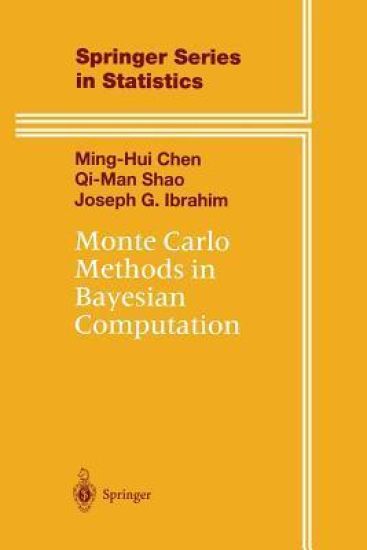
Sampling from the posterior distribution and computing posterior quanti ties of interest using Markov chain Monte Carlo (MCMC) samples are two major challenges involved in advanced Bayesian computation. This book examines each of these issues in detail and focuses heavily on comput ing various posterior quantities of interest from a given MCMC sample. Several topics are addressed, including techniques for MCMC sampling, Monte Carlo (MC) methods for estimation of posterior summaries, improv ing simulation accuracy, marginal posterior density estimation, estimation of normalizing constants, constrained parameter problems, Highest Poste rior Density (HPD) interval calculations, computation of posterior modes, and posterior computations for proportional hazards models and Dirichlet process models. Also extensive discussion is given for computations in volving model comparisons, including both nested and nonnested models. Marginal likelihood methods, ratios of normalizing constants, Bayes fac tors, the Savage-Dickey density ratio, Stochastic Search Variable Selection (SSVS), Bayesian Model Averaging (BMA), the reverse jump algorithm, and model adequacy using predictive and latent residual approaches are also discussed. The book presents an equal mixture of theory and real applications.
Sampling from the posterior distribution and computing posterior quanti ties of interest using Markov chain Monte Carlo (MCMC) samples are two major challenges involved in advanced Bayesian computation. This book examines each of these issues in detail and focuses heavily on comput ing various posterior quantities of interest from a given MCMC sample. Several topics are addressed, including techniques for MCMC sampling, Monte Carlo (MC) methods for estimation of posterior summaries, improv ing simulation accuracy, marginal posterior density estimation, estimation of normalizing constants, constrained parameter problems, Highest Poste rior Density (HPD) interval calculations, computation of posterior modes, and posterior computations for proportional hazards models and Dirichlet process models. Also extensive discussion is given for computations in volving model comparisons, including both nested and nonnested models. Marginal likelihood methods, ratios of normalizing constants, Bayes fac tors, the Savage-Dickey density ratio, Stochastic Search Variable Selection (SSVS), Bayesian Model Averaging (BMA), the reverse jump algorithm, and model adequacy using predictive and latent residual approaches are also discussed. The book presents an equal mixture of theory and real applications.
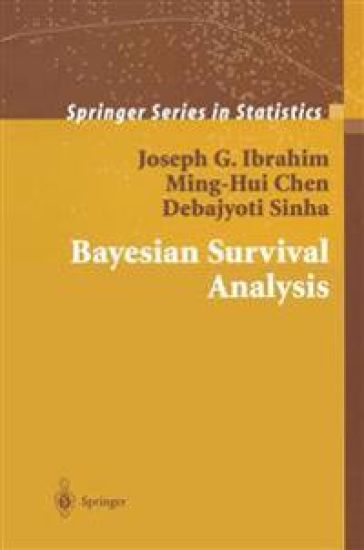
Survival analysis arises in many fields of study including medicine, biology, engineering, public health, epidemiology, and economics. This book provides a comprehensive treatment of Bayesian survival analysis.Several topics are addressed, including parametric models, semiparametric models based on prior processes, proportional and non-proportional hazards models, frailty models, cure rate models, model selection and comparison, joint models for longitudinal and survival data, models with time varying covariates, missing covariate data, design and monitoring of clinical trials, accelerated failure time models, models for mulitivariate survival data, and special types of hierarchial survival models. Also various censoring schemes are examined including right and interval censored data. Several additional topics are discussed, including noninformative and informative prior specificiations, computing posterior qualities of interest, Bayesian hypothesis testing, variable selection, model selection with nonnested models, model checking techniques using Bayesian diagnostic methods, and Markov chain Monte Carlo (MCMC) algorithms for sampling from the posteiror and predictive distributions.The book presents a balance between theory and applications, and for each class of models discussed, detailed examples and analyses from case studies are presented whenever possible. The applications are all essentially from the health sciences, including cancer, AIDS, and the environment. The book is intended as a graduate textbook or a reference book for a one semester course at the advanced masters or Ph.D. level. This book would be most suitable for second or third year graduate students in statistics or biostatistics. It would also serve as a useful reference book for applied or theoretical researchers as well as practitioners.
Survival analysis arises in many fields of study including medicine, biology, engineering, public health, epidemiology, and economics. This book provides a comprehensive treatment of Bayesian survival analysis.Several topics are addressed, including parametric models, semiparametric models based on prior processes, proportional and non-proportional hazards models, frailty models, cure rate models, model selection and comparison, joint models for longitudinal and survival data, models with time varying covariates, missing covariate data, design and monitoring of clinical trials, accelerated failure time models, models for mulitivariate survival data, and special types of hierarchial survival models. Also various censoring schemes are examined including right and interval censored data. Several additional topics are discussed, including noninformative and informative prior specificiations, computing posterior qualities of interest, Bayesian hypothesis testing, variable selection, model selection with nonnested models, model checking techniques using Bayesian diagnostic methods, and Markov chain Monte Carlo (MCMC) algorithms for sampling from the posteiror and predictive distributions.The book presents a balance between theory and applications, and for each class of models discussed, detailed examples and analyses from case studies are presented whenever possible. The applications are all essentially from the health sciences, including cancer, AIDS, and the environment. The book is intended as a graduate textbook or a reference book for a one semester course at the advanced masters or Ph.D. level. This book would be most suitable for second or third year graduate students in statistics or biostatistics. It would also serve as a useful reference book for applied or theoretical researchers as well as practitioners.