Kirjojen hintavertailu. Mukana 12 595 353 kirjaa ja 12 kauppaa.

Kirjailija

Joseph H. Silverman

Kirjat ja teokset yhdessä paikassa: 15 kirjaa, julkaisuja vuosilta 1992-2022, suosituimpien joukossa Rational Points on Elliptic Curves. Vertaile teosten hintoja ja tarkista saatavuus suomalaisista kirjakaupoista.

15 kirjaa

Kirjojen julkaisuhaarukka 1992-2022.

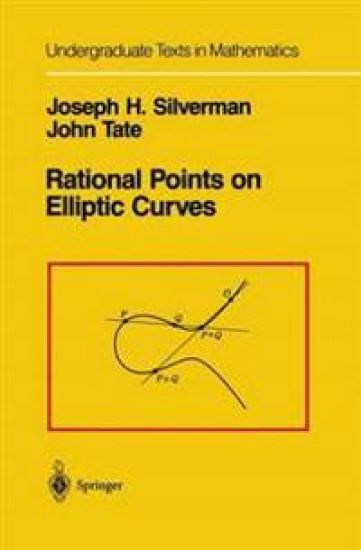
Rational Points on Elliptic Curves

Rational Points on Elliptic Curves

Joseph H. Silverman; John T. Tate

Springer International Publishing AG
2015
nidottu
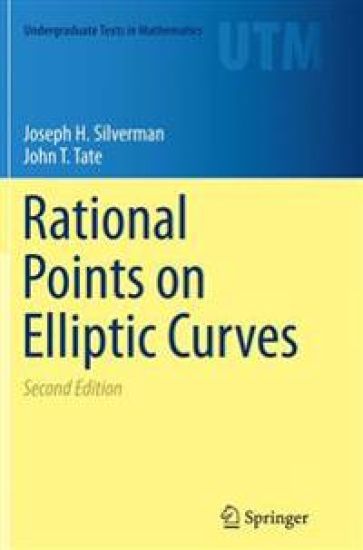
The theory of elliptic curves involves a pleasing blend of algebra, geometry, analysis, and number theory. This volume stresses this interplay as it develops the basic theory, thereby providing an opportunity for advanced undergraduates to appreciate the unity of modern mathematics. At the same time, every effort has been made to use only methods and results commonly included in the undergraduate curriculum. This accessibility, the informal writing style, and a wealth of exercises make Rational Points on Elliptic Curves an ideal introduction for students at all levels who are interested in learning about Diophantine equations and arithmetic geometry.Most concretely, an elliptic curve is the set of zeroes of a cubic polynomial in two variables. If the polynomial has rational coefficients, then one can ask for a description of those zeroes whose coordinates are either integers or rational numbers. It is this number theoretic question that is the main subject of Rational Points on Elliptic Curves. Topics covered include the geometry and group structure of elliptic curves, the Nagell–Lutz theorem describing points of finite order, the Mordell–Weil theorem on the finite generation of the group of rational points, the Thue–Siegel theorem on the finiteness of the set of integer points, theorems on counting points with coordinates in finite fields, Lenstra's elliptic curve factorization algorithm, and a discussion of complex multiplication and the Galois representations associated to torsion points. Additional topics new to the second edition include an introduction to elliptic curve cryptography and a brief discussion of the stunning proof of Fermat's Last Theorem by Wiles et al. via the use of elliptic curves.
Rational Points on Elliptic Curves

Rational Points on Elliptic Curves

Joseph H. Silverman; John T. Tate

Springer International Publishing AG
2015
sidottu
The theory of elliptic curves involves a pleasing blend of algebra, geometry, analysis, and number theory. This volume stresses this interplay as it develops the basic theory, thereby providing an opportunity for advanced undergraduates to appreciate the unity of modern mathematics. At the same time, every effort has been made to use only methods and results commonly included in the undergraduate curriculum. This accessibility, the informal writing style, and a wealth of exercises make Rational Points on Elliptic Curves an ideal introduction for students at all levels who are interested in learning about Diophantine equations and arithmetic geometry.Most concretely, an elliptic curve is the set of zeroes of a cubic polynomial in two variables. If the polynomial has rational coefficients, then one can ask for a description of those zeroes whose coordinates are either integers or rational numbers. It is this number theoretic question that is the main subject of Rational Points on Elliptic Curves. Topics covered include the geometry and group structure of elliptic curves, the Nagell–Lutz theorem describing points of finite order, the Mordell–Weil theorem on the finite generation of the group of rational points, the Thue–Siegel theorem on the finiteness of the set of integer points, theorems on counting points with coordinates in finite fields, Lenstra's elliptic curve factorization algorithm, and a discussion of complex multiplication and the Galois representations associated to torsion points. Additional topics new to the second edition include an introduction to elliptic curve cryptography and a brief discussion of the stunning proof of Fermat's Last Theorem by Wiles et al. via the use of elliptic curves.
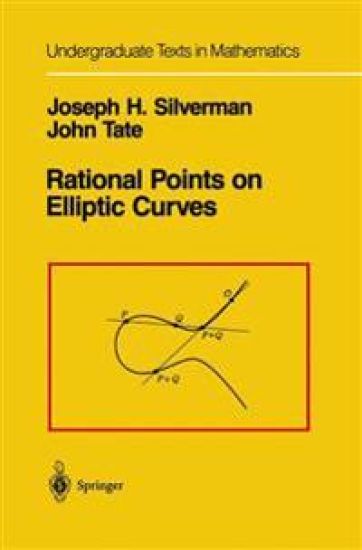
Rational Points on Elliptic Curves

Rational Points on Elliptic Curves

Joseph H. Silverman; John Tate

Springer-Verlag New York Inc.
2010
nidottu
In 1961 the second author deliv1lred a series of lectures at Haverford Col­ lege on the subject of "Rational Points on Cubic Curves. " These lectures, intended for junior and senior mathematics majors, were recorded, tran­ scribed, and printed in mimeograph form. Since that time they have been widely distributed as photocopies of ever decreasing legibility, and por­ tions have appeared in various textbooks (Husemoller [1], Chahal [1]), but they have never appeared in their entirety. In view of the recent inter­ est in the theory of elliptic curves for subjects ranging from cryptogra­ phy (Lenstra [1], Koblitz [2]) to physics (Luck-Moussa-Waldschmidt [1]), as well as the tremendous purely mathematical activity in this area, it seems a propitious time to publish an expanded version of those original notes suitable for presentation to an advanced undergraduate audience. We have attempted to maintain much of the informality of the orig­ inal Haverford lectures. Our main goal in doing this has been to write a textbook in a technically difficult field which is "readable" by the average undergraduate mathematics major. We hope we have succeeded in this goal. The most obvious drawback to such an approach is that we have not been entirely rigorous in all of our proofs. In particular, much of the foundational material on elliptic curves presented in Chapter I is meant to explain and convince, rather than to rigorously prove.
Rational Points on Elliptic Curves

Rational Points on Elliptic Curves

Joseph H. Silverman; John Tate

Springer-Verlag New York Inc.
1992
sidottu
The theory of elliptic curves involves a pleasing blend of algebra, geometry, analysis, and number theory. "Rational Points on Elliptic Curves" stresses this interplay as it develops the basic theory, thereby providing an opportunity for advance undergraduates to appreciate the unity of modern mathematics.
Folk Literature of the Sephardic Jews, Vol. III

Folk Literature of the Sephardic Jews, Vol. III

Samuel G. Armistead; Joseph H. Silverman

University of California Press
2022
sidottu
Folk Literature of the Sephardic Jews: Judeo-Spanish Ballads from Oral Tradition offers a comprehensive exploration of the rich oral traditions within the Sephardic Jewish community, focusing on ballads that trace their roots to medieval epic narratives. Drawing from a collection of ballads recorded between 1957 and 1980 across Eastern and North African Sephardic communities, the book examines five key narrative types, particularly those connected to the French medieval epic Chanson de Roland and the historical event of Roncesvalles. The volume provides a deep dive into the relationship between these modern Sephardic ballads and their epic antecedents, comparing them with sixteenth-century romancero versions, and placing them within the wider context of Pan-European balladry. Through synthetic texts and an analysis of variants, it uncovers the creative evolution of these ballads within the oral tradition, offering a fresh perspective on their narrative structures and thematic elements. The book addresses ongoing debates in scholarship, particularly the contested connection between epic poetry and ballads. While some critics have downplayed or denied this link, the study presents ample evidence to confirm the genetic and oral-traditional relationship between the romancero and its epic origins. It highlights the preservation of medieval poetic forms and narrative motifs across centuries, particularly the survival of specific poetic features in the Sephardic ballads. The volume also emphasizes the importance of these ballads in understanding the continuity of Hispanic epic poetry within the Sephardic diaspora. Through detailed analysis and scholarly commentary, the book sheds light on the dynamic, living tradition of balladry, demonstrating the creative and evolving nature of these oral narratives across generations. This title is part of UC Press's Voices Revived program, which commemorates University of California Press’s mission to seek out and cultivate the brightest minds and give them voice, reach, and impact. Drawing on a backlist dating to 1893, Voices Revived makes high-quality, peer-reviewed scholarship accessible once again using print-on-demand technology. This title was originally published in 1994.
Folk Literature of the Sephardic Jews, Vol. III

Folk Literature of the Sephardic Jews, Vol. III

Samuel G. Armistead; Joseph H. Silverman

University of California Press
2022
pokkari
Folk Literature of the Sephardic Jews: Judeo-Spanish Ballads from Oral Tradition offers a comprehensive exploration of the rich oral traditions within the Sephardic Jewish community, focusing on ballads that trace their roots to medieval epic narratives. Drawing from a collection of ballads recorded between 1957 and 1980 across Eastern and North African Sephardic communities, the book examines five key narrative types, particularly those connected to the French medieval epic Chanson de Roland and the historical event of Roncesvalles. The volume provides a deep dive into the relationship between these modern Sephardic ballads and their epic antecedents, comparing them with sixteenth-century romancero versions, and placing them within the wider context of Pan-European balladry. Through synthetic texts and an analysis of variants, it uncovers the creative evolution of these ballads within the oral tradition, offering a fresh perspective on their narrative structures and thematic elements. The book addresses ongoing debates in scholarship, particularly the contested connection between epic poetry and ballads. While some critics have downplayed or denied this link, the study presents ample evidence to confirm the genetic and oral-traditional relationship between the romancero and its epic origins. It highlights the preservation of medieval poetic forms and narrative motifs across centuries, particularly the survival of specific poetic features in the Sephardic ballads. The volume also emphasizes the importance of these ballads in understanding the continuity of Hispanic epic poetry within the Sephardic diaspora. Through detailed analysis and scholarly commentary, the book sheds light on the dynamic, living tradition of balladry, demonstrating the creative and evolving nature of these oral narratives across generations. This title is part of UC Press's Voices Revived program, which commemorates University of California Press’s mission to seek out and cultivate the brightest minds and give them voice, reach, and impact. Drawing on a backlist dating to 1893, Voices Revived makes high-quality, peer-reviewed scholarship accessible once again using print-on-demand technology. This title was originally published in 1994.
Abstract Algebra

Abstract Algebra

Joseph H. Silverman

AMERICAN MATHEMATICAL SOCIETY
2022
nidottu
This abstract algebra textbook takes an integrated approach that highlights the similarities of fundamental algebraic structures among a number of topics. The book begins by introducing groups, rings, vector spaces, and fields, emphasizing examples, definitions, homomorphisms, and proofs. The goal is to explain how all of the constructions fit into an axiomatic framework and to emphasize the importance of studying those maps that preserve the underlying algebraic structure. This fast-paced introduction is followed by chapters in which each of the four main topics is revisited and deeper results are proven. The second half of the book contains material of a more advanced nature. It includes a thorough development of Galois theory, a chapter on modules, and short surveys of additional algebraic topics designed to whet the reader's appetite for further study. This book is intended for a first introduction to abstract algebra and requires only a course in linear algebra as a prerequisite. The more advanced material could be used in an introductory graduate-level course.
An Introduction to Mathematical Cryptography

An Introduction to Mathematical Cryptography

Jeffrey Hoffstein; Jill Pipher; Joseph H. Silverman

Springer-Verlag New York Inc.
2016
nidottu
This self-contained introduction to modern cryptography emphasizes the mathematics behind the theory of public key cryptosystems and digital signature schemes. The book focuses on these key topics while developing the mathematical tools needed for the construction and security analysis of diverse cryptosystems. Only basic linear algebra is required of the reader; techniques from algebra, number theory, and probability are introduced and developed as required. This text provides an ideal introduction for mathematics and computer science students to the mathematical foundations of modern cryptography. The book includes an extensive bibliography and index; supplementary materials are available online.The book covers a variety of topics that are considered central to mathematical cryptography. Key topics include:classical cryptographic constructions, such as Diffie–Hellmann key exchange, discrete logarithm-based cryptosystems, the RSA cryptosystem, anddigital signatures;fundamental mathematical tools for cryptography, including primality testing, factorization algorithms, probability theory, information theory, and collision algorithms;an in-depth treatment of important cryptographic innovations, such as elliptic curves, elliptic curve and pairing-based cryptography, lattices, lattice-based cryptography, and the NTRU cryptosystem.The second edition of An Introduction to Mathematical Cryptography includes a significant revision of the material on digital signatures, including an earlier introduction to RSA, Elgamal, and DSA signatures, and new material on lattice-based signatures and rejection sampling. Many sections have been rewritten or expanded for clarity, especially in the chapters on information theory, elliptic curves, and lattices, and the chapter of additional topics has been expanded to include sections on digital cash and homomorphic encryption. Numerous new exercises have been included.
An Introduction to Mathematical Cryptography

An Introduction to Mathematical Cryptography

Jeffrey Hoffstein; Jill Pipher; Joseph H. Silverman

Springer-Verlag New York Inc.
2014
sidottu
This self-contained introduction to modern cryptography emphasizes the mathematics behind the theory of public key cryptosystems and digital signature schemes. The book focuses on these key topics while developing the mathematical tools needed for the construction and security analysis of diverse cryptosystems. Only basic linear algebra is required of the reader; techniques from algebra, number theory, and probability are introduced and developed as required. This text provides an ideal introduction for mathematics and computer science students to the mathematical foundations of modern cryptography. The book includes an extensive bibliography and index; supplementary materials are available online.The book covers a variety of topics that are considered central to mathematical cryptography. Key topics include:classical cryptographic constructions, such as Diffie–Hellmann key exchange, discrete logarithm-based cryptosystems, the RSA cryptosystem, anddigital signatures;fundamental mathematical tools for cryptography, including primality testing, factorization algorithms, probability theory, information theory, and collision algorithms;an in-depth treatment of important cryptographic innovations, such as elliptic curves, elliptic curve and pairing-based cryptography, lattices, lattice-based cryptography, and the NTRU cryptosystem.The second edition of An Introduction to Mathematical Cryptography includes a significant revision of the material on digital signatures, including an earlier introduction to RSA, Elgamal, and DSA signatures, and new material on lattice-based signatures and rejection sampling. Many sections have been rewritten or expanded for clarity, especially in the chapters on information theory, elliptic curves, and lattices, and the chapter of additional topics has been expanded to include sections on digital cash and homomorphic encryption. Numerous new exercises have been included.
Moduli Spaces and Arithmetic Dynamics

Moduli Spaces and Arithmetic Dynamics

Joseph H. Silverman

American Mathematical Society
2012
sidottu
This monograph studies moduli problems associated to algebraic dynamical systems. It is an expanded version of the notes for a series of lectures delivered at a workshop on Moduli Spaces and the Arithmetic of Dynamical Systems at the Bellairs Research Institute, Barbados, in 2010. The author's goal is to provide an overview, with enough details and pointers to the existing literature, to give the reader an entry into this exciting area of current research. Topics covered include: (1) Construction and properties of dynamical moduli spaces for self-maps of projective space. (2) Dynatomic modular curves for the space of quadratic polynomials. (3) The theory of canonical heights associated to dynamical systems. (4) Special loci in dynamical moduli spaces, in particular the locus of post-critically finite maps. (5) Field of moduli and fields of definition for dynamical systems.
The Arithmetic of Elliptic Curves

The Arithmetic of Elliptic Curves

Joseph H. Silverman

Springer-Verlag New York Inc.
2010
nidottu
The theory of elliptic curves is distinguished by its long history and by the diversity of the methods that have been used in its study. This book treats the arithmetic approach in its modern formulation, through the use of basic algebraic number theory and algebraic geometry. Following a brief discussion of the necessary algebro-geometric results, the book proceeds with an exposition of the geometry and the formal group of elliptic curves, elliptic curves over finite fields, the complex numbers, local fields, and global fields. Final chapters deal with integral and rational points, including Siegels theorem and explicit computations for the curve Y = X + DX, while three appendices conclude the whole: Elliptic Curves in Characteristics 2 and 3, Group Cohomology, and an overview of more advanced topics.
The Arithmetic of Elliptic Curves

The Arithmetic of Elliptic Curves

Joseph H. Silverman

Springer-Verlag New York Inc.
2009
sidottu
The theory of elliptic curves is distinguished by its long history and by the diversity of the methods that have been used in its study. This book treats the arithmetic approach in its modern formulation, through the use of basic algebraic number theory and algebraic geometry. Following a brief discussion of the necessary algebro-geometric results, the book proceeds with an exposition of the geometry and the formal group of elliptic curves, elliptic curves over finite fields, the complex numbers, local fields, and global fields. Final chapters deal with integral and rational points, including Siegels theorem and explicit computations for the curve Y = X + DX, while three appendices conclude the whole: Elliptic Curves in Characteristics 2 and 3, Group Cohomology, and an overview of more advanced topics.
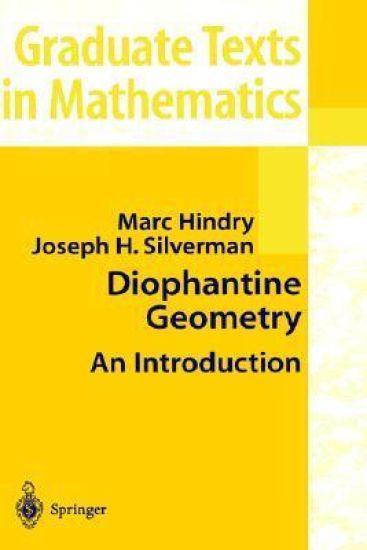
Diophantine Geometry

Diophantine Geometry

Marc Hindry; Joseph H. Silverman

Springer-Verlag New York Inc.
2000
sidottu
This is an introduction to diophantine geometry at the advanced graduate level. The book contains a proof of the Mordell conjecture which will make it quite attractive to graduate students and professional mathematicians. In each part of the book, the reader will find numerous exercises.
Advanced Topics in the Arithmetic of Elliptic Curves

Advanced Topics in the Arithmetic of Elliptic Curves

Joseph H. Silverman

Springer-Verlag New York Inc.
1994
sidottu
In the introduction to the first volume of The Arithmetic of Elliptic Curves (Springer-Verlag, 1986), I observed that "the theory of elliptic curves is rich, varied, and amazingly vast," and as a consequence, "many important topics had to be omitted." I included a brief introduction to ten additional topics as an appendix to the first volume, with the tacit understanding that eventually there might be a second volume containing the details. You are now holding that second volume. it turned out that even those ten topics would not fit Unfortunately, into a single book, so I was forced to make some choices. The following material is covered in this book: I. Elliptic and modular functions for the full modular group. II. Elliptic curves with complex multiplication. III. Elliptic surfaces and specialization theorems. IV. Neron models, Kodaira-Neron classification of special fibers, Tate's algorithm, and Ogg's conductor-discriminant formula. V. Tate's theory of q-curves over p-adic fields. VI. Neron's theory of canonical local height functions.
Advanced Topics in the Arithmetic of Elliptic Curves

Advanced Topics in the Arithmetic of Elliptic Curves

Joseph H. Silverman

Springer-Verlag New York Inc.
1994
nidottu
In the introduction to the first volume of The Arithmetic of Elliptic Curves (Springer-Verlag, 1986), I observed that "the theory of elliptic curves is rich, varied, and amazingly vast," and as a consequence, "many important topics had to be omitted." I included a brief introduction to ten additional topics as an appendix to the first volume, with the tacit understanding that eventually there might be a second volume containing the details. You are now holding that second volume. it turned out that even those ten topics would not fit Unfortunately, into a single book, so I was forced to make some choices. The following material is covered in this book: I. Elliptic and modular functions for the full modular group. II. Elliptic curves with complex multiplication. III. Elliptic surfaces and specialization theorems. IV. Neron models, Kodaira-Neron classification of special fibers, Tate's algorithm, and Ogg's conductor-discriminant formula. V. Tate's theory of q-curves over p-adic fields. VI. Neron's theory of canonical local height functions.