Kirjojen hintavertailu. Mukana 12 595 353 kirjaa ja 12 kauppaa.

Kirjailija

Joseph M. Hilbe

Kirjat ja teokset yhdessä paikassa: 14 kirjaa, julkaisuja vuosilta 2009-2024, suosituimpien joukossa Practical Guide to Logistic Regression. Vertaile teosten hintoja ja tarkista saatavuus suomalaisista kirjakaupoista.

14 kirjaa

Kirjojen julkaisuhaarukka 2009-2024.

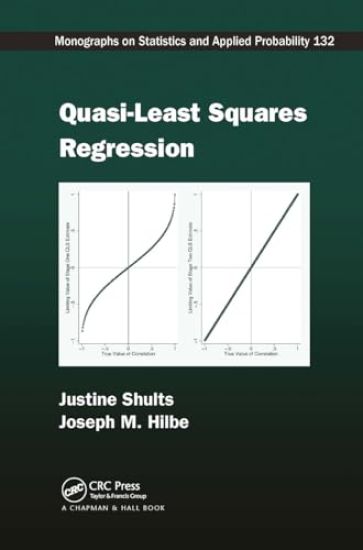
Quasi-Least Squares Regression

Quasi-Least Squares Regression

Justine Shults; Joseph M. Hilbe

TAYLOR FRANCIS LTD
2024
nidottu
Drawing on the authors’ substantial expertise in modeling longitudinal and clustered data, Quasi-Least Squares Regression provides a thorough treatment of quasi-least squares (QLS) regression—a computational approach for the estimation of correlation parameters within the framework of generalized estimating equations (GEEs). The authors present a detailed evaluation of QLS methodology, demonstrating the advantages of QLS in comparison with alternative methods. They describe how QLS can be used to extend the application of the traditional GEE approach to the analysis of unequally spaced longitudinal data, familial data, and data with multiple sources of correlation. In some settings, QLS also allows for improved analysis with an unstructured correlation matrix. Special focus is given to goodness-of-fit analysis as well as new strategies for selecting the appropriate working correlation structure for QLS and GEE. A chapter on longitudinal binary data tackles recent issues raised in the statistical literature regarding the appropriateness of semi-parametric methods, such as GEE and QLS, for the analysis of binary data; this chapter includes a comparison with the first-order Markov maximum-likelihood (MARK1ML) approach for binary data.Examples throughout the book demonstrate each topic of discussion. In particular, a fully worked out example leads readers from model building and interpretation to the planning stages for a future study (including sample size calculations). The code provided enables readers to replicate many of the examples in Stata, often with corresponding R, SAS, or MATLAB® code offered in the text or on the book’s website.
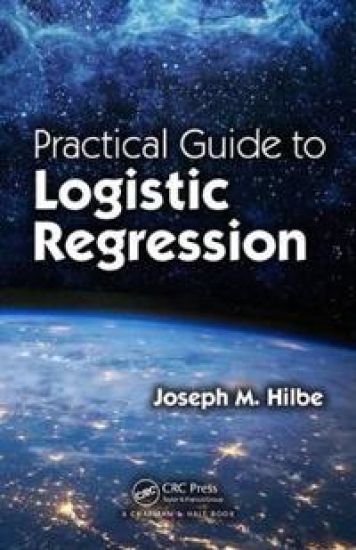
Practical Guide to Logistic Regression
Practical Guide to Logistic Regression covers the key points of the basic logistic regression model and illustrates how to use it properly to model a binary response variable. This powerful methodology can be used to analyze data from various fields, including medical and health outcomes research, business analytics and data science, ecology, fisheries, astronomy, transportation, insurance, economics, recreation, and sports. By harnessing the capabilities of the logistic model, analysts can better understand their data, make appropriate predictions and classifications, and determine the odds of one value of a predictor compared to another. Drawing on his many years of teaching logistic regression, using logistic-based models in research, and writing about the subject, Professor Hilbe focuses on the most important features of the logistic model. Serving as a guide between the author and readers, the book explains how to construct a logistic model, interpret coefficients and odds ratios, predict probabilities and their standard errors based on the model, and evaluate the model as to its fit. Using a variety of real data examples, mostly from health outcomes, the author offers a basic step-by-step guide to developing and interpreting observation and grouped logistic models as well as penalized and exact logistic regression. He also gives a step-by-step guide to modeling Bayesian logistic regression. R statistical software is used throughout the book to display the statistical models while SAS and Stata codes for all examples are included at the end of each chapter. The example code can be adapted to readers own analyses. All the code is available on the author‘s website.
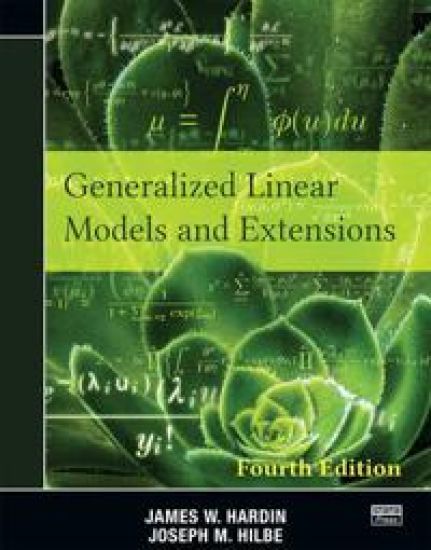
Generalized Linear Models and Extensions

Generalized Linear Models and Extensions

James W. Hardin; Joseph M. Hilbe

Stata Press
2018
nidottu
Generalized linear models (GLMs) extend linear regression to models with a non-Gaussian, or even discrete, response. GLM theory is predicated on the exponential family of distributions—a class so rich that it includes the commonly used logit, probit, and Poisson models. Although one can fit these models in Stata by using specialized commands (for example, logit for logit models), fitting them as GLMs with Stata’s glm command offers some advantages. For example, model diagnostics may be calculated and interpreted similarly regardless of the assumed distribution.This text thoroughly covers GLMs, both theoretically and computationally, with an emphasis on Stata. The theory consists of showing how the various GLMs are special cases of the exponential family, showing general properties of this family of distributions, and showing the derivation of maximum likelihood (ML) estimators and standard errors. Hardin and Hilbe show how iteratively reweighted least squares, another method of parameter estimation, are a consequence of ML estimation using Fisher scoring.
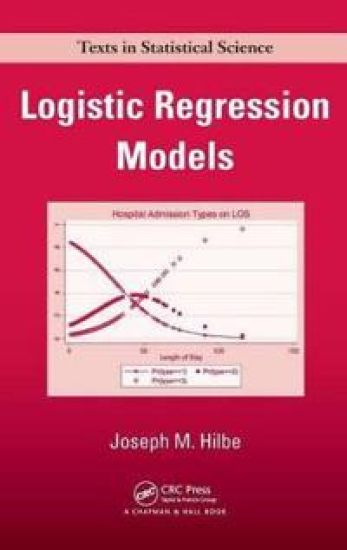
Logistic Regression Models

Logistic Regression Models

Joseph M. Hilbe

CRC Press
2017
nidottu
Logistic Regression Models presents an overview of the full range of logistic models, including binary, proportional, ordered, partially ordered, and unordered categorical response regression procedures. Other topics discussed include panel, survey, skewed, penalized, and exact logistic models. The text illustrates how to apply the various models to health, environmental, physical, and social science data.Examples illustrate successful modelingThe text first provides basic terminology and concepts, before explaining the foremost methods of estimation (maximum likelihood and IRLS) appropriate for logistic models. It then presents an in-depth discussion of related terminology and examines logistic regression model development and interpretation of the results. After focusing on the construction and interpretation of various interactions, the author evaluates assumptions and goodness-of-fit tests that can be used for model assessment. He also covers binomial logistic regression, varieties of overdispersion, and a number of extensions to the basic binary and binomial logistic model. Both real and simulated data are used to explain and test the concepts involved. The appendices give an overview of marginal effects and discrete change as well as a 30-page tutorial on using Stata commands related to the examples used in the text. Stata is used for most examples while R is provided at the end of the chapters to replicate examples in the text.Apply the models to your own dataData files for examples and questions used in the text as well as code for user-authored commands are provided on the book’s website, formatted in Stata, R, Excel, SAS, SPSS, and Limdep. See Professor Hilbe discuss the book.
Bayesian Models for Astrophysical Data

Bayesian Models for Astrophysical Data

Joseph M. Hilbe

Cambridge University Press
2017
sidottu
This comprehensive guide to Bayesian methods in astronomy enables hands-on work by supplying complete R, JAGS, Python, and Stan code, to use directly or to adapt. It begins by examining the normal model from both frequentist and Bayesian perspectives and then progresses to a full range of Bayesian generalized linear and mixed or hierarchical models, as well as additional types of models such as ABC and INLA. The book provides code that is largely unavailable elsewhere and includes details on interpreting and evaluating Bayesian models. Initial discussions offer models in synthetic form so that readers can easily adapt them to their own data; later the models are applied to real astronomical data. The consistent focus is on hands-on modeling, analysis of data, and interpretations that address scientific questions. A must-have for astronomers, its concrete approach will also be attractive to researchers in the sciences more generally.
Practical Guide to Logistic Regression

Practical Guide to Logistic Regression

Joseph M. Hilbe

Productivity Press
2015
nidottu
Practical Guide to Logistic Regression covers the key points of the basic logistic regression model and illustrates how to use it properly to model a binary response variable. This powerful methodology can be used to analyze data from various fields, including medical and health outcomes research, business analytics and data science, ecology, fisheries, astronomy, transportation, insurance, economics, recreation, and sports. By harnessing the capabilities of the logistic model, analysts can better understand their data, make appropriate predictions and classifications, and determine the odds of one value of a predictor compared to another.Drawing on his many years of teaching logistic regression, using logistic-based models in research, and writing about the subject, Professor Hilbe focuses on the most important features of the logistic model. Serving as a guide between the author and readers, the book explains how to construct a logistic model, interpret coefficients and odds ratios, predict probabilities and their standard errors based on the model, and evaluate the model as to its fit. Using a variety of real data examples, mostly from health outcomes, the author offers a basic step-by-step guide to developing and interpreting observation and grouped logistic models as well as penalized and exact logistic regression. He also gives a step-by-step guide to modeling Bayesian logistic regression.R statistical software is used throughout the book to display the statistical models while SAS and Stata codes for all examples are included at the end of each chapter. The example code can be adapted to readers’ own analyses. All the code is available on the author’s website.
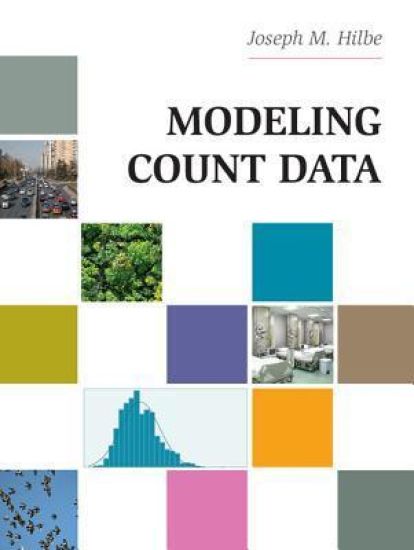
Modeling Count Data

Modeling Count Data

Joseph M. Hilbe

Cambridge University Press
2014
pokkari
This entry-level text offers clear and concise guidelines on how to select, construct, interpret, and evaluate count data. Written for researchers with little or no background in advanced statistics, the book presents treatments of all major models using numerous tables, insets, and detailed modeling suggestions. It begins by demonstrating the fundamentals of modeling count data, including a thorough presentation of the Poisson model. It then works up to an analysis of the problem of overdispersion and of the negative binomial model, and finally to the many variations that can be made to the base count models. Examples in Stata, R, and SAS code enable readers to adapt models for their own purposes, making the text an ideal resource for researchers working in health, ecology, econometrics, transportation, and other fields.
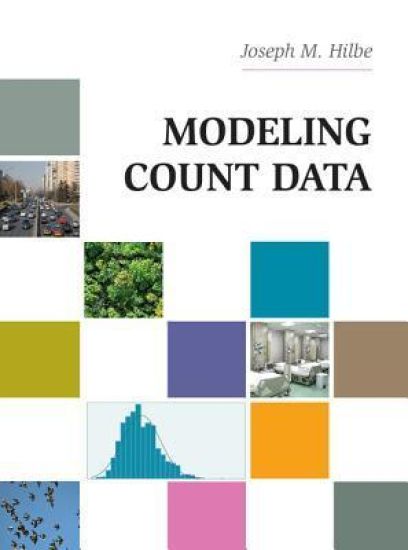
Modeling Count Data

Modeling Count Data

Joseph M. Hilbe

Cambridge University Press
2014
sidottu
This entry-level text offers clear and concise guidelines on how to select, construct, interpret, and evaluate count data. Written for researchers with little or no background in advanced statistics, the book presents treatments of all major models using numerous tables, insets, and detailed modeling suggestions. It begins by demonstrating the fundamentals of modeling count data, including a thorough presentation of the Poisson model. It then works up to an analysis of the problem of overdispersion and of the negative binomial model, and finally to the many variations that can be made to the base count models. Examples in Stata, R, and SAS code enable readers to adapt models for their own purposes, making the text an ideal resource for researchers working in health, ecology, econometrics, transportation, and other fields.
Quasi-Least Squares Regression

Quasi-Least Squares Regression

Justine Shults; Joseph M. Hilbe

Chapman Hall/CRC
2014
sidottu
Drawing on the authors’ substantial expertise in modeling longitudinal and clustered data, Quasi-Least Squares Regression provides a thorough treatment of quasi-least squares (QLS) regression—a computational approach for the estimation of correlation parameters within the framework of generalized estimating equations (GEEs). The authors present a detailed evaluation of QLS methodology, demonstrating the advantages of QLS in comparison with alternative methods. They describe how QLS can be used to extend the application of the traditional GEE approach to the analysis of unequally spaced longitudinal data, familial data, and data with multiple sources of correlation. In some settings, QLS also allows for improved analysis with an unstructured correlation matrix. Special focus is given to goodness-of-fit analysis as well as new strategies for selecting the appropriate working correlation structure for QLS and GEE. A chapter on longitudinal binary data tackles recent issues raised in the statistical literature regarding the appropriateness of semi-parametric methods, such as GEE and QLS, for the analysis of binary data; this chapter includes a comparison with the first-order Markov maximum-likelihood (MARK1ML) approach for binary data.Examples throughout the book demonstrate each topic of discussion. In particular, a fully worked out example leads readers from model building and interpretation to the planning stages for a future study (including sample size calculations). The code provided enables readers to replicate many of the examples in Stata, often with corresponding R, SAS, or MATLAB® code offered in the text or on the book’s website.
Generalized Estimating Equations

Generalized Estimating Equations

James W. Hardin; Joseph M. Hilbe

Taylor Francis Inc
2012
sidottu
Generalized Estimating Equations, Second Edition updates the best-selling previous edition, which has been the standard text on the subject since it was published a decade ago. Combining theory and application, the text provides readers with a comprehensive discussion of GEE and related models. Numerous examples are employed throughout the text, along with the software code used to create, run, and evaluate the models being examined. Stata is used as the primary software for running and displaying modeling output; associated R code is also given to allow R users to replicate Stata examples. Specific examples of SAS usage are provided in the final chapter as well as on the book’s website.This second edition incorporates comments and suggestions from a variety of sources, including the Statistics.com course on longitudinal and panel models taught by the authors. Other enhancements include an examination of GEE marginal effects; a more thorough presentation of hypothesis testing and diagnostics, covering competing hierarchical models; and a more detailed examination of previously discussed subjects. Along with doubling the number of end-of-chapter exercises, this edition expands discussion of various models associated with GEE, such as penalized GEE, cumulative and multinomial GEE, survey GEE, and quasi-least squares regression. It also offers a thoroughly new presentation of model selection procedures, including the introduction of an extension to the QIC measure that is applicable for choosing among working correlation structures. See Professor Hilbe discuss the book.
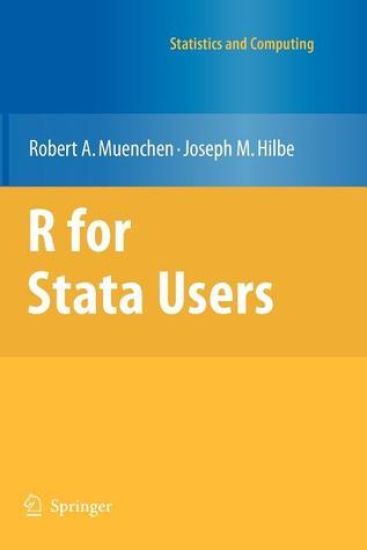
R for Stata Users

R for Stata Users

Robert A. Muenchen; Joseph M. Hilbe

Springer-Verlag New York Inc.
2012
nidottu
Stata is the most flexible and extensible data analysis package available from a commercial vendor. R is a similarly flexible free and open source package for data analysis, with over 3,000 add-on packages available. This book shows you how to extend the power of Stata through the use of R. It introduces R using Stata terminology with which you are already familiar. It steps through more than 30 programs written in both languages, comparing and contrasting the two packages' different approaches. When finished, you will be able to use R in conjunction with Stata, or separately, to import data, manage and transform it, create publication quality graphics, and perform basic statistical analyses. A glossary defines over 50 R terms using Stata jargon and again using more formal R terminology. The table of contents and index allow you to find equivalent R functions by looking up Stata commands and vice versa. The example programs and practice datasets for both R and Stata are available for download.
Negative Binomial Regression

Negative Binomial Regression

Joseph M. Hilbe

Cambridge University Press
2011
sidottu
This second edition of Hilbe's Negative Binomial Regression is a substantial enhancement to the popular first edition. The only text devoted entirely to the negative binomial model and its many variations, nearly every model discussed in the literature is addressed. The theoretical and distributional background of each model is discussed, together with examples of their construction, application, interpretation and evaluation. Complete Stata and R codes are provided throughout the text, with additional code (plus SAS), derivations and data provided on the book's website. Written for the practising researcher, the text begins with an examination of risk and rate ratios, and of the estimating algorithms used to model count data. The book then gives an in-depth analysis of Poisson regression and an evaluation of the meaning and nature of overdispersion, followed by a comprehensive analysis of the negative binomial distribution and of its parameterizations into various models for evaluating count data.
R for Stata Users

R for Stata Users

Robert A. Muenchen; Joseph M. Hilbe

Springer-Verlag New York Inc.
2010
sidottu
Stata is the most flexible and extensible data analysis package available from a commercial vendor. R is a similarly flexible free and open source package for data analysis, with over 3,000 add-on packages available. This book shows you how to extend the power of Stata through the use of R. It introduces R using Stata terminology with which you are already familiar. It steps through more than 30 programs written in both languages, comparing and contrasting the two packages' different approaches. When finished, you will be able to use R in conjunction with Stata, or separately, to import data, manage and transform it, create publication quality graphics, and perform basic statistical analyses. A glossary defines over 50 R terms using Stata jargon and again using more formal R terminology. The table of contents and index allow you to find equivalent R functions by looking up Stata commands and vice versa. The example programs and practice datasets for both R and Stata are available for download.
Logistic Regression Models

Logistic Regression Models

Joseph M. Hilbe

Chapman Hall/CRC
2009
sidottu
Logistic Regression Models presents an overview of the full range of logistic models, including binary, proportional, ordered, partially ordered, and unordered categorical response regression procedures. Other topics discussed include panel, survey, skewed, penalized, and exact logistic models. The text illustrates how to apply the various models to health, environmental, physical, and social science data.Examples illustrate successful modelingThe text first provides basic terminology and concepts, before explaining the foremost methods of estimation (maximum likelihood and IRLS) appropriate for logistic models. It then presents an in-depth discussion of related terminology and examines logistic regression model development and interpretation of the results. After focusing on the construction and interpretation of various interactions, the author evaluates assumptions and goodness-of-fit tests that can be used for model assessment. He also covers binomial logistic regression, varieties of overdispersion, and a number of extensions to the basic binary and binomial logistic model. Both real and simulated data are used to explain and test the concepts involved. The appendices give an overview of marginal effects and discrete change as well as a 30-page tutorial on using Stata commands related to the examples used in the text. Stata is used for most examples while R is provided at the end of the chapters to replicate examples in the text.Apply the models to your own dataData files for examples and questions used in the text as well as code for user-authored commands are provided on the book’s website, formatted in Stata, R, Excel, SAS, SPSS, and Limdep. See Professor Hilbe discuss the book.