
Kirjailija
Joseph Needham
Kirjat ja teokset yhdessä paikassa: 30 kirjaa, julkaisuja vuosilta 1936-2026, suosituimpien joukossa Science Religion and Reality. Vertaile teosten hintoja ja tarkista saatavuus suomalaisista kirjakaupoista.
30 kirjaa
Kirjojen julkaisuhaarukka 1936-2026.
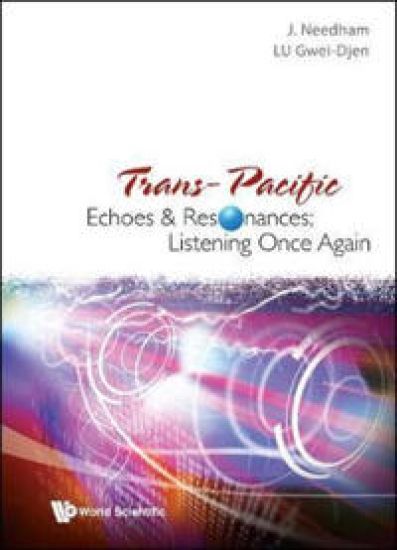
Trans-pacific Echoes And Resonances; Listening Once Again
Joseph Needham; Gwei-djen Lu
World Scientific Publishing Co Pte Ltd
1985
sidottu
This monograph is a review of the present state of knowledge of the relationships and consequences of over 25 centuries of interactions between the Amerindian and Asean Circum-Pacific regions. A fascinating, special case of previous work by two Asianists on similar themes of the Euro-Asian Continental land mass, providing the theoretical framework within which the complexities of cultural cross-pattern are studied.The subjects dicussed individually begin with the elements of recording and writing, continuing through the arts, religion, folklore and an eventual examination of the natural sciences and technology. There is also a discussion in this context of evidence from and the relevance of ethno-botany, ethno-zoology and ethno-helminthology.The underlying thesis of this volume is the relative independence and powerfully original development and evolution of Amerindian cultures and societies in Central and South America.
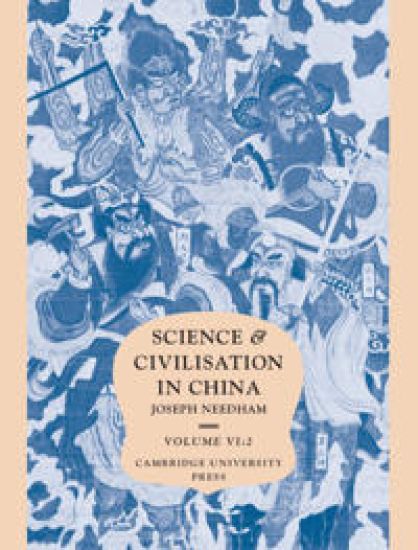
Science and Civilisation in China: Volume 6, Biology and Biological Technology, Part 2, Agriculture
Joseph Needham; Francesca Bray
Cambridge University Press
1984
sidottu
This second part of the sixth volume of Joseph Needham's great enterprise is the first to be written by a collaborator. Francesca Bray, working closely with Dr Needham, has produced the most comprehensive study of Chinese agriculture to be published in the West. From a huge mass of source material, often confusing and obscure, and from first-hand study in China, she brings order and illumination to a crucial area of Chinese technological development. The main body of the book is an account of the technological history of agriculture, with major sections devoted to field systems, implements and techniques (sowing, harvesting, storing) and crop systems (what has grown and where and how crops rotated). The concluding section contrasts Europe's Agricultural Revolution with agrarian change in North China in the Han and with the 'Green Revolution' in South China in the Sung. In the theoretical analysis which concludes this section we find a vital contribution to the elucidation of the main question posed by Dr Needham's work: why did the Scientific Revolution which transformed the world take place in Europe and not in China?
Science in Traditional China: a Comparative Perspective
Joseph Needham
THE CHINESE UNIVERSITY PRESS
1981
sidottu
The world's preeminent authority on Chinese science explores the philosophy, social structure, arts, crafts, and even military strategies that form our understanding of Chinese science, making instructive comparisons along the way to similar elements of Indian, Hellenistic, and Arabic cultures. A major portion of the book concentrates on Taoist alchemy that led not only to the invention of gunpowder and firearms, but also, through the search for macrobiotic life-elixirs, to the rise of modern medical chemistry.
Joseph Needham is one of the world’s experts on China and her culture, especially the history of science and technology in that great civilization. No one is better qualified to write about the contrasts and similarities between China and Europe, their mutual relations, and the ideas they have had of each other. Reprinted here are some of the most significant of his essays, lectures and broadcasts on these subjects, together with some more personal thoughts stimulated by his own travels and experience in China, including a number of poems that he has on occasion felt moved to write there. HE lived and worked in China all through the Second World War, and has revisited the country for considerable periods several times since the revolution. Dr Needham reminds us in the West of the great debt we owe to China, not only for her scientific and technical achievements which have been a part of the European heritage for so long that we assume them to be our own, but also for much enlightenment from the rationality of her culture. He also discusses the valuable social and intellectual influences which have for centuries flowed to Europe from South as well as East Asia. He suggests that this century’s happenings in the Chinese Republic are a natural development of all Chinese history, not a deviation from it. The present Master of Caius has had an unusual intellectual history. Trained in the biomedical of Frederick Gowland Hopkins at Cambridge, he made his name with ‘Chemical Embryology’ and ‘Biochemistry and Morphogenesis’ as a scientific worker on the borderline of physiological chemistry and the morphological sciences. This was the field of work for which he was elected into the Fellowship of the Royal Society. And those were the years in which we published his books of essays ‘Time, the Refreshing River’ and ‘History is on Our Side.’ But after several decades a new influence appeared in the form of certain young Chinese scientists who came to work with him and his colleagues in Cambridge; through them he acquired the beginnings of his knowledge of the language and culture of China. When the Second World War made China and Britain allies, Joseph Needham was asked to lead a mission of scientific and technological liaison which gave him four years of life in China, ranging widely in the course of his work through most of the historic provinces. He was thus able to meet a host of Chinese scientists, engineers and doctors who were able to give him an orientation into the history of science and technology in their own culture; and he began to build up a unique working library of the Chinese books necessary for the writing of the work on this whole subject which he started when he returned to Cambridge in 1948. Since the communist revolution he has revisited China thrice, in 1952, 1958, and 1964. The Master of Caius is thus a man who has a right to speak about traditional Chinese culture, its present position, and its probable future development. In this book he reprints a number of addresses and lectures given from time to time during the passion twenty-five years; but appropriately besides (since all Chinese scholars have always been poets) he adds a number of poems which in his various periods of life in China he has on occasion felt moved to write.
Science and Civilisation in China: Volume 4, Physics and Physical Technology, Part 3, Civil Engineering and Nautics
Joseph Needham
Cambridge University Press
1971
sidottu
As Dr Needham's immense undertaking gathers momentum it has been found necessary to subdivide volumes into parts, each bound and published separately. The first two parts of Volume IV deal respectively with the physical sciences and with the diverse applications of physics in the many branches of mechanical engineering. The third deals with civil and hydraulic engineering and with nautical technology.
Science and Civilisation in China: Volume 4, Physics and Physical Technology, Part 1, Physics
Joseph Needham
Cambridge University Press
1962
sidottu
Dr Needham's fourth volume traces the development of physics and physical technology in ancient and medieval China. It is conveniently divided into three separate parts, the present volume, IV:1, dealing with physics as such, IV:2 with mechanical engineering and IV:3 with civil engineering and nautics.
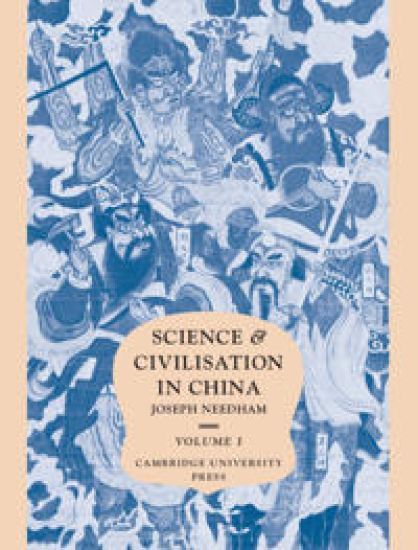
Science and Civilisation in China: Volume 1, Introductory Orientations
Joseph Needham
Cambridge University Press
1956
sidottu
Dr Joseph Needham's account of the Chinese achievement in science and technology will stand as one of the great works of our time. It has been acclaimed by specialists in both East and West and also by readers with wider and more general interests. The text, based on research of a high critical quality, is supported by many hundreds of illustrations and is imbued with a warm appreciation of China. Volume I is an introductory volume, in which Dr Needham prepares his readers for the study of a whole human culture. He begins by examining the structure of the Chinese language; he reviews the geography of China and the long history of its people, and discusses the scientific contacts which have occurred throughout the centuries, between Europe and East Asia.
This volume, which is based on the Terry Lectures delivered at Yale University in 1935, deals with the problem of the unity of natural knowledge. It considers the cleavage between the inorganic and biological sciences, and between the theology of intelligibility and that of inexplicability. Under the heading "The Nature of Biological Order" it considers some of the opinions which biologists, physicists, and philosophers hold regarding the form of organization which living things exhibit. The discussion is continued under the headings "The Deployment of Biological Order" and "The Hierarchical Continuity of Biological Order," and the conclusion is reached that "the profounder our insight into the nature of organic form, the clearer does the unity of science become.""It is an erudite volume, intended for the serious student of the philosophical aspects of biological science. To such it brings the product of a mature and discerning mind, well-versed in all the devious ramifications of a profoundly significant vein of thought." -Scientific Book Club Review