Kirjojen hintavertailu. Mukana 12 546 935 kirjaa ja 12 kauppaa.

Kirjailija

Josh Berson

Kirjat ja teokset yhdessä paikassa: 5 kirjaa, julkaisuja vuosilta 2015-2021, suosituimpien joukossa Computable Bodies. Vertaile teosten hintoja ja tarkista saatavuus suomalaisista kirjakaupoista.

5 kirjaa

Kirjojen julkaisuhaarukka 2015-2021.

The Human Scaffold

The Human Scaffold

Josh Berson

University of California Press
2021
pokkari
Humanity has precipitated a planetary crisis of resource consumption—a crisis of stuff. So ingrained is our stuff-centric view that we can barely imagine a way out beyond substituting a new portmanteau of material things for the one we have today.In The Human Scaffold, anthropologist Josh Berson offers a new theory of adaptation to environmental change. Drawing on niche construction, evolutionary game theory, and the enactive view of cognition, Berson considers cases in the archaeology of adaptation in which technology in the conventional sense was virtually absent. Far from representing anomalies, these cases exemplify an enduring feature of human behavior that has implications for our own fate.The time has come to ask what the environmental crisis demands of us not as consumers but as biological beings. The Human Scaffold offers a starting point.
The Human Scaffold

The Human Scaffold

Josh Berson

University of California Press
2021
sidottu
Humanity has precipitated a planetary crisis of resource consumption—a crisis of stuff. So ingrained is our stuff-centric view that we can barely imagine a way out beyond substituting a new portmanteau of material things for the one we have today.In The Human Scaffold, anthropologist Josh Berson offers a new theory of adaptation to environmental change. Drawing on niche construction, evolutionary game theory, and the enactive view of cognition, Berson considers cases in the archaeology of adaptation in which technology in the conventional sense was virtually absent. Far from representing anomalies, these cases exemplify an enduring feature of human behavior that has implications for our own fate.The time has come to ask what the environmental crisis demands of us not as consumers but as biological beings. The Human Scaffold offers a starting point.
The Meat Question

The Meat Question

Josh Berson

MIT Press
2019
sidottu
A provocative argument that eating meat is not what made humans human and that the future is not necessarily carnivorous.Humans are eating more meat than ever. Despite ubiquitous Sweetgreen franchises and the example set by celebrity vegans, demand for meat is projected to grow at twice the rate of demand for plant-based foods over the next thirty years. Between 1960 and 2010, per capita meat consumption in the developing world more than doubled; in China, meat consumption grew ninefold. It has even been claimed that meat made us human-that our disproportionately large human brains evolved because our early human ancestors ate meat. In The Meat Question, Josh Berson argues that not only did meat not make us human, but the contemporary increase in demand for meat is driven as much by economic insecurity as by affluence. Considering the full sweep of meat's history, Berson concludes provocatively that the future is not necessarily carnivorous.Berson, an anthropologist and historian, argues that we have the relationship between biology and capitalism backward. We may associate meat-eating with wealth, but in fact, meat-eating is a sign of poverty; cheap meat-hunger killing, easy to prepare, eaten on the go-enables a capitalism defined by inequality. To answer the meat question, says Berson, we need to think about meat-eating in a way that goes beyond Paleo diets and PETA protests to address the deeply entwined economic and political lives of humans and animals past, present, and future.
Computable Bodies

Computable Bodies

Josh Berson

Bloomsbury Academic
2015
sidottu
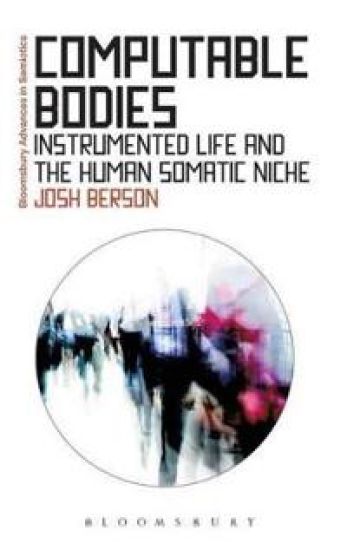
Winner of the 2016 PROSE Award in Language and LinguisticsData. Suddenly it is everywhere, and more and more of it is about us. The computing revolution has transformed our understanding of nature. Now it is transforming human behaviour.For some, pervasive computing offers a powerful vehicle of introspection and self-improvement. For others it signals the arrival of a dangerous ‘control society’ in which surveillance is no longer the prerogative of discrete institutions but a simple fact of life.In Computable Bodies, anthropologist Josh Berson asks how the data revolution is changing what it means to be human. Drawing on fieldwork in the Quantified Self and polyphasic sleeping communities and integrating perspectives from interaction design, the history and philosophy of science, and medical and linguistic anthropology, he probes a world where everyday life is mediated by a proliferating array of sensor montages, where we adjust our social signals to make them legible to algorithms, and where old rubrics for gauging which features of the world are animate no longer hold.Computable Bodies offers a vision of an anthropology for an age in which our capacity to generate data and share it over great distances is reconfiguring the body–world interface in ways scarcely imaginable a generation ago.
Computable Bodies

Computable Bodies

Josh Berson

Bloomsbury Academic
2015
nidottu
Winner of the 2016 PROSE Award in Language and Linguistics Data. Suddenly it is everywhere, and more and more of it is about us. The computing revolution has transformed our understanding of nature. Now it is transforming human behaviour. For some, pervasive computing offers a powerful vehicle of introspection and self-improvement. For others it signals the arrival of a dangerous ‘control society’ in which surveillance is no longer the prerogative of discrete institutions but a simple fact of life. In Computable Bodies, anthropologist Josh Berson asks how the data revolution is changing what it means to be human. Drawing on fieldwork in the Quantified Self and polyphasic sleeping communities and integrating perspectives from interaction design, the history and philosophy of science, and medical and linguistic anthropology, he probes a world where everyday life is mediated by a proliferating array of sensor montages, where we adjust our social signals to make them legible to algorithms, and where old rubrics for gauging which features of the world are animate no longer hold. Computable Bodies offers a vision of an anthropology for an age in which our capacity to generate data and share it over great distances is reconfiguring the body–world interface in ways scarcely imaginable a generation ago.