Kirjojen hintavertailu. Mukana 12 595 353 kirjaa ja 12 kauppaa.

Kirjailija

Josiah Ober

Kirjat ja teokset yhdessä paikassa: 17 kirjaa, julkaisuja vuosilta 1991-2026, suosituimpien joukossa The Origins of Democratic Thinking. Vertaile teosten hintoja ja tarkista saatavuus suomalaisista kirjakaupoista.

17 kirjaa

Kirjojen julkaisuhaarukka 1991-2026.

The Civic Bargain

The Civic Bargain

Brook Manville; Josiah Ober

PRINCETON UNIVERSITY PRESS
2026
pokkari
A powerful case for democracy and how it can adapt and survive—if we want it to Is democracy in trouble, perhaps even dying? Pundits say so, and polls show that most Americans believe that their country’s system of governance is being “tested” or is “under attack.” But is the future of democracy necessarily so dire? In The Civic Bargain, Brook Manville and Josiah Ober push back against the prevailing pessimism about the fate of democracy around the world. Instead of an epitaph for democracy, they offer a guide for democratic renewal, calling on citizens to recommit to a “civic bargain” with one another to guarantee civic rights of freedom, equality, and dignity. That bargain also requires them to fulfill the duties of democratic citizenship: governing themselves with no “boss” except one another, embracing compromise, treating each other as civic friends, and investing in civic education for each rising generation. Manville and Ober trace the long progression toward self-government through four key moments in democracy’s history: Classical Athens, Republican Rome, Great Britain’s constitutional monarchy, and America’s founding. Comparing what worked and what failed in each case, they draw out lessons for how modern democracies can survive and thrive. Manville and Ober show that democracy isn’t about getting everything we want; it’s about agreeing on a shared framework for pursuing our often conflicting aims. Crucially, citizens need to be able to compromise, and must not treat one another as political enemies. And we must accept imperfection; democracy is never finished but evolves and renews itself continually. As long as the civic bargain is maintained—through deliberation, bargaining, and compromise—democracy will live.
The Origins of Democratic Thinking

The Origins of Democratic Thinking

Cynthia Farrar; Josiah Ober

Cambridge University Press
2026
pokkari
The Athenians invented democracy – and as they grappled with the implications, they also invented democratic political theory. By reconstruing Protagoras the sophist, Thucydides the historian, and Democritus the cosmologist in the context of political developments and contemporary scientific, literary, and philosophical works, Cynthia Farrar's seminal study reveals the emergence of a distinctive and still cogent understanding of democratic order. All three thinkers wrestled with democracy's insistence on separating political from social identity and status. Unlike Plato and Aristotle, they constructed democratic theories that were genuinely democratic: addressed to citizens, and inviting them to interpret what their own and collective well-being demands in the world as it is. In a new introduction, Farrar makes the case for the continued relevance of the ideas explored in this book by recounting her own attempts to adapt Athenian structures of democratic citizenship and reinterpret their democratic theory for the modern world.
The Origins of Democratic Thinking

The Origins of Democratic Thinking

Cynthia Farrar; Josiah Ober

Cambridge University Press
2026
sidottu
The Athenians invented democracy – and as they grappled with the implications, they also invented democratic political theory. By reconstruing Protagoras the sophist, Thucydides the historian, and Democritus the cosmologist in the context of political developments and contemporary scientific, literary, and philosophical works, Cynthia Farrar's seminal study reveals the emergence of a distinctive and still cogent understanding of democratic order. All three thinkers wrestled with democracy's insistence on separating political from social identity and status. Unlike Plato and Aristotle, they constructed democratic theories that were genuinely democratic: addressed to citizens, and inviting them to interpret what their own and collective well-being demands in the world as it is. In a new introduction, Farrar makes the case for the continued relevance of the ideas explored in this book by recounting her own attempts to adapt Athenian structures of democratic citizenship and reinterpret their democratic theory for the modern world.
The Civic Bargain

The Civic Bargain

Brook Manville; Josiah Ober

PRINCETON UNIVERSITY PRESS
2023
sidottu
A powerful case for democracy and how it can adapt and survive—if we want it toIs democracy in trouble, perhaps even dying? Pundits say so, and polls show that most Americans believe that their country’s system of governance is being “tested” or is “under attack.” But is the future of democracy necessarily so dire? In The Civic Bargain, Brook Manville and Josiah Ober push back against the prevailing pessimism about the fate of democracy around the world. Instead of an epitaph for democracy, they offer a guide for democratic renewal, calling on citizens to recommit to a “civic bargain” with one another to guarantee civic rights of freedom, equality, and dignity. That bargain also requires them to fulfill the duties of democratic citizenship: governing themselves with no “boss” except one another, embracing compromise, treating each other as civic friends, and investing in civic education for each rising generation.Manville and Ober trace the long progression toward self-government through four key moments in democracy’s history: Classical Athens, Republican Rome, Great Britain’s constitutional monarchy, and America’s founding. Comparing what worked and what failed in each case, they draw out lessons for how modern democracies can survive and thrive. Manville and Ober show that democracy isn’t about getting everything we want; it’s about agreeing on a shared framework for pursuing our often conflicting aims. Crucially, citizens need to be able to compromise, and must not treat one another as political enemies. And we must accept imperfection; democracy is never finished but evolves and renews itself continually. As long as the civic bargain is maintained—through deliberation, bargaining, and compromise—democracy will live.
The Greeks and the Rational

The Greeks and the Rational

Josiah Ober

University of California Press
2022
sidottu
Tracing practical reason from its origins to its modern and contemporary permutations The Greek discovery of practical reason, as the skilled performance of strategic thinking in public and private affairs, was an intellectual breakthrough that remains both a feature of and a bug in our modern world. Countering arguments that rational choice-making is a contingent product of modernity, The Greeks and the Rational traces the long history of theorizing rationality back to ancient Greece. In this book, Josiah Ober explores how ancient Greek sophists, historians, and philosophers developed sophisticated and systematic ideas about practical reason. At the same time, they recognized its limits—that not every decision can be reduced to mechanistic calculations of optimal outcomes. Ober finds contemporary echoes of this tradition in the application of game theory to political science, economics, and business management. The Greeks and the Rational offers a striking revisionist history with widespread implications for the study of ancient Greek civilization, the history of thought, and human rationality itself.
The Threshold of Democracy

The Threshold of Democracy

Josiah Ober; Naomi J. Norman; Mark C. Carnes

THE UNIVERSITY OF NORTH CAROLINA PRESS
2022
pokkari
The Threshold of Democracy re-creates the intellectual dynamics of one of the most formative periods in Western history. In the wake of Athenian military defeat and rebellion, advocates of democracy have reopened the Assembly, but stability remains elusive. As members of the Assembly, players must contend with divisive issues like citizenship, elections, remilitarization, and dissent. Foremost among the troublemakers: Socrates.
Demopolis

Demopolis

Josiah Ober

Cambridge University Press
2017
sidottu
What did democracy mean before liberalism? What are the consequences for our lives today? Combining history with political theory, this book restores the core meaning of democracy as collective and limited self-government by citizens. That, rather than majority tyranny, is what democracy meant in ancient Athens, before liberalism. Participatory self-government is the basis of political practice in 'Demopolis', a hypothetical modern state powerfully imagined by award-winning historian and political scientist Josiah Ober. Demopolis' residents aim to establish a secure, prosperous, and non-tyrannical community, where citizens govern as a collective, both directly and through representatives, and willingly assume the costs of self-government because doing so benefits them, both as a group and individually. Basic democracy, as exemplified in real Athens and imagined Demopolis, can provide a stable foundation for a liberal state. It also offers a possible way forward for religious societies seeking a realistic alternative to autocracy.
Demopolis

Demopolis

Josiah Ober

Cambridge University Press
2017
pokkari
What did democracy mean before liberalism? What are the consequences for our lives today? Combining history with political theory, this book restores the core meaning of democracy as collective and limited self-government by citizens. That, rather than majority tyranny, is what democracy meant in ancient Athens, before liberalism. Participatory self-government is the basis of political practice in 'Demopolis', a hypothetical modern state powerfully imagined by award-winning historian and political scientist Josiah Ober. Demopolis' residents aim to establish a secure, prosperous, and non-tyrannical community, where citizens govern as a collective, both directly and through representatives, and willingly assume the costs of self-government because doing so benefits them, both as a group and individually. Basic democracy, as exemplified in real Athens and imagined Demopolis, can provide a stable foundation for a liberal state. It also offers a possible way forward for religious societies seeking a realistic alternative to autocracy.
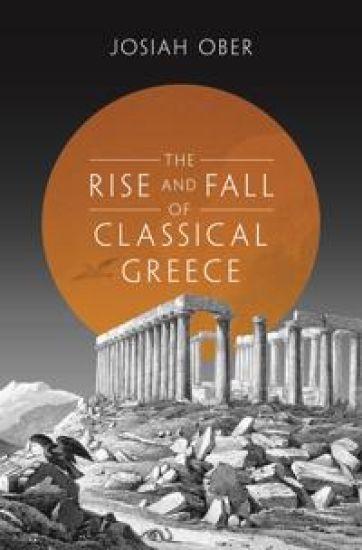
The Rise and Fall of Classical Greece

The Rise and Fall of Classical Greece

Josiah Ober

Princeton University Press
2016
pokkari
Lord Byron described Greece as great, fallen, and immortal, a characterization more apt than he knew. Through most of its long history, Greece was poor. But in the classical era, Greece was densely populated and highly urbanized. Many surprisingly healthy Greeks lived in remarkably big houses and worked for high wages at specialized occupations. Middle-class spending drove sustained economic growth and classical wealth produced a stunning cultural efflorescence lasting hundreds of years. Why did Greece reach such heights in the classical period--and why only then? And how, after "the Greek miracle" had endured for centuries, did the Macedonians defeat the Greeks, seemingly bringing an end to their glory? Drawing on a massive body of newly available data and employing novel approaches to evidence, Josiah Ober offers a major new history of classical Greece and an unprecedented account of its rise and fall. Ober argues that Greece's rise was no miracle but rather the result of political breakthroughs and economic development. The extraordinary emergence of citizen-centered city-states transformed Greece into a society that defeated the mighty Persian Empire. Yet Philip and Alexander of Macedon were able to beat the Greeks in the Battle of Chaeronea in 338 BCE, a victory made possible by the Macedonians' appropriation of Greek innovations. After Alexander's death, battle-hardened warlords fought ruthlessly over the remnants of his empire. But Greek cities remained populous and wealthy, their economy and culture surviving to be passed on to the Romans--and to us. A compelling narrative filled with uncanny modern parallels, this is a book for anyone interested in how great civilizations are born and die. This book is based on evidence available on a new interactive website. To learn more, please visit: http://polis.stanford.edu/.
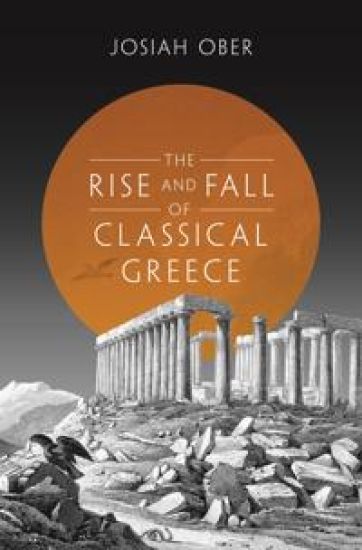
The Rise and Fall of Classical Greece

The Rise and Fall of Classical Greece

Josiah Ober

PRINCETON UNIVERSITY PRESS
2015
sidottu
Lord Byron described Greece as great, fallen, and immortal, a characterization more apt than he knew. Through most of its long history, Greece was poor. But in the classical era, Greece was densely populated and highly urbanized. Many surprisingly healthy Greeks lived in remarkably big houses and worked for high wages at specialized occupations. Middle-class spending drove sustained economic growth and classical wealth produced a stunning cultural efflorescence lasting hundreds of years. Why did Greece reach such heights in the classical period--and why only then? And how, after "the Greek miracle" had endured for centuries, did the Macedonians defeat the Greeks, seemingly bringing an end to their glory? Drawing on a massive body of newly available data and employing novel approaches to evidence, Josiah Ober offers a major new history of classical Greece and an unprecedented account of its rise and fall. Ober argues that Greece's rise was no miracle but rather the result of political breakthroughs and economic development. The extraordinary emergence of citizen-centered city-states transformed Greece into a society that defeated the mighty Persian Empire. Yet Philip and Alexander of Macedon were able to beat the Greeks in the Battle of Chaeronea in 338 BCE, a victory made possible by the Macedonians' appropriation of Greek innovations. After Alexander's death, battle-hardened warlords fought ruthlessly over the remnants of his empire. But Greek cities remained populous and wealthy, their economy and culture surviving to be passed on to the Romans--and to us. A compelling narrative filled with uncanny modern parallels, this is a book for anyone interested in how great civilizations are born and die. This book is based on evidence available on a new interactive website. To learn more, please visit: http://polis.stanford.edu/.
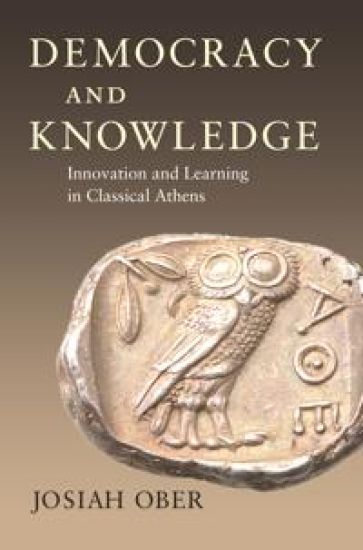
Democracy and Knowledge

Democracy and Knowledge

Josiah Ober

Princeton University Press
2010
pokkari
When does democracy work well, and why? Is democracy the best form of government? These questions are of supreme importance today as the United States seeks to promote its democratic values abroad. Democracy and Knowledge is the first book to look to ancient Athens to explain how and why directly democratic government by the people produces wealth, power, and security. Combining a history of Athens with contemporary theories of collective action and rational choice developed by economists and political scientists, Josiah Ober examines Athenian democracy's unique contribution to the ancient Greek city-state's remarkable success, and demonstrates the valuable lessons Athenian political practices hold for us today. He argues that the key to Athens's success lay in how the city-state managed and organized the aggregation and distribution of knowledge among its citizens. Ober explores the institutional contexts of democratic knowledge management, including the use of social networks for collecting information, publicity for building common knowledge, and open access for lowering transaction costs. He explains why a government's attempt to dam the flow of information makes democracy stumble. Democratic participation and deliberation consume state resources and social energy. Yet as Ober shows, the benefits of a well-designed democracy far outweigh its costs. Understanding how democracy can lead to prosperity and security is among the most pressing political challenges of modern times. Democracy and Knowledge reveals how ancient Greek politics can help us transcend the democratic dilemmas that confront the world today.
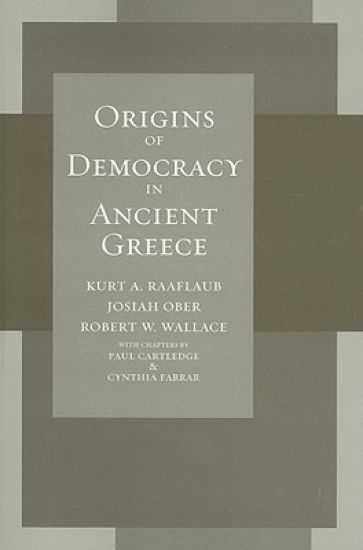
Origins of Democracy in Ancient Greece

Origins of Democracy in Ancient Greece

Kurt A. Raaflaub; Josiah Ober; Robert Wallace

University of California Press
2008
pokkari
This book presents a state-of-the-art debate about the origins of Athenian democracy by five eminent scholars. The result is a stimulating, critical exploration and interpretation of the extant evidence on this intriguing and important topic. The authors address such questions as: Why was democracy first realized in ancient Greece? Was democracy 'invented' or did it evolve over a long period of time? What were the conditions for democracy, the social and political foundations that made this development possible? And what factors turned the possibility of democracy into necessity and reality? The authors first examine the conditions in early Greek society that encouraged equality and 'people's power.' They then scrutinize, in their social and political contexts, three crucial points in the evolution of democracy: the reforms connected with the names of Solon, Cleisthenes, and Ephialtes in the early and late sixth and mid-fifth century. Finally, an ancient historian and a political scientist review the arguments presented in the previous chapters and add their own perspectives, asking what lessons we can draw today from the ancient democratic experience. Designed for a general readership as well as students and scholars, the book intends to provoke discussion by presenting side by side the evidence and arguments that support various explanations of the origins of democracy, thus enabling readers to join in the debate and draw their own conclusions.
Athenian Legacies

Athenian Legacies

Josiah Ober

Princeton University Press
2007
pokkari
How do communities survive catastrophe? Using classical Athens as its case study, this book argues that if a democratic community is to survive over time, its people must choose to go on together. That choice often entails hardship and hard bargains. In good times, going on together presents few difficulties. But in the face of loss, disruption, and civil war, it requires tragic sacrifices and agonizing compromises. Athenian Legacies demonstrates with flair and verve how the people of one influential political community rebuilt their democratic government, rewove their social fabric, and, through thick and thin, went on together. The book's essays address amnesty, civic education, and institutional innovation in early Athens, a city that built and lost an empire while experiencing plague, war, economic trauma, and civil conflict. As Ober vividly demonstrates, Athenians became adept at collective survival. They conjoined a cultural commitment to government by the people with new institutions that captured the social and technical knowledge of a diverse population to recover from revolution, foreign occupation, and the ravages of war. Ober provides insight into notorious instances of Athenian injustice, explaining why slaves, women, and foreign residents willingly risked their lives to support a regime in which they were systematically mistreated. He answers the question of why Socrates never left a city he said was badly governed. At a time when social scientists debate the cultural grounding necessary to foster democracy, Athenian Legacies advances new arguments about the role of diversity and the relevance of shared understanding of the past in creating democracies that flourish when the going gets rough.
Political Dissent in Democratic Athens

Political Dissent in Democratic Athens

Josiah Ober

Princeton University Press
2001
pokkari
How and why did the Western tradition of political theorizing arise in Athens during the late fifth and fourth centuries B.C.? By interweaving intellectual history with political philosophy and literary analysis, Josiah Ober argues that the tradition originated in a high-stakes debate about democracy. Since elite Greek intellectuals tended to assume that ordinary men were incapable of ruling themselves, the longevity and resilience of Athenian popular rule presented a problem: how to explain the apparent success of a regime "irrationally" based on the inherent wisdom and practical efficacy of decisions made by non-elite citizens? The problem became acute after two oligarchic coups d' tat in the late fifth century B.C. The generosity and statesmanship that democrats showed after regaining political power contrasted starkly with the oligarchs' violence and corruption. Since it was no longer self-evident that "better men" meant "better government," critics of democracy sought new arguments to explain the relationship among politics, ethics, and morality. Ober offers fresh readings of the political works of Thucydides, Plato, and Aristotle, among others, by placing them in the context of a competitive community of dissident writers. These thinkers struggled against both democratic ideology and intellectual rivals to articulate the best and most influential criticism of popular rule. The competitive Athenian environment stimulated a century of brilliant literary and conceptual innovation. Through Ober's re-creation of an ancient intellectual milieu, early Western political thought emerges not just as a "footnote to Plato," but as a dissident commentary on the first Western democracy.
The Athenian Revolution

The Athenian Revolution

Josiah Ober

Princeton University Press
1999
pokkari
Where did "democracy" come from, and what was its original form and meaning? Here Josiah Ober shows that this "power of the people" crystallized in a revolutionary uprising by the ordinary citizens of Athens in 508-507 B.C. He then examines the consequences of the development of direct democracy for upper-and lower-class citizens, for dissident Athenian intellectuals, and for those who were denied citizenship under the new regime (women, slaves, resident foreigners), as well as for the general development of Greek history. When the citizens suddenly took power into their own hands, they changed the cultural and social landscape of Greece, thereby helping to inaugurate the Classical Era. Democracy led to fundamental adjustments in the basic structures of Athenian society, altered the forms and direction of political thinking, and sparked a series of dramatic reorientations in international relations. It quickly made Athens into the most powerful Greek city-state, but it also fatally undermined the traditional Greek rules of warfare. It stimulated the development of the Western tradition of political theorizing and encouraged a new conception of justice that has striking parallels to contemporary theories of rights. But Athenians never embraced the notions of inherency and inalienability that have placed the concept of rights at the center of modern political thought. Thus the play of power that constituted life in democratic Athens is revealed as at once strangely familiar and desperately foreign, and the values sustaining the Athenian political community as simultaneously admirable and terrifying.
Mass and Elite in Democratic Athens

Mass and Elite in Democratic Athens

Josiah Ober

Princeton University Press
1991
pokkari
This book asks an important question often ignored by ancient historians and political scientists alike: Why did Athenian democracy work as well and for as long as it did? Josiah Ober seeks the answer by analyzing the sociology of Athenian politics and the nature of communication between elite and nonelite citizens. After a preliminary survey of the development of the Athenian "constitution," he focuses on the role of political and legal rhetoric. As jurymen and Assemblymen, the citizen masses of Athens retained important powers, and elite Athenian politicians and litigants needed to address these large bodies of ordinary citizens in terms understandable and acceptable to the audience. This book probes the social strategies behind the rhetorical tactics employed by elite speakers. A close reading of the speeches exposes both egalitarian and elitist elements in Athenian popular ideology. Ober demonstrates that the vocabulary of public speech constituted a democratic discourse that allowed the Athenians to resolve contradictions between the ideal of political equality and the reality of social inequality. His radical reevaluation of leadership and political power in classical Athens restores key elements of the social and ideological context of the first western democracy.