Kirjojen hintavertailu. Mukana 12 310 018 kirjaa ja 12 kauppaa.

Kirjailija

Joy Kreeft Peyton

Kirjat ja teokset yhdessä paikassa: 5 kirjaa, julkaisuja vuosilta 1988-2021, suosituimpien joukossa Dialogue Journal Communication. Vertaile teosten hintoja ja tarkista saatavuus suomalaisista kirjakaupoista.

5 kirjaa

Kirjojen julkaisuhaarukka 1988-2021.

Dialogue Journal Communication

Dialogue Journal Communication

Jana Staton; Roger W. Shuy; Joy Kreeft Peyton; Leslee Reed

Praeger Publishers Inc
1988
nidottu
The thesis of this volume is that writing done by students who control their own topics, who have genuine purposes for writing, and have a real, known audience, is quite different and valuable in its own right. It forms a rich source of information about how young students think, manage their social interactions, and use language with competence to get things done. By selecting dialogue journal writing as a corpus for analysis, it is possible to observe children's communicative competence in using written language purposefully, apart from their ability to master a particular form of writing. The central argument is that dialogue journal communication represents a kind of personal literacy, prior to and more comprehensive than the particular literacies emphasized and assessed in schools. The contents include a practitioner's view of the practice itself and a summary of the research study methods developed to analyze interactive written conversations.
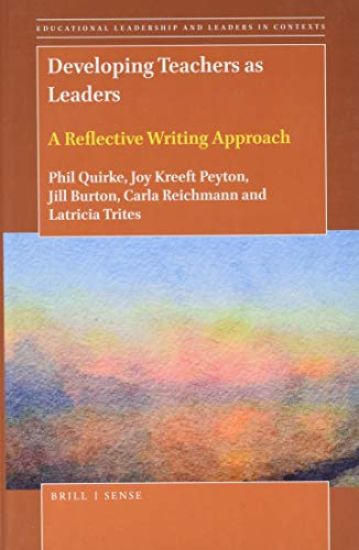
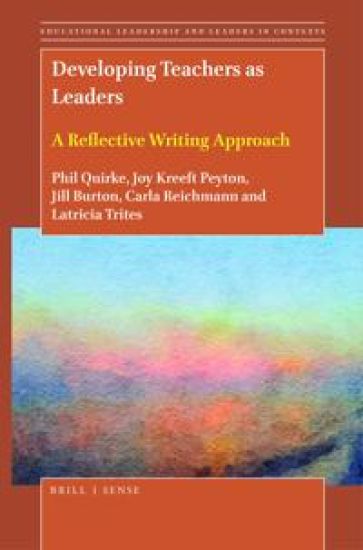
Developing Teachers as Leaders

Developing Teachers as Leaders

Phil Quirke; Joy Kreeft Peyton; Jill Burton; Carla Reichmann; Latricia Trites

BRILL
2021
sidottu
This book focuses on reflective writing, guiding teachers to recognize their potential as professional leaders. The shift to online and blended learning models now favored in education encourages a broader understanding of leadership, particularly its growing relevance to teachers. These models, combined with reflective writing, foster flexible, inclusive teacher learning that responds to each teacher’s strengths, can be used individually and collaboratively to develop teachers as leaders inside and outside the classroom who are critically involved in creating their own professional learning environments. The authors examine leadership in a global range of teaching contexts, each chapter raising diverse issues for teachers aspiring to be leaders in this post-COVID world. All royalties from this book are donated to the Instituto dos Cegos da Paraiba Adalgisa Cunha (ICPAC), a school in João Pessoa, Paraíba, Brazil, that serves the low vision and blind community in the area. For years, the Institute has collaborated as a supervised internship site for various teacher education university programs, providing inspiring field work experiences such as those described in Chapter 4 by Carla Reichmann. Brill is proud to support this important cause and match the donation to the Instituto dos Cegos da Paraiba Adalgisa Cunha (ICPAC).
Developing Teachers as Leaders

Developing Teachers as Leaders

Phil Quirke; Joy Kreeft Peyton; Jill Burton; Carla Reichmann; Latricia Trites

BRILL
2021
nidottu
This book focuses on reflective writing, guiding teachers to recognize their potential as professional leaders. The shift to online and blended learning models now favored in education encourages a broader understanding of leadership, particularly its growing relevance to teachers. These models, combined with reflective writing, foster flexible, inclusive teacher learning that responds to each teacher’s strengths, can be used individually and collaboratively to develop teachers as leaders inside and outside the classroom who are critically involved in creating their own professional learning environments. The authors examine leadership in a global range of teaching contexts, each chapter raising diverse issues for teachers aspiring to be leaders in this post-COVID world. All royalties from this book are donated to the Instituto dos Cegos da Paraiba Adalgisa Cunha (ICPAC), a school in João Pessoa, Paraíba, Brazil, that serves the low vision and blind community in the area. For years, the Institute has collaborated as a supervised internship site for various teacher education university programs, providing inspiring field work experiences such as those described in Chapter 4 by Carla Reichmann. Brill is proud to support this important cause and match the donation to the Instituto dos Cegos da Paraiba Adalgisa Cunha (ICPAC).
Dialogue Journals in the Multilingual Classroom

Dialogue Journals in the Multilingual Classroom

Joy Kreeft Peyton; Jana Staton

Praeger Publishers Inc
1996
sidottu
This volume focuses on the use of dialogue journals in classrooms with students from diverse language and cultural backgrounds whose proficiency with spoken and written English is limited. The companion volume to Dialogue Journal Communication (Ablex, 1988), it carefully describes, from a teacher's experience, how dialogue journal writing can be effectively implemented in the multilingual classroom, with practical tips for starting and maintaining the practice, exploiting the benefits, and avoiding the pitfalls. It presents a model of researchers working in close collaboration with teachers and shows the development in the journals of individual students, with extended examples of student and teacher writing so that teachers can see research results that are not hopelessly extracted from the context in which they were produced. At the same time, it has a strong research orientation.
Dialogue Journals in the Multilingual Classroom

Dialogue Journals in the Multilingual Classroom

Joy Kreeft Peyton

Praeger Publishers Inc
1996
nidottu
This volume focuses on the use of dialogue journals in classrooms with students from diverse language and cultural backgrounds whose proficiency with spoken and written English is limited. The companion volume to Dialogue Journal Communication (Ablex, 1988), it carefully describes, from a teacher's experience, how dialogue journal writing can be effectively implemented in the multilingual classroom, with practical tips for starting and maintaining the practice, exploiting the benefits, and avoiding the pitfalls. It presents a model of researchers working in close collaboration with teachers and shows the development in the journals of individual students, with extended examples of student and teacher writing so that teachers can see research results that are not hopelessly extracted from the context in which they were produced. At the same time, it has a strong research orientation.