
Kirjojen hintavertailu. Mukana 12 230 718 kirjaa ja 12 kauppaa.

Kirjailija

Juan Díez Medrano

Kirjat ja teokset yhdessä paikassa: 4 kirjaa, julkaisuja vuosilta 2010-2020, suosituimpien joukossa Europe in Love. Vertaile teosten hintoja ja tarkista saatavuus suomalaisista kirjakaupoista.

Mukana myös kirjoitusasut: Juan Diez Medrano

4 kirjaa

Kirjojen julkaisuhaarukka 2010-2020.

Europe in Love

Europe in Love

Juan Díez Medrano

Routledge
2020
sidottu
Inter-marriage both reflects and brings social change. This book draws on a unique survey of randomly selected samples of national and European binational couples to demonstrate that the latter are core cells of a future European society.Unrestricted freedom of movement has enabled a rise in the number of lower-class and middle-class binational couples among Europeans. Euro-couples fully integrate in their host cities but secure less support in solving everyday problems than do national ones, partly because of a relatively small network of relatives living close-by. Embeddedness in a dense international network and a cosmopolitan outlook also distinguish them from national couples. The book challenges the view of cosmopolitanism as exclusively middle-class and highlights contrasts between lower-class and middle-class binational couples. Furthermore, it shows that social cosmopolitanism among binational couples is not matched by a commensurate weaker national identification that would enhance support to a more federal Europe. This book is primarily addressed to the general public interested in contemporary European society and to academics interested in inter-marriage. Since the chapters are quasi stand-alone pieces devoted to specific topics, it provides suitable reading material for social stratification, social networks, civil society, popular culture, and European integration undergraduate and graduate courses.

Europe in Love

Europe in Love

Juan Díez Medrano

Routledge
2020
nidottu
Inter-marriage both reflects and brings social change. This book draws on a unique survey of randomly selected samples of national and European binational couples to demonstrate that the latter are core cells of a future European society.Unrestricted freedom of movement has enabled a rise in the number of lower-class and middle-class binational couples among Europeans. Euro-couples fully integrate in their host cities but secure less support in solving everyday problems than do national ones, partly because of a relatively small network of relatives living close-by. Embeddedness in a dense international network and a cosmopolitan outlook also distinguish them from national couples. The book challenges the view of cosmopolitanism as exclusively middle-class and highlights contrasts between lower-class and middle-class binational couples. Furthermore, it shows that social cosmopolitanism among binational couples is not matched by a commensurate weaker national identification that would enhance support to a more federal Europe. This book is primarily addressed to the general public interested in contemporary European society and to academics interested in inter-marriage. Since the chapters are quasi stand-alone pieces devoted to specific topics, it provides suitable reading material for social stratification, social networks, civil society, popular culture, and European integration undergraduate and graduate courses.
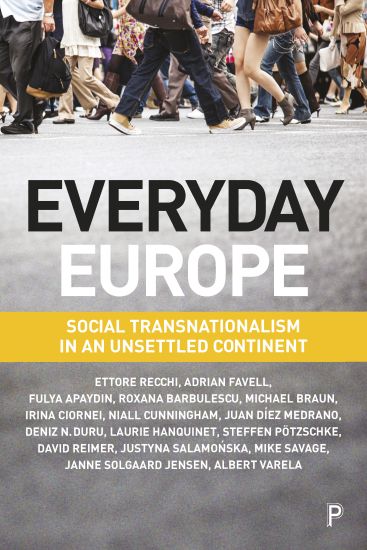
Everyday Europe

Everyday Europe

Ettore Recchi; Adrian Favell; Fulya Apaydin; Roxana Barbulescu; Michael Braun; Irina Ciornei; Niall Cunningham; Juan Diez Medrano; Deniz Neriman Duru; Laurie Hanquinet; Janne Solgaard Jensen; Steffen Pötzschke; David Reimer; Justyna Salamonska; Mike Savage; Albert Varela

Policy Press
2019
sidottu
This book offers an empirically-based view on Europeans’ interconnections in everyday life. It looks at the ways in which EU residents have been getting closer across national frontiers: in their everyday experiences of foreign countries – work, travel, personal networks – but also their knowledge, consumption of foreign products, and attitudes towards foreign culture. The book considers how people reconcile their increasing cross-border interconnections and a politically separating Europe of nation states and national interests.
Framing Europe

Framing Europe

Juan Díez Medrano

Princeton University Press
2010
pokkari
This book provides a major empirical analysis of differing attitudes to European integration in three of Europe's most important countries: Germany, Spain, and the United Kingdom. From its beginnings, the European Union has resounded with debate over whether to move toward a federal or intergovernmental system. However, Juan Diez Medrano argues that empirical analyses of support for integration--by specialists in international relations, comparative politics, and survey research--have failed to explain why some countries lean toward federalism whereas others lean toward intergovernmentalism. By applying frame analysis to a unique set of primary sources (in-depth interviews, newspaper articles, novels, history texts, political speeches, and survey data), Diez Medrano demonstrates the role of major historical events in transforming national cultures and thus creating new opportunities for political transformation. Clearly written and rigorously argued, Framing Europe explains differences in support for European integration between the three countries studied in light of the degree to which each realized its particular "supranational project" outside Western Europe. Only the United Kingdom succeeded in consolidating an empire and retaining it after World War II, while Germany and Spain each abandoned their corresponding aspirations. These differences meant that these countries' populations developed different degrees of identification as Europeans and, partly in consequence, different degrees of support for the building of a federal Europe.