Kirjojen hintavertailu. Mukana 12 455 264 kirjaa ja 12 kauppaa.

Kirjailija

Judith Brett

Kirjat ja teokset yhdessä paikassa: 6 kirjaa, julkaisuja vuosilta 2003-2020, suosituimpien joukossa Exit Right. Vertaile teosten hintoja ja tarkista saatavuus suomalaisista kirjakaupoista.

6 kirjaa

Kirjojen julkaisuhaarukka 2003-2020.

Fair Share: Country and City in Australia: Quarterly Essay 42
Once the country believed itself to be the true face of Australia: sunburnt men and capable women raising crops and children, enduring isolation and a fickle environment, carrying the nation on their sturdy backs. For almost 200 years after white settlement began, city Australia needed the country: to feed it, to earn its export income, to fill the empty land, to provide it with distinctive images of the nation being built in the great south land. But Australia no longer rides on the sheep's back, and since the1980s, when "economic rationalism" became the new creed, the country has felt abandoned, its contribution to the nation dismissed, its historic purpose forgotten.In Fair Share, Judith Brett argues that our federation was built on the idea of a big country and a fair share, no matter where one lived. We also looked to the bush for our legends and we still look to it for our food. In late 2010, with the country independents deciding who would form federal government, it seemed that rural and regional Australia's time had come again. But, as Murray-Darling water reform shows, the politics of dependence are complicated. The question remains: what will be the fate of the country in an era of user-pays, water cutbacks, climate change, droughts and flooding rains? What are the prospects for a new compact between country and city in Australia in the twenty-first century?"Once the problems of the country were problems for the country as a whole. But then government stepped back ... The problems of the country were seen as unfortunate for those affected but not likely to have much impact on the rest of Australia. The agents of neoliberalism cut the country loose from the city and left it to fend for itself." Judith Brett, Fair Share
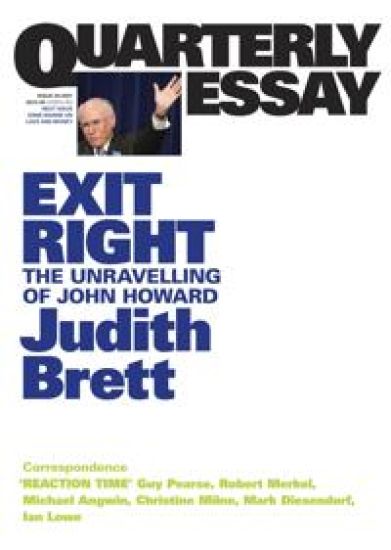
Exit Right

Exit Right

Judith Brett

Black Inc.
2007
pokkari
In Exit Right, Judith Brett explains why the tide turned on John Howard. This is an essay about leadership, in particular Howard's style of strong leadership which led him to dominate his party with such ultimately catastrophic results.In this definitive account, Brett discusses how age became Howard's Achilles heel, how he lost the youth vote, how he lost Bennelong, and how he waited too long to call the election. She looks at the government's core failings - the policy vacuum, the blindness to climate change, the disastrous misjudgment of WorkChoices - and shows how Howard and his team came more and more to insulate themselves from reality.With drama and insight, Judith Brett traces the key moments when John Howard stared defeat in the face, and explains why, after the Keating-Howard years, the ascendancy of Kevin Rudd marks a new phase in the nation's political life."It is when a leader's grip on political power starts to slip, when his threats and bribes miss their mark, when he starts to make uncharacteristic mis- takes and when what had once been strengths reveal their limitations, that we can see most clearly the inner workings of that leadership. This essay is about John Howard's leadership, seen through the prism of its failings." Judith Brett, Exit RightThis issue contains correspondence relating to Reaction Time by Ian Lowe from Guy Pearse, Robert Merkel, Michael Angwin, Christine Milne, Mark Diesendorf, and Ian Lowe.
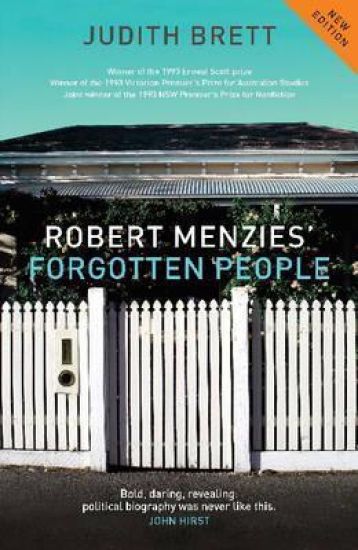
Robert Menzies' Forgotten People

Robert Menzies' Forgotten People

Judith Brett

MELBOURNE UNIVERSITY PRESS
2007
pokkari
In 1941, RG Menzies delivered to war-time Australia what was to be his richest, most creative speech, and one of his most influential. ""The Forgotten People"" was a direct address to the Australian middle class, the 'people' who would return him to power in 1949 and keep him there until his retirement in 1966. Who were these 'forgotten people'? The middle class pitting their values of hard work and independence against the collectivist ethos of labour? Women, shunning the class-based politics of men? The parents of Menzies' childhood in the small country town of Jeparit? And how did this relate to his fervently held belief in his status as a Briton, the boundaries of which nation were 'not on the Kentish Coast but at Cape York and Invercargill'? Judith Brett deftly traces the links between the private and public meanings of Menzies' political career. Taking us deep into both the man and the culture he represented and well beyond the restraints of conventional biography, Brett, reveals the ambivalence that lay at the heart of the Australian self-image. This is absorbing and essential reading for an understanding of the Australia that produced a Menzies - and of a prime minister who, whether loved or hated, shaped the way we imagined ourselves in the postwar world.
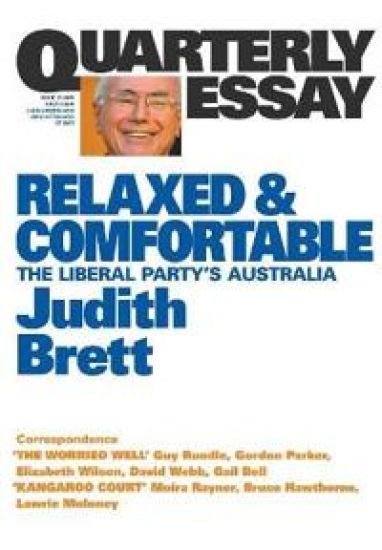
Relaxed & Comfortable: The Liberal Party's Australia: Quarterly Essay 19
What is the Liberal Party's core appeal to Australian voters? Has John Howard made a dramatic break with the past, or has he ingeniously modernised the strategies of his party's founder, Sir Robert Menzies?For Judith Brett, the governmeant of John Howard has done what successful Liberal governments have always done: it has made its stand firmly at the centre and presented itself as the true guardian of the national interest. In doing this, John Howard has taken over the national traditions of the Australian Legend that Labor once considered its own.Brett offers a lucid short history of the Liberals as well as an original account of the Prime Minister, arguing that, above all, he is a man obsessed with the fight against Labor. She explores both his inventiveness in practising the politics of unity and his great ruthlessness in practising the politics of division. She incorporates fascinating interview material with Liberal voters, shedding light on some of the different ways in which the Liberals appeal as the natural party of government.Full of provocative ideas, Relaxed & Comfortable will change the way Australians see the last decade of national politics.
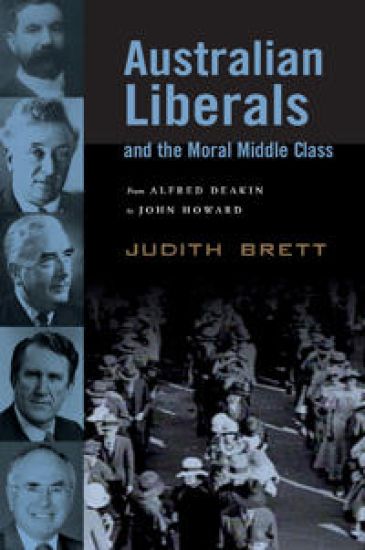
Australian Liberals and the Moral Middle Class

Australian Liberals and the Moral Middle Class

Judith Brett

Cambridge University Press
2003
pokkari
The Liberal Party of Australia was late to form in 1945, but the traditions and ideals upon which it is founded have been central to Australian politics since Federation. This 2003 book, by award-winning author and leading Australian political scientist Judith Brett, provides the very first complete history of the Australian liberal tradition, and then of the Liberal Party from the second half of the twentieth century. The book sparkles with insight, particularly in its sustained analysis of the shifting relationships between the experiences of the moral middle class and Australian liberals' own self understandings. It begins with Alfred Deakin facing the organised working class in parliament and ends with John Howard, electorally triumphant but alienated from key sections of middle class opinion. This book is destined to become the definitive account of Australian liberalism, and of the Liberal Party of Australia.