Kirjojen hintavertailu. Mukana 12 595 353 kirjaa ja 12 kauppaa.

Kirjailija

Judy Fudge

Kirjat ja teokset yhdessä paikassa: 5 kirjaa, julkaisuja vuosilta 2001-2025, suosituimpien joukossa Self-Employed Workers Organize. Vertaile teosten hintoja ja tarkista saatavuus suomalaisista kirjakaupoista.

5 kirjaa

Kirjojen julkaisuhaarukka 2001-2025.

Constructing Modern Slavery

Constructing Modern Slavery

Judy Fudge

Cambridge University Press
2025
sidottu
Modern slavery laws are a response to global capitalism, which undermines the distinction between free and unfree labour and poses intense challenges to state sovereignty. Instead of being a solution, Constructing Modern Slavery argues that modern slavery laws divert attention from the underlying structures and processes that generate exploitation. Focusing on unfree labour associated with international immigration and global supply chains, it provides a novel socio-legal genealogy of the concept 'modern slavery' through a series of linked case studies of influential actors associated with key legal instruments: the United Nations, the United States, the International Labour Organization, the European Union, the United Kingdom, and Walk Free Foundation. Constructing Modern Slavery demonstrates that despite the best efforts of academics, advocates, and policymakers to develop a truly multifaceted approach to modern slavery, it is difficult to uncouple antislavery initiatives from the conservative moral and economic agendas with which they are aligned. This title is also available as Open Access on Cambridge Core.

Labour Before the Law

Labour Before the Law

Judy Fudge; Eric Tucker

University of Toronto Press
2001
pokkari
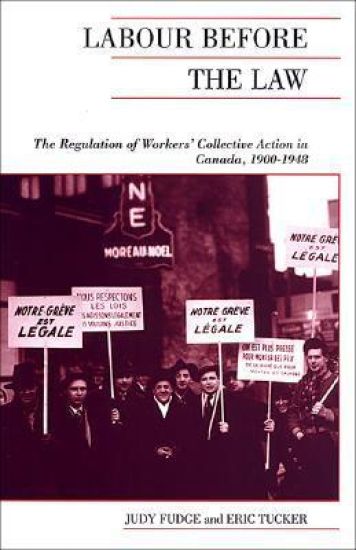
In this groundbreaking study of the relations between workers and the state, Judy Fudge and Eric Tucker examine the legal regulation of workers' collective action from 1900 to 1948. They analyze the strikes, violent confrontations, lockouts, union organizing drives, legislative initiatives, and major judicial decisions that transformed the labour relations regime of liberal voluntarism, which prevailed in the later part of the nineteenth century, into industrial voluntarism, whose centrepiece was Mackenzie King's Industrial Disputes Investigation Act of 1907. This period was marked by coercion and compromise, as workers organized and fought to extend their rights against the profit oriented owners of capital, while the state struggled to define a labour regime that contained industrial conflict. The authors then trace the conflicts that eventually produced the industrial pluralism that Canadians have known in more recent years. By 1948 a detailed set of legal rules and procedures had evolved and achieved a hegemonic status that no prior legal regime had even approached. This regime has become so central to our everyday thinking about labour relations that one might be forgiven for thinking that everything that came earlier was, truly, before the law. But, as Labour Before the Law demonstrates, workers who acted collectively prior to 1948 often found themselves before the law, whether appearing before a magistrate charged with causing a disturbance, facing a superior court judge to oppose an injunction, or in front of a board appointed pursuant to a statutory scheme that was investigating a labour dispute and making recommendations for its resolution. The book is simultaneously a history of law, aspects of the state, trade unions and labouring people, and their interaction within the broad and shifting terrain of political economy. The authors are attentive to regional differences and sectoral divergences, and they attempt to address the fragmentation of class experience.
Labour Before the Law

Labour Before the Law

Judy Fudge; Eric Tucker

Oxford University Press, Canada
2001
pokkari
In this groundbreaking study of the relations between workers and the state, Judy Fudge and Eric Tucker examine the legal regulation of workers' collective action from 1900 to 1948. They analyze the strikes, violent confrontations, lockouts, union organizing drives, legislative initiatives, and major judicial decisions that transformed the labour relations regime of liberal voluntarism, which prevailed in the later part of the nineteenth century, into industrial voluntarism, whose centrepiece was Mackenzie King's Industrial Disputes Investigation Act of 1907. This period was marked by coercion and compromise, as workers organized and fought to extend their rights against the profit oriented owners of capital, while the state struggled to define a labour regime that contained industrial conflict. The authors then trace the conflicts that eventually produced the industrial pluralism that Canadians have known in more recent years. By 1948 a detailed set of legal rules and procedures had evolved and achieved a hegemonic status that no prior legal regime had even approached. This regime has become so central to our everyday thinking about labour relations that one might be forgiven for thinking that everything that came earlier was, truly, before the law. But, as Labour Before the Law demonstrates, workers who acted collectively prior to 1948 often found themselves before the law, whether appearing before a magistrate charged with causing a disturbance, facing a superior court judge to oppose an injunction, or in front of a board appointed pursuant to a statutory scheme that was investigating a labour dispute and making recommendations for its resolution. The book is simultaneously a history of law, aspects of the state, trade unions and labouring people, and their interaction within the broad and shifting terrain of political economy. The authors are attentive to regional differences and sectoral divergences, and they attempt to address the fragmentation of class experience.