Kirjojen hintavertailu. Mukana 12 595 353 kirjaa ja 12 kauppaa.
Kirjailija
Juerg Kohlas
Kirjat ja teokset yhdessä paikassa: 4 kirjaa, julkaisuja vuosilta 1972-2011, suosituimpien joukossa Information Algebras. Vertaile teosten hintoja ja tarkista saatavuus suomalaisista kirjakaupoista.
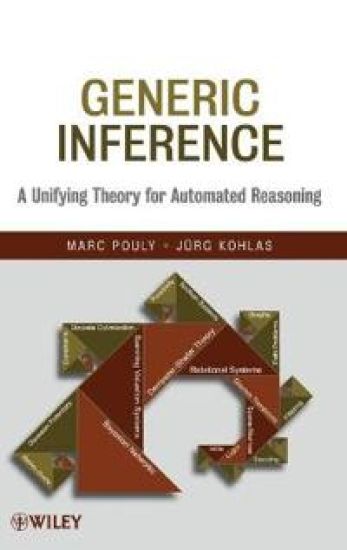
This book provides a rigorous algebraic study of the most popular inference formalisms with a special focus on their wide application area, showing that all these tasks can be performed by a single generic inference algorithm. Written by the leading international authority on the topic, it includes an algebraic perspective (study of the valuation algebra framework), an algorithmic perspective (study of the generic inference schemes) and a "practical" perspective (formalisms and applications). Researchers in a number of fields including artificial intelligence, operational research, databases and other areas of computer science; graduate students; and professional programmers of inference methods will benefit from this work.
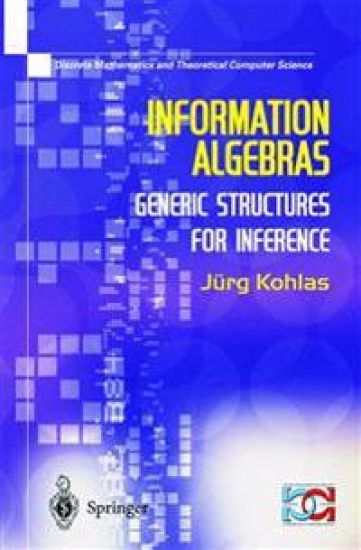
Information usually comes in pieces, from different sources. It refers to different, but related questions. Therefore information needs to be aggregated and focused onto the relevant questions. Considering combination and focusing of information as the relevant operations leads to a generic algebraic structure for information. This book introduces and studies information from this algebraic point of view. Algebras of information provide the necessary abstract framework for generic inference procedures. They allow the application of these procedures to a large variety of different formalisms for representing information. At the same time they permit a generic study of conditional independence, a property considered as fundamental for knowledge presentation. Information algebras provide a natural framework to define and study uncertain information. Uncertain information is represented by random variables that naturally form information algebras. This theory also relates to probabilistic assumption-based reasoning in information systems and is the basis for the belief functions in the Dempster-Shafer theory of evidence.
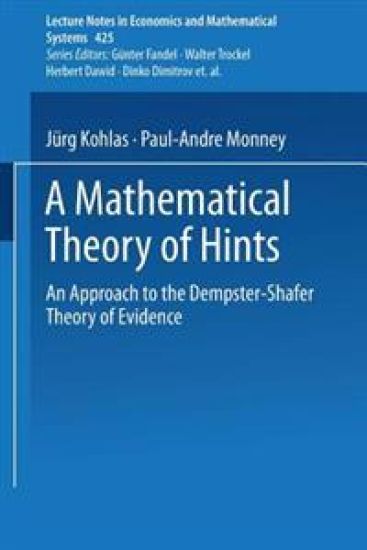
The subject of the book is an approach to the modeling of and the reasoning under uncertainty. It develops the Dempster-Shafer Theory as a theory of the reliability of reasoning with uncertain arguments. A particular interest of this approach is that it yields a new synthesis and integration of logic and probability theory. The reader will benefit from a new view at uncertainty modeling which extends classical probability theory.
Der vorliegende Band ist die schriftliche Fassung einer zweistOndigen Vorlesung, die im Wintersemester 1970/71 an der Universitat ZOrich ge- halten wurde. Die Vorlesung richtete sich in erster Linie an Student en der Volks- und Betriebswirtschaft. Obwohl die Methode der Monte Carlo- Simulation sich in der Praxis als wichtiges und vie I verwendetes analy- tisches Instrument des Operations Research erwiesen hat, findet man min- destens im deutschen Schrifttum keine adaequate elementare Darstellung dieses Gebietes. Daher hoffe ich, dass dieser Kleine Band einer weite- ren Leserschicht von Nutzen ist. Die Monte Carlo-Methode wurzelt in der Wahrscheinlichkeitstheorie und der Statistik. Solange man sich aber auf die Betrachtung der "direkten" Monte Carlo-Methode zur numerischen Analyse stochastischer Systeme be- schrankt, kommt man mit elementaren Begriffen der Wahrscheinlichkeits- rechnung und Statistik aus. Anders verhalt es sich bei den "indirekten" Anwendungen der Monte Carlo-Methode zur Losung numerischer Aufgaben, etwa der Integral-, oder Eigenwert-Berechnung oder der Potentialtheorie. Da der weitaus Oberwiegende Anteil der Anwendungen der Monte Carlo-Metho- de "direkt" ist, kann in einer elementaren Darstellung getrost auf die "indirekten" Methoden verzichtet werden; das urn so mehr als es ausge- zeichnete BOcher zur "indirekten" Monte Carlo-Technik gibt (vgl. Litera- turverzeichnis am Schluss des B ndes). Die benotigten wahrscheinlich- keitstheoretischen und statistischen Begriffe und Satze werden jeweils an Ort und Stelle bei Bedarf eingefOhrt, so dass keine Vorkenntnisse in dieser Richtung vorausgesetzt werden. Im kurzen Kapitel 1 wird die Idee der Monte Carlo-Methode anhand ein- fachster Beispiele vorgestellt.