Kirjojen hintavertailu. Mukana 12 595 353 kirjaa ja 12 kauppaa.

Kirjailija

Julian Henriques

Kirjat ja teokset yhdessä paikassa: 6 kirjaa, julkaisuja vuosilta 1998-2027, suosituimpien joukossa Changing the Subject. Vertaile teosten hintoja ja tarkista saatavuus suomalaisista kirjakaupoista.

6 kirjaa

Kirjojen julkaisuhaarukka 1998-2027.

Picturing Sound and Sounding History

Picturing Sound and Sounding History

Julian Henriques

BLOOMSBURY ACADEMIC
2027
nidottu
What do we see in sound? Picturing Sound and Sounding History focuses on the important intersection between sight and the way visual items such as as paintings, drawings, and diagrams stimulate our auditory imagination. Though, as Marcel Duchamp says, "one can look at seeing, one can't hear hearing", the media and mechanisms for sound making - its propagation, transmission, recording and reception - are clearly visible. This book explores the relationships between sound, sight and image chronologically, in a variety of historical contexts across the arts and sciences. With reference to the phenomenon of synesthesia, it examines the way sights and sounds affect us physically, socially and emotionally, and highlights the important role that sound and sound-making have had historically from pre-history to the present.

Sonic Bodies

Sonic Bodies

Julian Henriques

Continuum Publishing Corporation
2011
sidottu
Breaking new ground in the field of Sound Studies, this book provides an in-depth study of the culture and physicality of dancehall reggae music. The reggae sound system has exerted a major influence on music and popular culture. Every night, on the streets of inner city Kingston, Jamaica, Dancehall sessions stage a visceral, immersive and immensely pleasurable experience of sonic dominance for the participating crowd. "Sonic Bodies" concentrates on the skilled performance of the crewmembers responsible for this signature of Jamaican music: the audio engineers designing, building and fine-tuning the hugely powerful "set" of equipment; the selectors choosing the music tracks played; and, MCs (DJs) on the mic hyping up the crowd. Julian Henriques proposes that these dancehall "vibes" are taken literally as the periodic movement of vibrations, and offers an analysis of how a sound system operates - not only at auditory, but also at corporeal and sociocultural frequencies. "Sonic Bodies" formulates a fascinating auditory critique of visual dominance and the dualities inherent in ideas of image, text or discourse. This innovative book questions the assumptions that reason resides only in the mind, that communication is an exchange of information and that meaning is only ever representation.
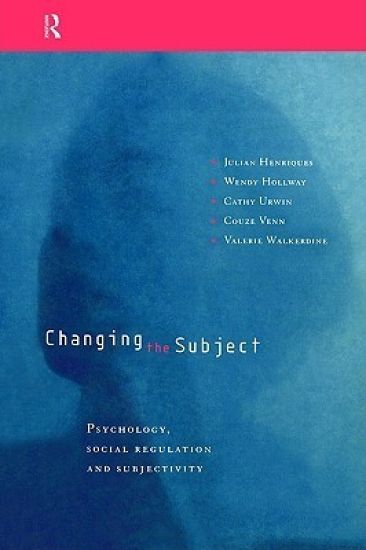
Changing the Subject

Changing the Subject

Julian Henriques; Wendy Hollway; Cathy Urwin; Couze Venn; Valerie Walkerdine

Routledge
1998
sidottu
Changing the Subject is a classic critique of traditional psychology in which the foundations of critical and feminist psychology are laid down. Pioneering and foundational, it is still the groundbreaking text crucial to furthering the new psychology in both teaching and research. Now reissued with a new foreword describing the changes which have taken place over the last few years, Changing the Subject will continue to have a significant impact on thinking about psychology and social theory.
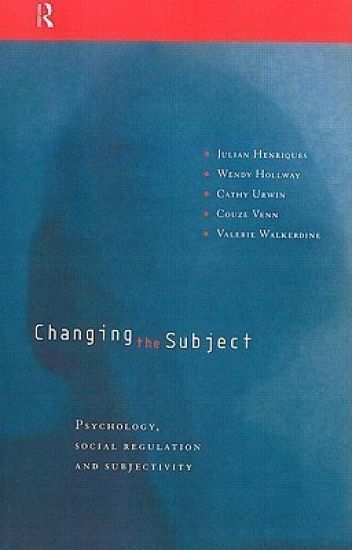
Changing the Subject

Changing the Subject

Julian Henriques; Wendy Hollway; Cathy Urwin; Couze Venn; Valerie Walkerdine

Routledge
1998
nidottu
Changing the Subject is a classic critique of traditional psychology in which the foundations of critical and feminist psychology are laid down. Pioneering and foundational, it is still the groundbreaking text crucial to furthering the new psychology in both teaching and research. Now reissued with a new foreword describing the changes which have taken place over the last few years, Changing the Subject will continue to have a significant impact on thinking about psychology and social theory.
Picturing Sound and Sounding History

Picturing Sound and Sounding History

Julian Henriques

BLOOMSBURY ACADEMIC
2027
sidottu
What do we see in sound? Picturing Sound and Sounding History focuses on the important intersection between sight and the way visual items such as as paintings, drawings, and diagrams stimulate our auditory imagination. Though, as Marcel Duchamp says, "one can look at seeing, one can't hear hearing", the media and mechanisms for sound making - its propagation, transmission, recording and reception - are clearly visible. This book explores the relationships between sound, sight and image chronologically, in a variety of historical contexts across the arts and sciences. With reference to the phenomenon of synesthesia, it examines the way sights and sounds affect us physically, socially and emotionally, and highlights the important role that sound and sound-making have had historically from pre-history to the present.
Sonic Bodies

Sonic Bodies

Julian Henriques

Continuum Publishing Corporation
2011
nidottu
Breaking new ground in the field of Sound Studies, this book provides an in-depth study of the culture and physicality of dancehall reggae music. The reggae sound system has exerted a major influence on music and popular culture. Every night, on the streets of inner city Kingston, Jamaica, Dancehall sessions stage a visceral, immersive and immensely pleasurable experience of sonic dominance for the participating crowd. "Sonic Bodies" concentrates on the skilled performance of the crewmembers responsible for this signature of Jamaican music: the audio engineers designing, building and fine-tuning the hugely powerful "set" of equipment; the selectors choosing the music tracks played; and, MCs (DJs) on the mic hyping up the crowd. Julian Henriques proposes that these dancehall "vibes" are taken literally as the periodic movement of vibrations, and offers an analysis of how a sound system operates - not only at auditory, but also at corporeal and sociocultural frequencies. "Sonic Bodies" formulates a fascinating auditory critique of visual dominance and the dualities inherent in ideas of image, text or discourse. This innovative book questions the assumptions that reason resides only in the mind, that communication is an exchange of information and that meaning is only ever representation.