Kirjojen hintavertailu. Mukana 12 595 353 kirjaa ja 12 kauppaa.

Kirjailija

Julian McDougall

Kirjat ja teokset yhdessä paikassa: 19 kirjaa, julkaisuja vuosilta 2008-2026, suosituimpien joukossa Media Literacy for the Communication Ecosystem. Vertaile teosten hintoja ja tarkista saatavuus suomalaisista kirjakaupoista.

19 kirjaa

Kirjojen julkaisuhaarukka 2008-2026.

Media Studies: The Basics

Media Studies: The Basics

Claire Pollard; Julian McDougall

TAYLOR FRANCIS LTD
2026
sidottu
Fully updated and revised, the third edition of Media Studies: The Basics is the ideal guide to the changing landscape of media and Media Studies. There have been seismic shifts in what constitutes (the) media in recent years with technological advances ushering in whole new categories of producers, consumers and modes of delivery. This has been reflected in the way media is studied with new theories, concepts and practices coming to the fore. This new edition addresses core questions including: • Who, or what, are the media? • What are the key terms and concepts used in analysing media? • Where have new media technologies, platforms and AI had the biggest impact? • How do media theory and practice relate? Covering new developments in media, Big Tech and A.I, an updated glossary and suggestions for further reading, this updated edition cements itself as the ideal introduction to Media Studies today for both A Level and undergraduate students.
Media Studies: The Basics

Media Studies: The Basics

Claire Pollard; Julian McDougall

TAYLOR FRANCIS LTD
2026
nidottu
Fully updated and revised, the third edition of Media Studies: The Basics is the ideal guide to the changing landscape of media and Media Studies. There have been seismic shifts in what constitutes (the) media in recent years with technological advances ushering in whole new categories of producers, consumers and modes of delivery. This has been reflected in the way media is studied with new theories, concepts and practices coming to the fore. This new edition addresses core questions including: • Who, or what, are the media? • What are the key terms and concepts used in analysing media? • Where have new media technologies, platforms and AI had the biggest impact? • How do media theory and practice relate? Covering new developments in media, Big Tech and A.I, an updated glossary and suggestions for further reading, this updated edition cements itself as the ideal introduction to Media Studies today for both A Level and undergraduate students.
Understanding Virtual Reality

Understanding Virtual Reality

Sarah Jones; Steve Dawkins; Julian McDougall

TAYLOR FRANCIS LTD
2022
nidottu
This book provides critical commentary on key issues around virtual reality, using media technology as a tool to challenge perspectives for learning and understanding cultural diversities.With a focus on empathy, embodiment and ethics, the book interrogates the use of immersive technologies for formal and informal educational contexts. Taking a critical approach to discourses around emerging technology and learning, the book presents the idea that a new literacy is emerging and an emphasis on media and technology is needed in the context of education to explore and experience cultural diversities. Employing a personal reflexive narrative, the chapters highlight key issues through research and interviews with leading practitioners in the field.Understanding Virtual Reality will be of great interest to academics and students interested in the effects of immersive realities on the education experience, and to anyone keen on exploring the paradigm shift from entertainment to education.
Understanding Virtual Reality

Understanding Virtual Reality

Sarah Jones; Steve Dawkins; Julian McDougall

TAYLOR FRANCIS LTD
2022
sidottu
This book provides critical commentary on key issues around virtual reality, using media technology as a tool to challenge perspectives for learning and understanding cultural diversities.With a focus on empathy, embodiment and ethics, the book interrogates the use of immersive technologies for formal and informal educational contexts. Taking a critical approach to discourses around emerging technology and learning, the book presents the idea that a new literacy is emerging and an emphasis on media and technology is needed in the context of education to explore and experience cultural diversities. Employing a personal reflexive narrative, the chapters highlight key issues through research and interviews with leading practitioners in the field.Understanding Virtual Reality will be of great interest to academics and students interested in the effects of immersive realities on the education experience, and to anyone keen on exploring the paradigm shift from entertainment to education.
The Uses of Media Literacy

The Uses of Media Literacy

Pete Bennett; Julian McDougall; John Potter

TAYLOR FRANCIS LTD
2022
nidottu
Revisiting Richard Hoggart’s classic work The Uses of Literacy (1957), this book applies Hoggart’s framework to media literacy today, examining media literacy’s various uses, the tensions between them and what this means for people, communities and the contemporary configurations of social class.In The Uses of Literacy (1957), Richard Hoggart wrote about how his working class community, in the North of England, were at once using the new ‘mass literacy’ for self-improvement, education, social mobility and civic engagement and, at the same time, the powerful were seizing the opportunity also to use this expansion in literacy, through the new popular culture, for commercial and political ends. Working in the intersection between education, cultural studies and literacies, the authors write about media literacy as a contested, under-theorised field through Hoggart’s ‘line of sight’ to provide a perspective on media literacy and working class culture today.This reimagining of a classic work, piercingly relevant to studies of class in Britain in 2019, will be of key interest to scholars in Media Studies, as well as interested readers in Communication Studies, Literacy Studies, Cultural Studies, Politics and Sociology.
Critical Approaches to Online Learning

Critical Approaches to Online Learning

Julian McDougall

Critical Publishing Ltd
2021
nidottu
Online learning has become an increasing presence in higher education course design, with most courses combining physical real time engagement with asynchronous learning activity. Now, however, there is a greater need for this one-stop guide to critical practice in this area, as we rethink the role of digital in the social practices of university learning and teaching. This book provides a critical and contemporary ‘deep dive’ into the socio-material, technological and pedagogical practices at work in virtual and digital higher education. Examples are drawn from across and between disciplinary pedagogies with a focus on blended and hybrid approaches and the pivot to fully online made urgent by Covid-19 but drawing on existing best practice.The Critical Practice in Higher Education series provides a scholarly and practical entry point for academics into key areas of higher education practice. Each book in the series explores an individual topic in depth, providing an overview in relation to current thinking and practice, informed by recent research. The series will be of interest to those engaged in the study of higher education, those involved in leading learning and teaching or working in academic development, and individuals seeking to explore particular topics of professional interest. Through critical engagement, this series aims to promote an expanded notion of being an academic – connecting research, teaching, scholarship, community engagement and leadership – while developing confidence and authority.
The Uses of Media Literacy

The Uses of Media Literacy

Pete Bennett; Julian McDougall; John Potter

Routledge
2020
sidottu
Revisiting Richard Hoggart’s classic work The Uses of Literacy (1957), this book applies Hoggart’s framework to media literacy today, examining media literacy’s various uses, the tensions between them and what this means for people, communities and the contemporary configurations of social class.In The Uses of Literacy (1957), Richard Hoggart wrote about how his working class community, in the North of England, were at once using the new ‘mass literacy’ for self-improvement, education, social mobility and civic engagement and, at the same time, the powerful were seizing the opportunity also to use this expansion in literacy, through the new popular culture, for commercial and political ends. Working in the intersection between education, cultural studies and literacies, the authors write about media literacy as a contested, under-theorised field through Hoggart’s ‘line of sight’ to provide a perspective on media literacy and working class culture today.This reimagining of a classic work, piercingly relevant to studies of class in Britain in 2019, will be of key interest to scholars in Media Studies, as well as interested readers in Communication Studies, Literacy Studies, Cultural Studies, Politics and Sociology.
Fake News vs Media Studies

Fake News vs Media Studies

Julian McDougall

Springer Nature Switzerland AG
2019
nidottu
This book explores the place of Media Studies in the age of ‘fake news’, analysing the calls for a curriculum of critical news literacy as part of a cyclical policy debate. With the need for young people in democracies to understand mainstream news agendas and take a critical perspective on social media news, including so-called ‘fake news’, this book argues for Media Studies as a mandatory subject. However, ‘fake news’ is not presented in the book as a stable, neutral term with a clear definition, but is instead defined as an idea that risks obscuring the key critical and political premise of Media Studies. All media representation requires critical deconstruction: therefore, any distinction between ‘real’ and ‘fake’ media is a false binary. The author draws together two narrative strands: one analysing contemporary news and journalism, featuring interviews with journalists and news commentators, and the other re-appraising the discipline of Media Studies itself. This bold and innovative book will appeal to all those interested in the nebulous and often confusing media landscape, as well as students and practitioners of Media Studies.
Media Studies: The Basics

Media Studies: The Basics

Julian McDougall; Claire Pollard

Routledge
2019
sidottu
Fully updated and revised, the second edition of Media Studies: The Basics is the ideal guide to the changing landscape of media and Media Studies. There have been seismic shifts in what constitutes (the) media in recent years with technological advances ushering in whole new categories of producers, consumers and modes of delivery. This has been reflected in the way media is studied with new theories, concepts and practices coming to the fore. This new edition addresses core questions including: Who, or what, are the media? What are the key terms and concepts used in analysing media? Where have new media technologies had the biggest impact? How, and by whom, is media made in the 21st century?Featuring new case studies, an updated glossary and suggestions for further reading, this is the ideal introduction to Media Studies today for both A Level and undergraduate students.
Media Studies: The Basics

Media Studies: The Basics

Julian McDougall; Claire Pollard

Routledge
2019
nidottu
Fully updated and revised, the second edition of Media Studies: The Basics is the ideal guide to the changing landscape of media and Media Studies. There have been seismic shifts in what constitutes (the) media in recent years with technological advances ushering in whole new categories of producers, consumers and modes of delivery. This has been reflected in the way media is studied with new theories, concepts and practices coming to the fore. This new edition addresses core questions including: Who, or what, are the media? What are the key terms and concepts used in analysing media? Where have new media technologies had the biggest impact? How, and by whom, is media made in the 21st century?Featuring new case studies, an updated glossary and suggestions for further reading, this is the ideal introduction to Media Studies today for both A Level and undergraduate students.
Doing Theory on Education

Doing Theory on Education

Andy Cramp; Julian McDougall

Routledge
2018
sidottu
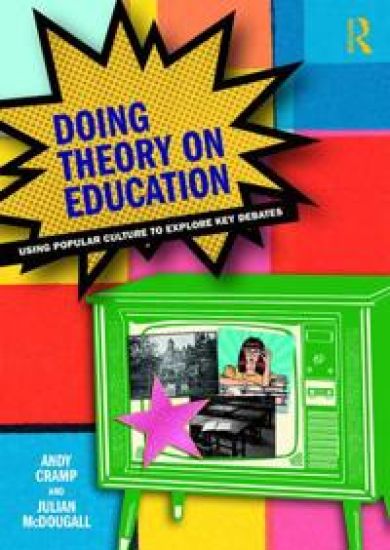
Doing Theory on Education explores key debates using examples from contemporary media and popular culture to guide Education Studies students through the perennial debates that surround teaching and learning. Aimed at undergraduates, postgraduates and teachers in education settings, it uses over seventy popular culture texts from television, music, videogames, fiction, film, architecture, social media, the press and art to illuminate important issues and make the critical theory that underpins educational debates more accessible and engaging.Each chapter also offers essential background knowledge and historical perspective and includes reflective activities to help you develop a critical approach, enabling you to argue your own point of view with confidence and consider where issues may progress to in the future. It examines core issues such as: Class and educational choice Learning styles Testing and assessment What counts as knowledge Leadership and professionalism Education students and those in education settings often struggle to see the value of theory. Doing Theory on Education: Using Popular Culture to Explore Key Debates is an accessible text designed for educationalists who want to put theory to work as an active strategy for influencing thinking and practice.
Doing Theory on Education

Doing Theory on Education

Andy Cramp; Julian McDougall

Routledge
2018
nidottu
Doing Theory on Education explores key debates using examples from contemporary media and popular culture to guide Education Studies students through the perennial debates that surround teaching and learning. Aimed at undergraduates, postgraduates and teachers in education settings, it uses over seventy popular culture texts from television, music, videogames, fiction, film, architecture, social media, the press and art to illuminate important issues and make the critical theory that underpins educational debates more accessible and engaging.Each chapter also offers essential background knowledge and historical perspective and includes reflective activities to help you develop a critical approach, enabling you to argue your own point of view with confidence and consider where issues may progress to in the future. It examines core issues such as: Class and educational choice Learning styles Testing and assessment What counts as knowledge Leadership and professionalism Education students and those in education settings often struggle to see the value of theory. Doing Theory on Education: Using Popular Culture to Explore Key Debates is an accessible text designed for educationalists who want to put theory to work as an active strategy for influencing thinking and practice.
Digital Media, Culture and Education

Digital Media, Culture and Education

John Potter; Julian McDougall

Palgrave Macmillan
2017
sidottu
This book provides a critical commentary on key issues around learning in the digital age in both formal and informal educational settings. The book presents research and thinking about new dynamic literacies, porous expertise, digital making/coding/remixing, curation, storying in digital media, open learning, the networked educator and a number of related topics; it further addresses and develops the notion of a ‘third space literacies’ in contexts for learning. The book takes as its starting point the idea that an emphasis on technology and media, as part of material culture and lived experience, is much needed in the discussion of education, along with a criticality which is too often absent in the discourse around technology and learning. It constructs a narrative thread and a critical synthesis from a sociocultural account of the memes and stereotypical positions around learning, media and technology in the digital age, and will beof great interest to academics interested in the mechanics of learning and the effects of technology on the education experience. It closes with a conversation as a reflexive ‘afterword’ featuring discussion of the key issues with, amongst others, Neil Selwyn and Cathy Burnett.
Doing Text

Doing Text

Pete Bennett; Julian Mcdougall

Auteur Publishing
2016
sidottu
This collection re-imagines the study of English and media in a way that decentralises the text (e.g. romantic poetry or film noir) or media formats/platforms (e.g. broadcast media/new media). Instead, the authors work across boundaries in meaningful thematic contexts that reflect the ways in which people engage with reading, watching, making, and listening in their textual lives. In so doing, this project recasts both subjects as combined in a more reflexive, critical space for the study of our everyday social and cultural interactions. Across the chapters, the authors present applicable learning and teaching strategies that weave together art works, films, social practices, creativity, 'viral' media, theater, TV, social media, videogames, and literature. The culmination of this range of strategies is a reclaimed 'blue skies' approach to progressive textual education, free from constraining shackles of outdated ideas about textual categories and value that have hitherto alienated generations of students and both English and media from themselves.
After the Media

After the Media

Peter Bennett; Alex Kendall; Julian McDougall

Routledge
2011
sidottu
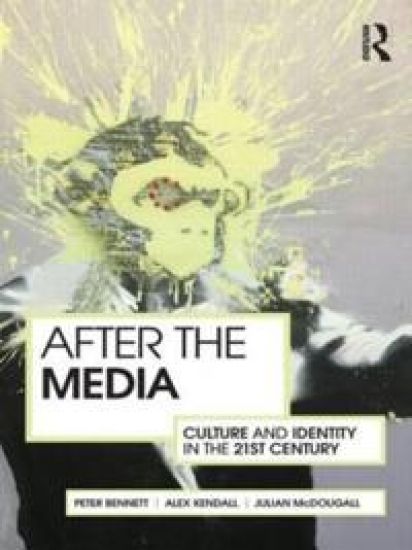
This provocative text considers the state of media and cultural studies today after the demolition of the traditional media paradigm, and engages with the new, active consumer culture. Media Studies, particularly within schools, has until recently been concerned with mass media and the effects of ‘the media’ in society and on people. As new media technology has blurred the boundaries between the audience and the media, the status of this area of education is threatened. Whilst some have called for a drastic re-think (Media Studies 2.0), others have called for caution, arguing that the power dynamics of ownership and gatekeeping are left intact. This book uses cultural and technological change as a context for a more forensic exploration of the traditional dependence on the idea of ‘the media’ as one homogenous unit. It suggests that it would be liberating for students, teachers and academics to depart from such a model and shift the focus to people and how they create culture in this contemporary ‘mediascape’.
After the Media

After the Media

Peter Bennett; Alex Kendall; Julian McDougall

Routledge
2011
nidottu
This provocative text considers the state of media and cultural studies today after the demolition of the traditional media paradigm, and engages with the new, active consumer culture. Media Studies, particularly within schools, has until recently been concerned with mass media and the effects of ‘the media’ in society and on people. As new media technology has blurred the boundaries between the audience and the media, the status of this area of education is threatened. Whilst some have called for a drastic re-think (Media Studies 2.0), others have called for caution, arguing that the power dynamics of ownership and gatekeeping are left intact. This book uses cultural and technological change as a context for a more forensic exploration of the traditional dependence on the idea of ‘the media’ as one homogenous unit. It suggests that it would be liberating for students, teachers and academics to depart from such a model and shift the focus to people and how they create culture in this contemporary ‘mediascape’.
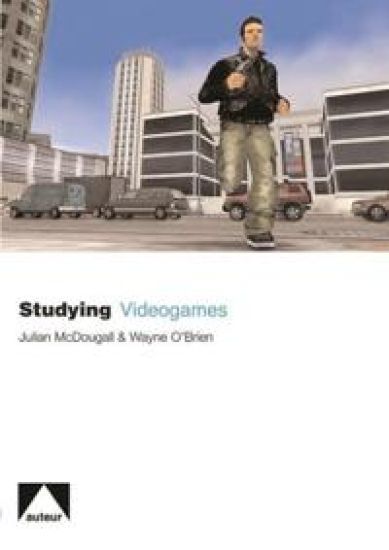
Studying Videogames

Studying Videogames

Julian McDougall; Wayne O'Brien

Auteur Publishing
2008
sidottu
Studying Videogames is the first book to look at videogames as media texts. Written specifically for advanced level/undergraduate students it covers a broad range of games, industry contexts, and research findings. The book challenges conventional media-analysis approaches; sets out the history, present, and future of games; and interrogates claims about their "social effects." Featuring student activities, interviews with key players in the industry, and an extended case study of the Grand Theft Auto cycle, Studying Videogames seriously engages with this powerful media.
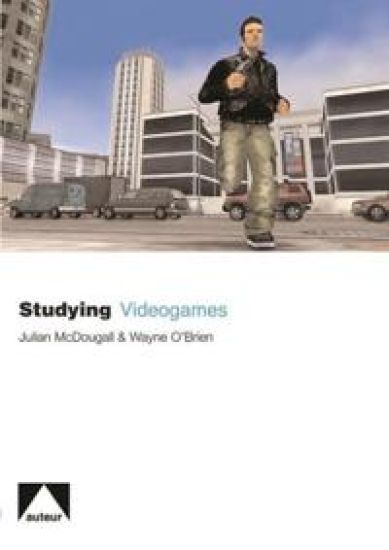
Studying Videogames

Studying Videogames

Julian McDougall; Wayne O'Brien

Auteur Publishing
2008
pokkari
Studying Videogames is the first book to look at videogames as media texts. Written specifically for advanced level/undergraduate students it covers a broad range of games, industry contexts, and research findings. The book challenges conventional media-analysis approaches; sets out the history, present, and future of games; and interrogates claims about their "social effects." Featuring student activities, interviews with key players in the industry, and an extended case study of the Grand Theft Auto cycle, Studying Videogames seriously engages with this powerful media.