Kirjojen hintavertailu. Mukana 12 426 272 kirjaa ja 12 kauppaa.

Kirjailija

Julie Cupples

Kirjat ja teokset yhdessä paikassa: 7 kirjaa, julkaisuja vuosilta 2016-2024, suosituimpien joukossa Communications/Media/Geographies. Vertaile teosten hintoja ja tarkista saatavuus suomalaisista kirjakaupoista.

7 kirjaa

Kirjojen julkaisuhaarukka 2016-2024.

Communications/Media/Geographies

Communications/Media/Geographies

Paul C. Adams; Julie Cupples; Kevin Glynn; André Jansson; Shaun Moores

Routledge
2016
sidottu
Although there are human geographers who have previously written on matters of media and communication, and those in media and communication studies who have previously written on geographical issues, this is the first book-length dialogue in which experienced theorists and researchers from these different fields address each other directly and engage in conversation across traditional academic boundaries. The result is a compelling discussion, with the authors setting out statements of their positions before responding to the arguments made by others.One significant aspect of this discussion is a spirited debate about the sort of interdisciplinary area that might emerge as a focus for future work. Does the already-established idea of communication geography offer the best way forward? If so, what would applied or critical forms of communication geography be concerned to do? Could communication geography benefit from the sorts of conjunctural analysis that have been developed in contemporary cultural studies? Might a further way forward be to imagine an interdisciplinary field of everyday-life studies, which would draw critically on non-representational theories of practice and movement?Readers of Communications/Media/Geographies are invited to join the debate, thinking through such questions for themselves, and the themes that are explored in this book (for example, of space, place, meaning, power, and ethics) will be of interest not only to academics in human geography and in media and communication studies, but also to a wider range of scholars from across the humanities and social sciences.
Communications/Media/Geographies

Communications/Media/Geographies

Paul C. Adams; Julie Cupples; Kevin Glynn; André Jansson; Shaun Moores

Routledge
2018
nidottu
Although there are human geographers who have previously written on matters of media and communication, and those in media and communication studies who have previously written on geographical issues, this is the first book-length dialogue in which experienced theorists and researchers from these different fields address each other directly and engage in conversation across traditional academic boundaries. The result is a compelling discussion, with the authors setting out statements of their positions before responding to the arguments made by others.One significant aspect of this discussion is a spirited debate about the sort of interdisciplinary area that might emerge as a focus for future work. Does the already-established idea of communication geography offer the best way forward? If so, what would applied or critical forms of communication geography be concerned to do? Could communication geography benefit from the sorts of conjunctural analysis that have been developed in contemporary cultural studies? Might a further way forward be to imagine an interdisciplinary field of everyday-life studies, which would draw critically on non-representational theories of practice and movement?Readers of Communications/Media/Geographies are invited to join the debate, thinking through such questions for themselves, and the themes that are explored in this book (for example, of space, place, meaning, power, and ethics) will be of interest not only to academics in human geography and in media and communication studies, but also to a wider range of scholars from across the humanities and social sciences.
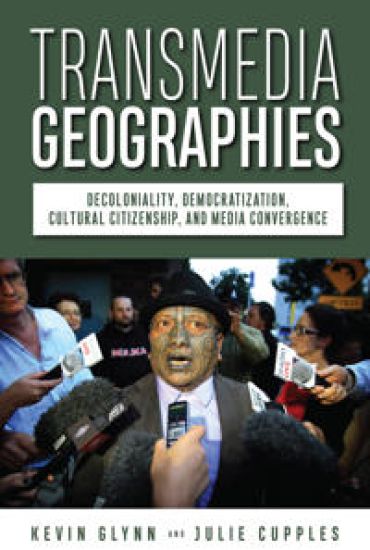
Transmedia Geographies

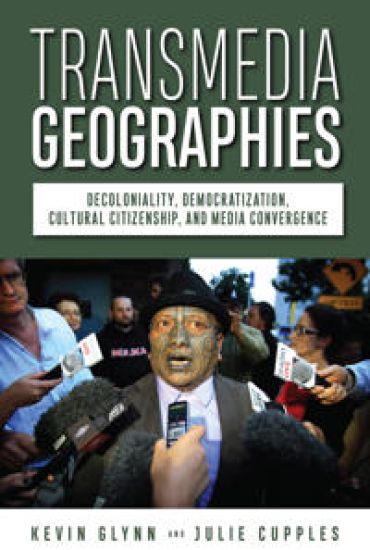
Transmedia Geographies

Kevin Glynn; Julie Cupples

RUTGERS UNIVERSITY PRESS
2024
nidottu
Looking at the US, New Zealand, and Central America, this book considers how cultural politics has been deeply reworked in our contemporary media environment. The authors analyze how rampant technological convergence has allowed stories to spill across media platforms as well as geographical borders and how those stories reemerge as transmediated events. The authors explore the cultural politics that have developed within this new media environment by moving across the mediated landscapes of the first, third, and fourth (Indigenous people’s) worlds, which are deeply intertwined and interconnected under contemporary conditions of neoliberal globalization and emergent regimes of authoritarian postdemocracy. The book attends both to the platforms and digital networks of the new media environment and to the cultural forms and practices that have constituted television as the dominant medium of communication throughout the second half of the twentieth century. In the new media environment, transmediation works on behalf not only of those corporate megaconglomerates that have become all too familiar to media consumers around the world but also of many communities that have previously been excluded from access to the means of electronic textual production and circulation. For the latter, grassroots transmediation has become an important technique for the production of cultural citizenship.
Transmedia Geographies

Transmedia Geographies

Kevin Glynn; Julie Cupples

RUTGERS UNIVERSITY PRESS
2024
sidottu
Looking at the US, New Zealand, and Central America, this book considers how cultural politics has been deeply reworked in our contemporary media environment. The authors analyze how rampant technological convergence has allowed stories to spill across media platforms as well as geographical borders and how those stories reemerge as transmediated events. The authors explore the cultural politics that have developed within this new media environment by moving across the mediated landscapes of the first, third, and fourth (Indigenous people’s) worlds, which are deeply intertwined and interconnected under contemporary conditions of neoliberal globalization and emergent regimes of authoritarian postdemocracy. The book attends both to the platforms and digital networks of the new media environment and to the cultural forms and practices that have constituted television as the dominant medium of communication throughout the second half of the twentieth century. In the new media environment, transmediation works on behalf not only of those corporate megaconglomerates that have become all too familiar to media consumers around the world but also of many communities that have previously been excluded from access to the means of electronic textual production and circulation. For the latter, grassroots transmediation has become an important technique for the production of cultural citizenship.
Development and Decolonization in Latin America

Development and Decolonization in Latin America

Julie Cupples

TAYLOR FRANCIS LTD
2021
sidottu
Written in an accessible language, this book is a fully updated and revised edition of Latin American Development, a text that provides a comprehensive introduction to Latin American development in the twenty-first century and is anchored in decolonial theory and other critical approaches. This new edition has been revised and updated in a way that takes into account recent changes in political leadership, the retreat of the Pink Tide, the Colombian peace accords, new forms of political and territorial mobilization, the intensification of extractivism, murders of environmental defenders, major disasters, and the new contours of feminist and anti-patriarchal struggles. It features new chapters on decolonial theory, Latin America in the world, disastrous development, Afrodescendant struggles, and the Latin American city. The book emphasizes political, economic, social, cultural, and environmental dimensions of development and considers key challenges facing the region and the diverse ways in which its people are responding, as well as providing analysis of the ways in which such challenges and responses can be theorized. It explores the region’s historical trajectories, the implementation and rejection of the neoliberal model, and the role played by diverse social movements. It is an indispensable resource for students and university lecturers and professors in development studies, Latin American studies, geography, anthropology, sociology, political science, economics, and cultural studies. In addition, it provides an invaluable introduction to the region for journalists and development practitioners.
Development and Decolonization in Latin America

Development and Decolonization in Latin America

Julie Cupples

TAYLOR FRANCIS LTD
2021
nidottu
Written in an accessible language, this book is a fully updated and revised edition of Latin American Development, a text that provides a comprehensive introduction to Latin American development in the twenty-first century and is anchored in decolonial theory and other critical approaches. This new edition has been revised and updated in a way that takes into account recent changes in political leadership, the retreat of the Pink Tide, the Colombian peace accords, new forms of political and territorial mobilization, the intensification of extractivism, murders of environmental defenders, major disasters, and the new contours of feminist and anti-patriarchal struggles. It features new chapters on decolonial theory, Latin America in the world, disastrous development, Afrodescendant struggles, and the Latin American city. The book emphasizes political, economic, social, cultural, and environmental dimensions of development and considers key challenges facing the region and the diverse ways in which its people are responding, as well as providing analysis of the ways in which such challenges and responses can be theorized. It explores the region’s historical trajectories, the implementation and rejection of the neoliberal model, and the role played by diverse social movements. It is an indispensable resource for students and university lecturers and professors in development studies, Latin American studies, geography, anthropology, sociology, political science, economics, and cultural studies. In addition, it provides an invaluable introduction to the region for journalists and development practitioners.
Shifting Nicaraguan Mediascapes

Shifting Nicaraguan Mediascapes

Julie Cupples; Kevin Glynn

Springer International Publishing AG
2017
nidottu
This book explores the mediated struggles for autonomy, land rights and social justice in a context of growing authoritarianism and persistent coloniality in Nicaragua. To do so, it draws on in-depth fieldwork, analysis of media texts, and decolonial and other cultural theories. There are two main threats to the authoritarian rule of the Nicaraguan government led by Daniel Ortega: the first is the Managua-based NGO and civil society sector led largely by educated dissident Sandinistas, and the second is the escalating struggle for autonomy and land rights being fought by Nicaragua’s indigenous and Afro-descended inhabitants on the country’s Caribbean coast. In order to confront these threats and, it seems, secure indefinite political tenure, the government engages in a set of centralizing and anti-democratic political strategies characterized by secrecy, institutional power grabs, highly suspect electoral practices, clientelistic anti-poverty programmes, and the control through purchase or co-optation of much of the nation's media. The social movements that threaten Ortega’s rule are however operating through dispersed and topological modalities of power and the creative use of emergent spaces for the circulation of counter-discourses and counter-narratives within a rapidly transforming media environment. The primary response to these mediated tactics is a politics of silence and a refusal to acknowledge or respond to the political claims made by social movements. In the current conjuncture, the authors identify a struggle for hegemony whose strategies and tactics include the citizenship-stripping activities of the state and the citizenship-claiming activities of black, indigenous and dissident actors and activists. This struggle plays out in part through the mediated circulation and counter-circulation of discourses and the infrastructural dynamics of media convergence.