Kirjojen hintavertailu. Mukana 12 595 353 kirjaa ja 12 kauppaa.

Kirjailija

Julie Wilhelmsen

Kirjat ja teokset yhdessä paikassa: 3 kirjaa, julkaisuja vuosilta 2016-2021, suosituimpien joukossa Urban Protest. Vertaile teosten hintoja ja tarkista saatavuus suomalaisista kirjakaupoista.

3 kirjaa

Kirjojen julkaisuhaarukka 2016-2021.

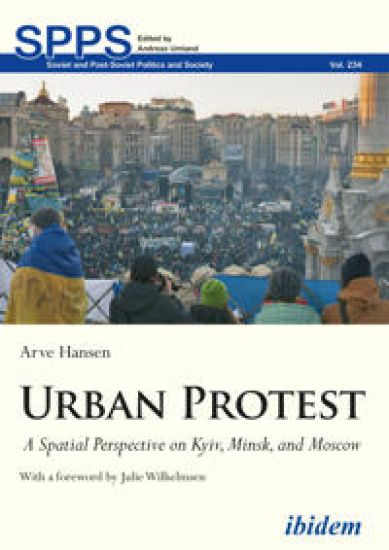
Urban Protest

Urban Protest

Arve Hansen; Julie Wilhelmsen

Ibidem Press
2021
nidottu
Urban space is an important part of the political environment-a place where people congregate to discuss, deliberate, and interact with each other. In times of great public discontent, people often turn to urban spaces to make their opinions heard and to demand change, with varying degrees of success. How are mass protests affected by the urban public space in which they occur? This book provides a theoretical model to analyse city spaces, based on the use of theories from political science, urban planning, and sociology. Hansen's approach consists of a mapping of the causal mechanisms between spatial elements, the political environment, and their combined effects on protests. This mapping is applied to three case studies-Kyiv, Minsk, and Moscow. In addition to the spatial perspective model, Urban Protest provides new insights as to how the interactions in space occur, and demonstrates how geography can create limitations and opportunities in a large variety of ways.
Russia's Securitization of Chechnya

Russia's Securitization of Chechnya

Julie Wilhelmsen

Routledge
2018
nidottu
This book provides an in-depth analysis of how mobilization and legitimation for war are made possible, with a focus on Russia's conflict with Chechnya.Through which processes do leaders and their publics come to define and accept certain conflicts as difficult to engage in, and others as logical, even necessary? Drawing on a detailed study of changes in Russia’s approach to Chechnya, this book argues that ‘re-phrasing’ Chechnya as a terrorist threat in 1999 was essential to making the use of violence acceptable to the Russian public. The book refutes popular explanations that see Russian war-making as determined and grounded in a sole, authoritarian leader. Close study of the statements and texts of Duma representatives, experts and journalists before and during the war demonstrates how the Second Chechen War was made a ‘legitimate’ undertaking through the efforts of many. A post-structuralist reinterpretation of securitization theory guides and structures the book, with discourse theory and method employed as a means to uncover the social processes that make war acceptable. More generally, the book provides a framework for understanding the broad social processes that underpin legitimized war-making.This book will be of much interest to students of Russian politics, critical terrorism studies, security studies and international relations.
Russia's Securitization of Chechnya

Russia's Securitization of Chechnya

Julie Wilhelmsen

Routledge
2016
sidottu
This book provides an in-depth analysis of how mobilization and legitimation for war are made possible, with a focus on Russia's conflict with Chechnya.Through which processes do leaders and their publics come to define and accept certain conflicts as difficult to engage in, and others as logical, even necessary? Drawing on a detailed study of changes in Russia’s approach to Chechnya, this book argues that ‘re-phrasing’ Chechnya as a terrorist threat in 1999 was essential to making the use of violence acceptable to the Russian public. The book refutes popular explanations that see Russian war-making as determined and grounded in a sole, authoritarian leader. Close study of the statements and texts of Duma representatives, experts and journalists before and during the war demonstrates how the Second Chechen War was made a ‘legitimate’ undertaking through the efforts of many. A post-structuralist reinterpretation of securitization theory guides and structures the book, with discourse theory and method employed as a means to uncover the social processes that make war acceptable. More generally, the book provides a framework for understanding the broad social processes that underpin legitimized war-making.This book will be of much interest to students of Russian politics, critical terrorism studies, security studies and international relations.