Kirjojen hintavertailu. Mukana 12 390 323 kirjaa ja 12 kauppaa.

Kirjailija

Jun Rentschler

Kirjat ja teokset yhdessä paikassa: 7 kirjaa, julkaisuja vuosilta 2018-2025, suosituimpien joukossa Detox Development. Vertaile teosten hintoja ja tarkista saatavuus suomalaisista kirjakaupoista.

7 kirjaa

Kirjojen julkaisuhaarukka 2018-2025.

Nature's Paradox

Nature's Paradox

Richard Damania; Ebad Ebadi; Kentaro Mayr; Jun Rentschler; Jason Russ; Esha Zaveri

WORLD BANK PUBLICATIONS
2025
nidottu
Nature's Paradox is about the intersection of two major crises of the 21st century; the sustainability crisis and the social exclusion and inequality crisis. It explores the disproportionate impact that environmental decline is having on excluded populations, and presents solutions for bringing environmental justice to underrepresented communities.
Within Reach

Within Reach

Stephane Hallegatte; Paolo Avner; Ira Dorband; Catrina Godinho; Dirk Heine; Penelope Mealy; Jun Rentschler

WORLD BANK PUBLICATIONS
2024
nidottu
This report looks at the political economy of net zero policy, from common challenges to the development of strategies to overcome them. It shows how governments can improve political economy conditions over time with progressive climate governance interventions, while overcoming more immediate barriers with better policy design and communication.
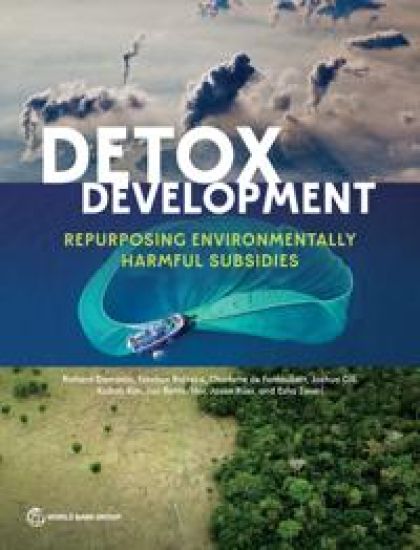
Detox Development

Detox Development

Richard Damania; Esteban Balseca; Charlotte De Fontaubert; Joshua Gill; Kichan Kim; Jun Rentschler; Jason Russ; Esha Zaveri

WORLD BANK PUBLICATIONS
2023
nidottu
This report examines the impacts of subsidies on the world's stock of foundational natural capital: clean air, land, and oceans. It presents new research on the magnitude and impact of these subsidies, and presents solutions to reform them in efficient and equitable ways.
Fossil Fuel Subsidy Reforms

Fossil Fuel Subsidy Reforms

Jun Rentschler

Routledge
2020
nidottu
Countries around the world are spending up to $500 billion per year on subsidising fossil fuel consumption. By some estimates, the G20 countries alone are spending around another $450 billion on subsidising fossil fuel production. In addition, the indirect social welfare costs of these subsidies have been shown to be substantial – for instance due to air pollution, road congestion, climate change, and economic inefficiency, to name a few. Considering these numbers, there is no doubt that fossil fuel subsidies cause severe economic distortions that compromise countries’ prospects of achieving equitable and sustainable development.This book provides a guide to the complex challenge of designing, assessing, and implementing effective fossil fuel subsidy reforms. It shows that subsidy reform requires a careful balancing of complex economic and political trade-offs, as well as measures to mitigate adverse effects on vulnerable households and to assist firms with implementing efficiency enhancing measures. Going beyond the purely fiscal perspective, this book emphasises that smart subsidy reforms can contribute to all three dimensions of sustainable development – environment, society, and economy. Over the course of eight chapters, this book considers a wide range of agents and stakeholders, markets, and policy measures in order to distil the key principles of designing effective fossil fuel subsidy reforms. This book will be of great relevance to scholars and policy makers with an interest in energy economics and policy, climate change policy, and sustainable development more broadly.
Lifelines

Lifelines

Stephane Hallegatte; Jun Rentschler; Julie Rozenberg

World Bank Publications
2019
nidottu
Infrastructure--electricity, telecommunications, roads, water, and sanitation--are central to people's lives. Without it, they cannot make a living, stay healthy, and maintain a good quality of life. Access to basic infrastructure is also a key driver of economic development. This report lays out a framework for understanding infrastructure resilience - the ability of infrastructure systems to function and meet users' needs during and after a natural hazard. It focuses on four infrastructure systems that are essential to economic activity and people's well-being: power systems, including the generation, transmission, and distribution of electricity; water and sanitation--especially water utilities; transport systems--multiple modes such as road, rail, waterway, and airports, and multiple scales, including urban transit and rural access; and telecommunications, including telephone and Internet connections.
Fossil Fuel Subsidy Reforms

Fossil Fuel Subsidy Reforms

Jun Rentschler

CRC Press Inc
2018
sidottu
Countries around the world are spending up to $500 billion per year on subsidising fossil fuel consumption. By some estimates, the G20 countries alone are spending around another $450 billion on subsidising fossil fuel production. In addition, the indirect social welfare costs of these subsidies have been shown to be substantial – for instance due to air pollution, road congestion, climate change, and economic inefficiency, to name a few. Considering these numbers, there is no doubt that fossil fuel subsidies cause severe economic distortions that compromise countries’ prospects of achieving equitable and sustainable development.This book provides a guide to the complex challenge of designing, assessing, and implementing effective fossil fuel subsidy reforms. It shows that subsidy reform requires a careful balancing of complex economic and political trade-offs, as well as measures to mitigate adverse effects on vulnerable households and to assist firms with implementing efficiency enhancing measures. Going beyond the purely fiscal perspective, this book emphasises that smart subsidy reforms can contribute to all three dimensions of sustainable development – environment, society, and economy. Over the course of eight chapters, this book considers a wide range of agents and stakeholders, markets, and policy measures in order to distil the key principles of designing effective fossil fuel subsidy reforms. This book will be of great relevance to scholars and policy makers with an interest in energy economics and policy, climate change policy, and sustainable development more broadly.