Kirjojen hintavertailu. Mukana 12 595 353 kirjaa ja 12 kauppaa.

Kirjailija

Jun Shao

Kirjat ja teokset yhdessä paikassa: 11 kirjaa, julkaisuja vuosilta 1995-2024, suosituimpien joukossa Mathematical Statistics: Exercises and Solutions. Vertaile teosten hintoja ja tarkista saatavuus suomalaisista kirjakaupoista.

11 kirjaa

Kirjojen julkaisuhaarukka 1995-2024.

Statistical Methods for Handling Incomplete Data

Statistical Methods for Handling Incomplete Data

Jae Kwang Kim; Jun Shao

TAYLOR FRANCIS LTD
2024
nidottu
Due to recent theoretical findings and advances in statistical computing, there has been a rapid development of techniques and applications in the area of missing data analysis. Statistical Methods for Handling Incomplete Data covers the most up-to-date statistical theories and computational methods for analyzing incomplete data.Features Uses the mean score equation as a building block for developing the theory for missing data analysis Provides comprehensive coverage of computational techniques for missing data analysis Presents a rigorous treatment of imputation techniques, including multiple imputation fractional imputation Explores the most recent advances of the propensity score method and estimation techniques for nonignorable missing data Describes a survey sampling application Updated with a new chapter on Data Integration Now includes a chapter on Advanced Topics, including kernel ridge regression imputation and neural network model imputation The book is primarily aimed at researchers and graduate students from statistics, and could be used as a reference by applied researchers with a good quantitative background. It includes many real data examples and simulated examples to help readers understand the methodologies.
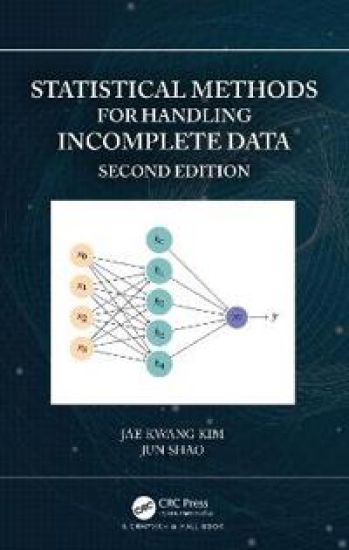
Statistical Methods for Handling Incomplete Data

Statistical Methods for Handling Incomplete Data

Jae Kwang Kim; Jun Shao

CRC Press
2021
sidottu
Due to recent theoretical findings and advances in statistical computing, there has been a rapid development of techniques and applications in the area of missing data analysis. Statistical Methods for Handling Incomplete Data covers the most up-to-date statistical theories and computational methods for analyzing incomplete data.Features Uses the mean score equation as a building block for developing the theory for missing data analysis Provides comprehensive coverage of computational techniques for missing data analysis Presents a rigorous treatment of imputation techniques, including multiple imputation fractional imputation Explores the most recent advances of the propensity score method and estimation techniques for nonignorable missing data Describes a survey sampling application Updated with a new chapter on Data Integration Now includes a chapter on Advanced Topics, including kernel ridge regression imputation and neural network model imputation The book is primarily aimed at researchers and graduate students from statistics, and could be used as a reference by applied researchers with a good quantitative background. It includes many real data examples and simulated examples to help readers understand the methodologies.
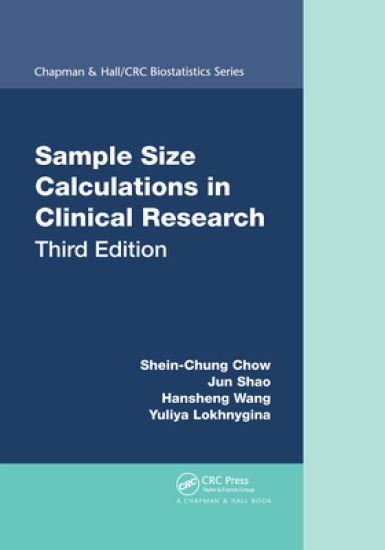
Sample Size Calculations in Clinical Research

Sample Size Calculations in Clinical Research

Shein-Chung Chow; Jun Shao; Hansheng Wang; Yuliya Lokhnygina

CRC Press
2020
nidottu
Praise for the Second Edition:"… this is a useful, comprehensive compendium of almost every possible sample size formula. The strong organization and carefully defined formulae will aid any researcher designing a study." -Biometrics"This impressive book contains formulae for computing sample size in a wide range of settings. One-sample studies and two-sample comparisons for quantitative, binary, and time-to-event outcomes are covered comprehensively, with separate sample size formulae for testing equality, non-inferiority, and equivalence. Many less familiar topics are also covered …" – Journal of the Royal Statistical SocietySample Size Calculations in Clinical Research, Third Edition presents statistical procedures for performing sample size calculations during various phases of clinical research and development. A comprehensive and unified presentation of statistical concepts and practical applications, this book includes a well-balanced summary of current and emerging clinical issues, regulatory requirements, and recently developed statistical methodologies for sample size calculation.Features: Compares the relative merits and disadvantages of statistical methods for sample size calculations Explains how the formulae and procedures for sample size calculations can be used in a variety of clinical research and development stages Presents real-world examples from several therapeutic areas, including cardiovascular medicine, the central nervous system, anti-infective medicine, oncology, and women’s health Provides sample size calculations for dose response studies, microarray studies, and Bayesian approaches This new edition is updated throughout, includes many new sections, and five new chapters on emerging topics: two stage seamless adaptive designs, cluster randomized trial design, zero-inflated Poisson distribution, clinical trials with extremely low incidence rates, and clinical trial simulation.
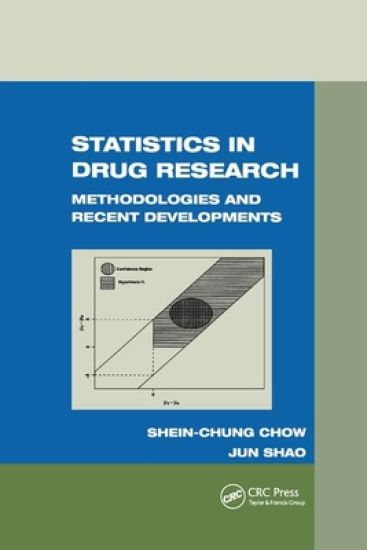
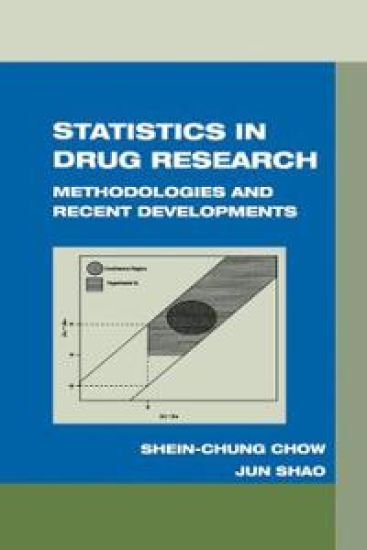
Statistics in Drug Research

Statistics in Drug Research

Shein-Chung Chow; Jun Shao

CRC Press
2019
nidottu
Emphasizing the role of good statistical practices (GSP) in drug research and formulation, this book outlines important statistics applications for each stage of pharmaceutical development to ensure the valid design, analysis, and assessment of drug products under investigation and establish the safety and efficacy of pharmaceutical compounds. Coverage include statistical techniques for assay validation and evaluation of drug performance characteristics, testing population/individual bioequivalence and in vitro bioequivalence according to the most recent FDA guidelines, basic considerations for the design and analysis of therapeutic equivalence and noninferiority trials.
Sample Size Calculations in Clinical Research

Sample Size Calculations in Clinical Research

Shein-Chung Chow; Jun Shao; Hansheng Wang; Yuliya Lokhnygina

CRC Press
2017
sidottu
Praise for the Second Edition:"… this is a useful, comprehensive compendium of almost every possible sample size formula. The strong organization and carefully defined formulae will aid any researcher designing a study." -Biometrics"This impressive book contains formulae for computing sample size in a wide range of settings. One-sample studies and two-sample comparisons for quantitative, binary, and time-to-event outcomes are covered comprehensively, with separate sample size formulae for testing equality, non-inferiority, and equivalence. Many less familiar topics are also covered …" – Journal of the Royal Statistical SocietySample Size Calculations in Clinical Research, Third Edition presents statistical procedures for performing sample size calculations during various phases of clinical research and development. A comprehensive and unified presentation of statistical concepts and practical applications, this book includes a well-balanced summary of current and emerging clinical issues, regulatory requirements, and recently developed statistical methodologies for sample size calculation.Features: Compares the relative merits and disadvantages of statistical methods for sample size calculations Explains how the formulae and procedures for sample size calculations can be used in a variety of clinical research and development stages Presents real-world examples from several therapeutic areas, including cardiovascular medicine, the central nervous system, anti-infective medicine, oncology, and women’s health Provides sample size calculations for dose response studies, microarray studies, and Bayesian approachesThis new edition is updated throughout, includes many new sections, and five new chapters on emerging topics: two stage seamless adaptive designs, cluster randomized trial design, zero-inflated Poisson distribution, clinical trials with extremely low incidence rates, and clinical trial simulation.
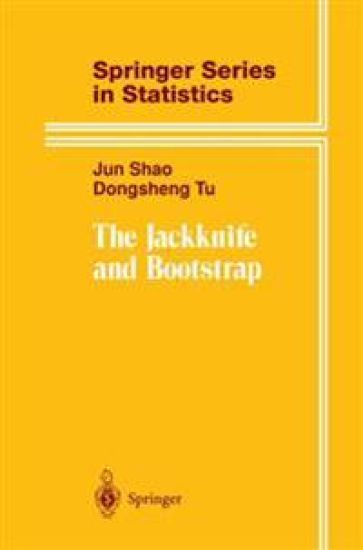
The Jackknife and Bootstrap

The Jackknife and Bootstrap

Jun Shao; Dongsheng Tu

Springer-Verlag New York Inc.
2012
nidottu
The jackknife and bootstrap are the most popular data-resampling meth­ ods used in statistical analysis. The resampling methods replace theoreti­ cal derivations required in applying traditional methods (such as substitu­ tion and linearization) in statistical analysis by repeatedly resampling the original data and making inferences from the resamples. Because of the availability of inexpensive and fast computing, these computer-intensive methods have caught on very rapidly in recent years and are particularly appreciated by applied statisticians. The primary aims of this book are (1) to provide a systematic introduction to the theory of the jackknife, the bootstrap, and other resampling methods developed in the last twenty years; (2) to provide a guide for applied statisticians: practitioners often use (or misuse) the resampling methods in situations where no theoretical confirmation has been made; and (3) to stimulate the use of the jackknife and bootstrap and further devel­ opments of the resampling methods. The theoretical properties of the jackknife and bootstrap methods are studied in this book in an asymptotic framework. Theorems are illustrated by examples. Finite sample properties of the jackknife and bootstrap are mostly investigated by examples and/or empirical simulation studies. In addition to the theory for the jackknife and bootstrap methods in problems with independent and identically distributed (Li.d.) data, we try to cover, as much as we can, the applications of the jackknife and bootstrap in various complicated non-Li.d. data problems.
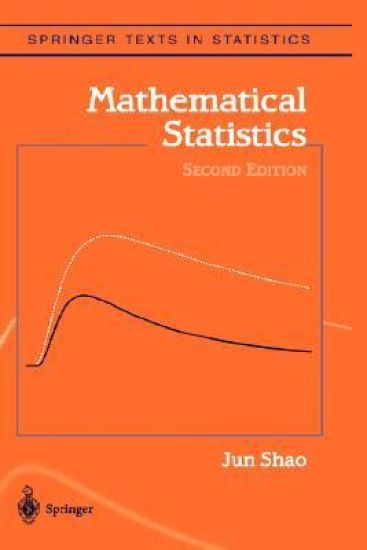
Mathematical Statistics

Mathematical Statistics

Jun Shao

Springer-Verlag New York Inc.
2010
nidottu
This graduate textbook covers topics in statistical theory essential for graduate students preparing for work on a Ph.D. degree in statistics. The first chapter provides a quick overview of concepts and results in measure-theoretic probability theory that are useful in statistics. The second chapter introduces some fundamental concepts in statistical decision theory and inference. Chapters 3-7 contain detailed studies on some important topics: unbiased estimation, parametric estimation, nonparametric estimation, hypothesis testing, and confidence sets. A large number of exercises in each chapter provide not only practice problems for students, but also many additional results. In addition to improving the presentation, the new edition makes Chapter 1 a self-contained chapter for probability theory with emphasis in statistics. Added topics include useful moment inequalities, more discussions of moment generating and characteristic functions, conditional independence, Markov chains, martingales, Edgeworth and Cornish-Fisher expansions, and proofs to many key theorems such as the dominated convergence theorem, monotone convergence theorem, uniqueness theorem, continuity theorem, law of large numbers, and central limit theorem. A new section in Chapter 5 introduces semiparametric models, and a number of new exercises were added to each chapter.
Mathematical Statistics: Exercises and Solutions

Mathematical Statistics: Exercises and Solutions

Jun Shao

Springer-Verlag New York Inc.
2005
nidottu
Since the publication of my book Mathematical Statistics (Shao, 2003), I have been asked many times for a solution manual to the exercises in my book. Without doubt, exercises form an important part of a textbook on mathematical statistics, not only in training students for their research ability in mathematical statistics but also in presenting many additional results as complementary material to the main text. Written solutions to these exercises are important for students who initially do not have the skills in solving these exercises completely and are very helpful for instructors of a mathematical statistics course (whether or not my book Mathematical Statistics is used as the textbook) in providing answers to students as well as ?nding additional examples to the main text. Mo- vatedbythisandencouragedbysomeofmycolleaguesandSpringer-Verlag editor John Kimmel, I have completed this book,Mathematical Statistics: Exercises and Solutions. This book consists of solutions to 400 exercises, over 95% of which are in my bookMathematical Statistics. Many of them are standard exercises that also appear in other textbooks listed in the references. It is only a partial solution manual to Mathematical Statistics (which contains over 900exercises).
Statistics in Drug Research

Statistics in Drug Research

Shein-Chung Chow; Jun Shao

CRC Press Inc
2002
sidottu
Emphasizing the role of good statistical practices (GSP) in drug research and formulation, this book outlines important statistics applications for each stage of pharmaceutical development to ensure the valid design, analysis, and assessment of drug products under investigation and establish the safety and efficacy of pharmaceutical compounds. Coverage include statistical techniques for assay validation and evaluation of drug performance characteristics, testing population/individual bioequivalence and in vitro bioequivalence according to the most recent FDA guidelines, basic considerations for the design and analysis of therapeutic equivalence and noninferiority trials.
The Jackknife and Bootstrap

The Jackknife and Bootstrap

Jun Shao; Dongsheng Tu

Springer-Verlag New York Inc.
1995
sidottu
The jackknife and bootstrap are the most popular data-resampling meth­ ods used in statistical analysis. The resampling methods replace theoreti­ cal derivations required in applying traditional methods (such as substitu­ tion and linearization) in statistical analysis by repeatedly resampling the original data and making inferences from the resamples. Because of the availability of inexpensive and fast computing, these computer-intensive methods have caught on very rapidly in recent years and are particularly appreciated by applied statisticians. The primary aims of this book are (1) to provide a systematic introduction to the theory of the jackknife, the bootstrap, and other resampling methods developed in the last twenty years; (2) to provide a guide for applied statisticians: practitioners often use (or misuse) the resampling methods in situations where no theoretical confirmation has been made; and (3) to stimulate the use of the jackknife and bootstrap and further devel­ opments of the resampling methods. The theoretical properties of the jackknife and bootstrap methods are studied in this book in an asymptotic framework. Theorems are illustrated by examples. Finite sample properties of the jackknife and bootstrap are mostly investigated by examples and/or empirical simulation studies. In addition to the theory for the jackknife and bootstrap methods in problems with independent and identically distributed (Li.d.) data, we try to cover, as much as we can, the applications of the jackknife and bootstrap in various complicated non-Li.d. data problems.