Kirjojen hintavertailu. Mukana 12 459 402 kirjaa ja 12 kauppaa.

Kirjailija

June Manning Thomas

Kirjat ja teokset yhdessä paikassa: 3 kirjaa, julkaisuja vuosilta 2009-2024, suosituimpien joukossa Redevelopment and Race. Vertaile teosten hintoja ja tarkista saatavuus suomalaisista kirjakaupoista.

3 kirjaa

Kirjojen julkaisuhaarukka 2009-2024.

Planning Progress

Planning Progress

June Manning Thomas

Association for Baha'i Studies
2024
pokkari
This is a practical examination of the idea that planning as a skill is essential to human progress, but that some individual exemplify this skill more than others, and furthermore that such individuals may be able to help organizations move in a more purposeful direction. The book reviews planning theory in relation to planning for a better future, looking at such classic authors as and then explores the planning style of one key leader, Shoghi Effendi, to show how such strategies as vision, encouragement, and feedback can help improve the planning outcomes for a range of human organizations. Other major components of able planning include consultation, goal-directed behavior, and meaningful action.The original letters of Shoghi Effendi, dating largely from 1936 to 1957, offer illustrative text for these principles. In this particular case, his leadership of a worldwide spiritual community devoted to the principles of unity and justice and yet stymied by low growth rates drew successfully on such principles in order to achieve progress in a series of countries and continents. The book includes practical suggestions for improving the planning success of organizations private and public as well as of individuals.
Redevelopment and Race

Redevelopment and Race

June Manning Thomas

Wayne State University Press
2013
nidottu
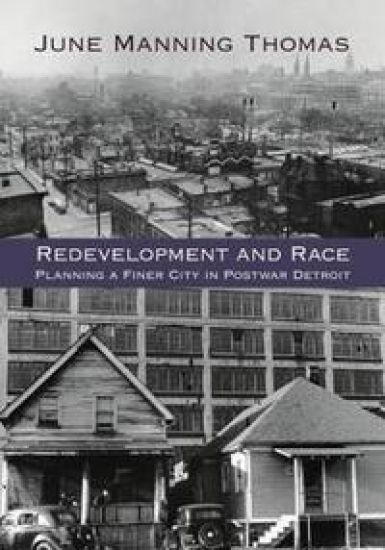
In the decades following World War II, professional city planners in Detroit made a concerted effort to halt the city's physical and economic decline. Their successes included an award-winning master plan, a number of laudable redevelopment projects, and exemplary planning leadership in the city and the nation. Yet despite their efforts, Detroit was rapidly transforming into a notorious symbol of urban decay. In Redevelopment and Race: Planning a Finer City in Postwar Detroit, June Manning Thomas takes a look at what went wrong, demonstrating how and why government programs were ineffective and even destructive to community needs. In confronting issues like housing shortages, blight in older areas, and changing economic conditions, Detroit's city planners worked during the urban renewal era without much consideration for low-income and African-American residents, and their efforts to stabilise racially-mixed neighbourhoods faltered as well. Steady declines in industrial prowess and the constant decentralisation of white residents counteracted planners' efforts to rebuild the city. Among the issues Thomas discusses in this volume are the harmful impacts of Detroit's highways, the mixed record of urban renewal projects like Lafayette Park, the effects of the 1967 riots on Detroit's ability to plan, the city-building strategies of Coleman Young (the city's first black mayor) and his mayoral successors, and the evolution of the Detroit's federally-designated Empowerment Zone. Examining the city she knew first as an undergraduate student at Michigan State University and later as a scholar and planner, Thomas ultimately argues for a different approach to traditional planning that places social justice, equity, and community ahead of purely physical and economic objectives. Redevelopment and Race was originally published in 1997 and was given the Paul Davidoff Award from the Association of Collegiate Schools of Planning in 1999. Students and teachers of urban planning will be grateful for this re-release. A new postscript offers insights into changes since 1997.
Urban Spaces

Urban Spaces

June Manning Thomas

Lexington Books
2009
sidottu
The control and utilization of urban spaces remains a highly contested issue. Much of the debate centers on issues of economic development versus the maintenance and support of already existing communities. As a number of urban areas are in the throes of gentrification and economic development projects, there is a dearth of information on not only the use of private power in this process, but also the response of the community members. This anthology responds to a growing concern about urban and community development, and the role of corporate power. These essays focus on key themes of land ownership and management, community resistance against corporate agendas, and public discourse over these issues. These themes are presented and developed within an interdisciplinary framework which includes information and commentary about history, contemporary politics, economic development, and ideology. Most of the chapters include case studies that provide concrete examples of contemporary developments in urban areas, and each chapter includes discussion questions and a list of key words and terms to help guide the reader.