Kirjojen hintavertailu. Mukana 12 595 353 kirjaa ja 12 kauppaa.

Kirjailija

Junyi Li

Kirjat ja teokset yhdessä paikassa: 5 kirjaa, julkaisuja vuosilta 2013-2026, suosituimpien joukossa Large Language Models. Vertaile teosten hintoja ja tarkista saatavuus suomalaisista kirjakaupoista.

5 kirjaa

Kirjojen julkaisuhaarukka 2013-2026.

Large Language Models

Large Language Models

Wayne Xin Zhao; Kun Zhou; Junyi Li; Tianyi Tang; Ji-Rong Wen

Springer Nature Switzerland AG
2025
sidottu
Are you eager to explore the latest breakthrough in artificial intelligence, particularly the domain of large language models (LLMs)? This book is your go-to guide for understanding the core foundations and advanced techniques of LLMs. This comprehensive resource offers a complete understanding of LLM developments, from pre-training to fine-tuning. It elaborates on the classic Transformer architecture, its adaptations for LLMs, and the full training process, including data collection, cleaning, and preparation. From the book, readers can also learn how to fine-tune LLMs to follow human instructions and align with human values and intentions, ensuring safer and more ethical AI behavior. Furthermore, it helps readers discover effective prompting strategies, such as in-context learning and chain-of-thought, to enhance LLM capabilities and solve complex tasks. Suitable for both beginners and experienced professionals, this book is an invaluable resource for navigating the dynamic field of LLMs, offering a concise yet comprehensive exploration of the subject. The translation was originally done using artificial intelligence. Subsequently, a comprehensive human revision was done to ensure content accuracy and coherence throughout the book.

Millimeter Wave Communications in 5G and Towards 6G

Millimeter Wave Communications in 5G and Towards 6G

Vasanthan Raghavan; Junyi Li; Ashwin Sampath; Ozge H. Koymen; Tao Luo

TAYLOR FRANCIS LTD
2024
sidottu
This book explores different facets of millimeter wave systems, which form a central part of 5G systems. It explains how these systems serve as a foundational building block of 5G-Advanced/6G as these systems evolve.Millimeter Wave Communications in 5G and Towards 6G focuses on millimeter wave channel modeling, radio frequency (RF) and antenna level constraints imposed on beamforming, beamforming design for link level incorporating the RF/antenna constraints and the channel structure, as well as system level deployment considerations. With significant academic and industrial experience, the authors are well-equipped in explaining how the millimeter wave research developed, the fundamental principles/math beneath the technology, and in explaining precisely the “Why?” behind the “What?” that make the 5G-NR specifications. The authors examine point-to-point systems at a single link level and show how the traditional sub-6 GHz-based beamforming procedures simplify to a simplistic signal processing approach of directional beam scanning. This book examines the foundational background that led to specific choices in the millimeter wave part of the 5G-NR spec as well as chart out the roadmap in terms of future research and development activities in this arena. The book ends by providing a scope of future research in this area.This book is geared towards both introductory as well as advanced researchers in both industry and academia working in the areas of 5G, 5G-Advanced and 6G communications. It would also be useful for senior undergraduate and graduate students in universities focusing on wireless communications topics.
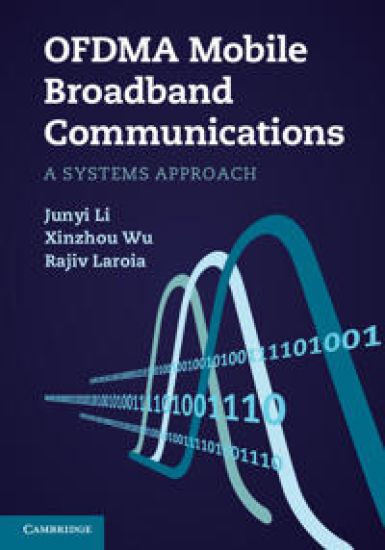
OFDMA Mobile Broadband Communications

OFDMA Mobile Broadband Communications

Junyi Li; Xinzhou Wu; Rajiv Laroia

Cambridge University Press
2013
sidottu
Written by the pioneers of Flash-OFDM, arguably the first commercially developed OFDMA-based mobile broadband system in the world, this book teaches OFDMA from first principles, enabling readers to understand mobile broadband as a whole. The book examines the key requirements for data-centric mobile; how OFDMA fits well with data networks; why mobile broadband needs to be IP-based; and how to bridge communications theory to real-world air interface design and make a good system choice between performance and complexity. It also explores the future of wireless technologies beyond conventional cellular architecture. One of the key challenges faced by newcomers to this field is how to apply the wireless communications theory and principles to the real world and how to understand sophisticated commercial systems such as LTE. The authors use their firsthand experience to help graduate students, researchers and professionals working on 4G to bridge the gap between theory and practice.
Millimeter Wave Communications in 5G and Towards 6G

Millimeter Wave Communications in 5G and Towards 6G

Vasanthan Raghavan; Junyi Li; Ashwin Sampath; Ozge H. Koymen; Tao Luo

TAYLOR FRANCIS LTD
2026
nidottu
This book explores different facets of millimeter wave systems, which form a central part of 5G systems. It explains how these systems serve as a foundational building block of 5G-Advanced/6G as these systems evolve. Millimeter Wave Communications in 5G and Towards 6G focuses on millimeter wave channel modeling, radio frequency (RF) and antenna level constraints imposed on beamforming, beamforming design for link level incorporating the RF/antenna constraints and the channel structure, as well as system level deployment considerations. With significant academic and industrial experience, the authors are well-equipped in explaining how the millimeter wave research developed, the fundamental principles/math beneath the technology, and in explaining precisely the “Why?” behind the “What?” that make the 5G-NR specifications. The authors examine point-to-point systems at a single link level and show how the traditional sub-6 GHz-based beamforming procedures simplify to a simplistic signal processing approach of directional beam scanning. This book examines the foundational background that led to specific choices in the millimeter wave part of the 5G-NR spec as well as chart out the roadmap in terms of future research and development activities in this arena. The book ends by providing a scope of future research in this area. This book is geared towards both introductory as well as advanced researchers in both industry and academia working in the areas of 5G, 5G-Advanced and 6G communications. It would also be useful for senior undergraduate and graduate students in universities focusing on wireless communications topics.