Kirjojen hintavertailu. Mukana 12 332 871 kirjaa ja 12 kauppaa.

Kirjailija

Jurgen Moser

Kirjat ja teokset yhdessä paikassa: 3 kirjaa, julkaisuja vuosilta 2001-2005, suosituimpien joukossa Notes on Dynamical Systems. Vertaile teosten hintoja ja tarkista saatavuus suomalaisista kirjakaupoista.

Mukana myös kirjoitusasut: Jürgen Moser

3 kirjaa

Kirjojen julkaisuhaarukka 2001-2005.

Notes on Dynamical Systems

Notes on Dynamical Systems

Jurgen Moser; Eduard J. Zehnder

American Mathematical Society
2005
nidottu
This book is an introduction to the field of dynamical systems, in particular, to the special class of Hamiltonian systems. The authors aimed at keeping the requirements of mathematical techniques minimal but giving detailed proofs and many examples and illustrations from physics and celestial mechanics. After all, the celestial $N$-body problem is the origin of dynamical systems and gave rise in the past to many mathematical developments. Jurgen Moser (1928-1999) was a professor at the Courant Institute, New York, and then at ETH Zurich. He served as president of the International Mathematical Union and received many honors and prizes, among them the Wolf Prize in mathematics. Jurgen Moser is the author of several books, among them ""Stable and Random Motions in Dynamical Systems"". Eduard Zehnder is a professor at ETH Zurich. He is coauthor with Helmut Hofer of the book ""Symplectic Invariants and Hamiltonian Dynamics"".
Selected Chapters in the Calculus of Variations

Selected Chapters in the Calculus of Variations

Jürgen Moser

Birkhauser Verlag AG
2003
nidottu
0.1 Introduction These lecture notes describe a new development in the calculus of variations which is called Aubry-Mather-Theory. The starting point for the theoretical physicist Aubry was a model for the descrip­ tion of the motion of electrons in a two-dimensional crystal. Aubry investigated a related discrete variational problem and the corresponding minimal solutions. On the other hand, Mather started with a specific class of area-preserving annulus mappings, the so-called monotone twist maps. These maps appear in mechanics as Poincare maps. Such maps were studied by Birkhoff during the 1920s in several papers. In 1982, Mather succeeded to make essential progress in this field and to prove the existence of a class of closed invariant subsets which are now called Mather sets. His existence theorem is based again on a variational principle. Although these two investigations have different motivations, they are closely re­ lated and have the same mathematical foundation. We will not follow those ap­ proaches but will make a connection to classical results of Jacobi, Legendre, Weier­ strass and others from the 19th century. Therefore in Chapter I, we will put together the results of the classical theory which are the most important for us. The notion of extremal fields will be most relevant. In Chapter II we will investigate variational problems on the 2-dimensional torus. We will look at the corresponding global minimals as well as at the relation be­ tween minimals and extremal fields. In this way, we will be led to Mather sets.
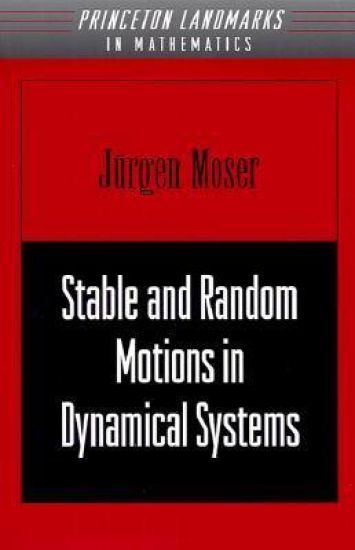
Stable and Random Motions in Dynamical Systems

Stable and Random Motions in Dynamical Systems

Jurgen Moser

Princeton University Press
2001
pokkari
For centuries, astronomers have been interested in the motions of the planets and in methods to calculate their orbits. Since Newton, mathematicians have been fascinated by the related N-body problem. They seek to find solutions to the equations of motion for N masspoints interacting with an inverse-square-law force and to determine whether there are quasi-periodic orbits or not. Attempts to answer such questions have led to the techniques of nonlinear dynamics and chaos theory. In this book, a classic work of modern applied mathematics, Jurgen Moser presents a succinct account of two pillars of the theory: stable and chaotic behavior. He discusses cases in which N-body motions are stable, covering topics such as Hamiltonian systems, the (Moser) twist theorem, and aspects of Kolmogorov-Arnold-Moser theory. He then explores chaotic orbits, exemplified in a restricted three-body problem, and describes the existence and importance of homoclinic points. This book is indispensable for mathematicians, physicists, and astronomers interested in the dynamics of few- and many-body systems and in fundamental ideas and methods for their analysis. After thirty years, Moser's lectures are still one of the best entrees to the fascinating worlds of order and chaos in dynamics.