Kirjojen hintavertailu. Mukana 12 657 676 kirjaa ja 12 kauppaa.

Kirjailija

Jurgen Schmandt

Kirjat ja teokset yhdessä paikassa: 4 kirjaa, julkaisuja vuosilta 1988-2020, suosituimpien joukossa Promoting High Technology Industry. Vertaile teosten hintoja ja tarkista saatavuus suomalaisista kirjakaupoista.

4 kirjaa

Kirjojen julkaisuhaarukka 1988-2020.

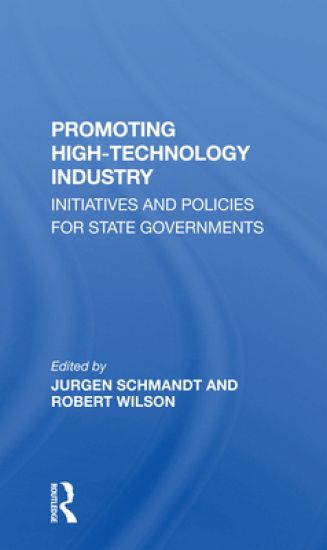
Promoting High Technology Industry

Promoting High Technology Industry

Jurgen Schmandt; Robert Wilson; Suzanne E Smith; Brian H Muller

Routledge
2020
nidottu
In the wake of declining federal involvement in state affairs, state governments have taken the initiative in creating science and technology policies and programs for economic development. The contributors to this study look at the attempts of eight states—California, Florida, Massachusetts, Minnesota, New York, North Carolina, Pennsylvania, and T
Promoting High Technology Industry

Promoting High Technology Industry

Jurgen Schmandt; Robert Wilson; Suzanne E Smith; Brian H Muller

Routledge
2019
sidottu
In the wake of declining federal involvement in state affairs, state governments have taken the initiative in creating science and technology policies and programs for economic development. The contributors to this study look at the attempts of eight states—California, Florida, Massachusetts, Minnesota, New York, North Carolina, Pennsylvania, and T

George P. Mitchell and the Idea of Sustainability

George P. Mitchell and the Idea of Sustainability

Jurgen Schmandt

Texas A M University Press
2010
sidottu
An energy tycoon, real estate developer, and philanthropist, George P. Mitchell is also an idealist, a big thinker who gave his time and fortune to the study of sustainability long before it became a household word. Jurgen Schmandt, who has worked for Mitchell for many years, explains and traces the idea of a sustainable society, from its origin in the eighteenth-century concept of the ""commons"" to its twentieth-century iteration in the 1987 United Nations report ""Our Common Future."" He then chronicles Mitchell’s commitment to this idea from the early 1960s, when the focus was on population growth, to today, when climate change and global warming dominate the debate. Mitchell advanced his belief that humankind could create ""a balance between economic and ecological well-being"" by organizing and hosting conferences, awarding prizes, supporting scholars and scientists, and funding research and publications. He did it at the Aspen Institute, at The Woodlands Conferences, at the National Academy of Sciences, at the Mitchell Center for Sustainable Development, and at the Houston Advanced Research Center. (Paradoxically, he did not always do it in his own energy company.) Documenting one important man’s engagement with one important idea, Schmandt has preserved a significant episode in the ongoing quest to create societies that are ""capable of reaching and then sustaining a decent quality of life for their citizens.
State Water Policies

State Water Policies

Jurgen Schmandt; Ernest T. Smerdon; Judith Clarkson

Praeger Publishers Inc
1988
sidottu
Written for communications specialists and policy makers, this book is a penetrating examination into the rapidly changing approach of states to telecommunications regulation and planning since the divesture of AT&T in January, 1984. The editors place particular emphasis on the conjunction between the increasing state role in developing and implementing telecommunications policy and a new interest in economic development on the part of state governments. Following a discussion of the major issues surrounding telecommunications regulation and an exploration of the links between telecommunications and economic development, the experiences of nine states are considered in separate chapters. The contributors also consider telecommunications applications for improving efficiency in state governments. The result is a comprehensive look at existing trends in state telecommunications regulations regulation that will be invaluable not only to officials ans legislators, but also to students of communications policy.Each of the nine state chapters includes a profile of the state's social and economic makeup, a description of the policy environment, a statement of regulatory policy, and an analysis of the relationship between telecommunications and economic development in that state. A number of chapters also include detailed case studies -- among them a study of New York's Teleport, Nebraska's AGNET, and Washington State's 1985 Regulatory Flexibility Act. Based on their in-depth study of the nine states' experiences, the editors argue that states need to become better informed about the changing telecommunications environment and its potential for improving efficiency in state government. In addition, both planning and regulation must be more related to economic development plans than they are currently in most states. Finally, the editors conclude that traditional state regulation of telecommunications companies is inadequate for establishing policy in this increasingly complex and important area.