Kirjojen hintavertailu. Mukana 12 290 406 kirjaa ja 12 kauppaa.

Kirjailija

Juris Dilevko

Kirjat ja teokset yhdessä paikassa: 6 kirjaa, julkaisuja vuosilta 2000-2011, suosituimpien joukossa Unobtrusive Evaluation of Reference Service and Individual Responsibility. Vertaile teosten hintoja ja tarkista saatavuus suomalaisista kirjakaupoista.

6 kirjaa

Kirjojen julkaisuhaarukka 2000-2011.

Contemporary World Fiction

Contemporary World Fiction

Juris Dilevko; Keren Dali; Glenda Garbutt

Libraries Unlimited Inc
2011
sidottu
This much-needed guide to translated literature offers readers the opportunity to hear from, learn about, and perhaps better understand our shrinking world from the perspective of insiders from many cultures and traditions.In a globalized world, knowledge about non-North American societies and cultures is a must. Contemporary World Fiction: A Guide to Literature in Translation provides an overview of the tremendous range and scope of translated world fiction available in English. In so doing, it will help readers get a sense of the vast world beyond North America that is conveyed by fiction titles from dozens of countries and language traditions.Within the guide, approximately 1,000 contemporary non-English-language fiction titles are fully annotated and thousands of others are listed. Organization is primarily by language, as language often reflects cultural cohesion better than national borders or geographies, but also by country and culture. In addition to contemporary titles, each chapter features a brief overview of earlier translated fiction from the group. The guide also provides in-depth bibliographic essays for each chapter that will enable librarians and library users to further explore the literature of numerous languages and cultural traditions.
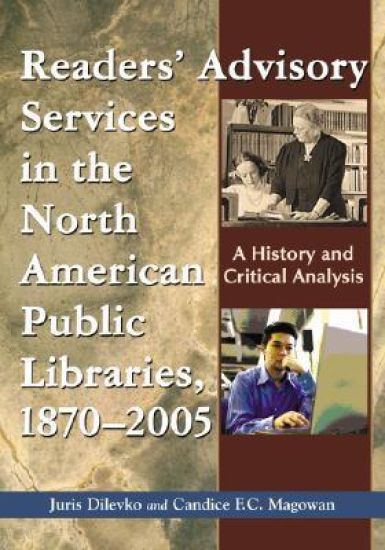
Readers' Advisory Service in North American Public Libraries, 1870-2005

Readers' Advisory Service in North American Public Libraries, 1870-2005

Juris Dilevko; Candice F.C. Magowan

McFarland Co Inc
2007
pokkari
"This book provides a history of readers' advisory philosophy and offers a perspective on the evolution of the service. The book analyzes the debate that shaped readers' advisory and discusses how the service has assumed its present form; and follows readers' advisory through its development, when the service was still a subject of debate about its meaning"--Provided by publisher.
Reading and the Reference Librarian

Reading and the Reference Librarian

Juris Dilevko; Lisa Gottlieb

McFarland Co Inc
2003
pokkari
Reference librarians are no longer expected to know much about the information they find; they are merely expected to find it. Technological competency rather than knowledge has become the order of the day. In many respects, reference service has become a matter of typing search terms into a library's online catalog or a web search engine and providing the patron with the results of the search. Calling for a re-intellectualization of reference librarianship, this book suggests another approach to providing quality reference service--reading. The authors surveyed both academic reference librarians and public library reference personnel in the United States and Canada about their reading habits. From the 950 responses, the authors present findings about the extent to which librarians read newspapers, periodicals, fiction and nonfiction, and recount and analyze stories about how reading has made them better librarians. The authors also report that North American professors in the humanities and social sciences believe that the best reference librarians are those who have wide-ranging, subject-based knowledge as opposed to the type of process-based, functional knowledge that is increasingly dominating the curricula of many Library and Information Science programs.
Unobtrusive Evaluation of Reference Service and Individual Responsibility
Many reference librarians have been highly critical about unobtrusive evaluation studies. But can their opposition be justified? Or is it just a way to detract attention from serious shortcomings in reference service? How can government documents reference service, and reference service in general, be improved? Do librarians have enough general and subject-specific knowledge to provide informed and intelligent answers to reference questions? Would any business or non-profit organization be satisfied with the traditional 55 percent efficacy rate in reference service revealed by unobtrusive evaluation studies?Long a controversial topic in the specialized world of reference librarianship, unobtrusive evaluation is nevertheless a useful tool in gauging the degree to which reference librarians are effectively performing their jobs. Based on a nationwide study of government documents reference service in Canada, this book examines the broad philosophical implications of negative attitudes to unobtrusive evaluation studies within libraries. It also discusses what really happens when librarians make referrals to external sources. Drawing on the insights of such library educators as Margaret Hutchins, S. R. Ranganathan, and James Wyer, it also suggests overlooked ways that may help reference librarians deliver better reference service. Finally, it argues that such proposals as certification and recertification of reference librarians need to be seriously considered if librarians do not willingly take personal responsibility for improving their own knowledge levels.
Unobtrusive Evaluation of Reference Service and Individual Responsibility
Many reference librarians have been highly critical about unobtrusive evaluation studies. But can their opposition be justified? Or is it just a way to detract attention from serious shortcomings in reference service? How can government documents reference service, and reference service in general, be improved? Do librarians have enough general and subject-specific knowledge to provide informed and intelligent answers to reference questions? Would any business or non-profit organization be satisfied with the traditional 55 percent efficacy rate in reference service revealed by unobtrusive evaluation studies?Long a controversial topic in the specialized world of reference librarianship, unobtrusive evaluation is nevertheless a useful tool in gauging the degree to which reference librarians are effectively performing their jobs. Based on a nationwide study of government documents reference service in Canada, this book examines the broad philosophical implications of negative attitudes to unobtrusive evaluation studies within libraries. It also discusses what really happens when librarians make referrals to external sources. Drawing on the insights of such library educators as Margaret Hutchins, S. R. Ranganathan, and James Wyer, it also suggests overlooked ways that may help reference librarians deliver better reference service. Finally, it argues that such proposals as certification and recertification of reference librarians need to be seriously considered if librarians do not willingly take personal responsibility for improving their own knowledge levels.