Kirjojen hintavertailu. Mukana 12 595 353 kirjaa ja 12 kauppaa.

Kirjailija

Justin Clemens

Kirjat ja teokset yhdessä paikassa: 9 kirjaa, julkaisuja vuosilta 2003-2023, suosituimpien joukossa Alain Badiou. Vertaile teosten hintoja ja tarkista saatavuus suomalaisista kirjakaupoista.

9 kirjaa

Kirjojen julkaisuhaarukka 2003-2023.

Barron Field in New South Wales

Barron Field in New South Wales

Thomas H Ford; Justin Clemens

MELBOURNE UNIVERSITY PRESS
2023
nidottu
On 24 February 1817, Barron Field sailed into Sydney Harbour on the convict transport Lord Melville to a ceremonial thirteen-gun salute. He was there as the new Judge of the Supreme Court of Civil Judicature in New South Wales — the highest legal authority in the turbulent colony. Energetic and gregarious, Field immediately set about impressing his vision of a future Australia as a liberal and prosperous nation. He courted the colony's leading figures, engaged in scientific research and even founded Australia's first bank. He also wrote poetry: in 1819, he published First Fruits of Australian Poetry, the first book of poems ever printed in the country. In England, Field had been the theatre critic for The Times, and a friend of such major Romantic writers as William Wordsworth, Charles Lamb and Leigh Hunt. In New South Wales, he saw the chance to become a major figure himself, someone who could shape culture and society in enduring ways. Founding Australian poetry was part of that ambition; so too was law. Asked to determine whether Governor Macquarie had authority to impose taxes in the colony, Field issued a fateful judgement that established, for the first time, what is now called terra nullius. This book is an extraordinary reconstruction of the circumstances and implications of Field's actions in New South Wales using an original and revealing method: the close reading of his poetry.
Lacan Deleuze Badiou

Lacan Deleuze Badiou

A. J. Bartlett; Justin Clemens; Roffe Jon

Discovery Press
2015
nidottu
Presents a critical intervention into the key conceptual dissensions between contemporary Continental philosophy's three most influential thinkers. The writings of Lacan, Deleuze and Badiou stand at the heart of contemporary thought. While the collective corpus of these three figures contains a significant number of references to each other's work, these are often simply critical, obscure, or both. Lacan Deleuze Badiou guides academics working philosophy, psychoanalysis and critical theory through the sensitive moments in their respective work and identifies the passages, connections and disjunctions that underlie the often superficial statements of critique, indifference or accord. The first book to examine Lacan, Deleuze and Badiou together; reconstructs a fundamental conceptual history of Badiou, Deleuze and Lacan's influences and intellectual context; it identifies and examines the key themes in contemporary European thought: the event, time and truth and shows how Deleuze and Badiou have followed and contravened the Lacanian intervention without reverting to pre Lacanian positions.
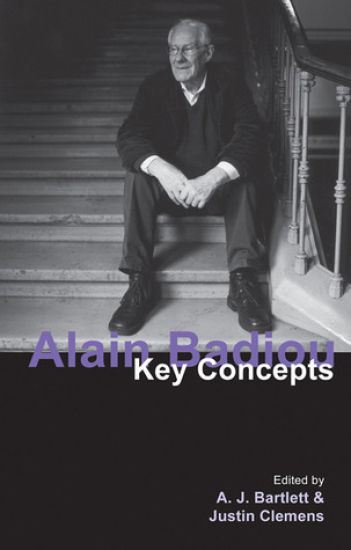
Alain Badiou

Alain Badiou

A. J. Bartlett; Justin Clemens

Acumen Publishing Ltd
2014
nidottu
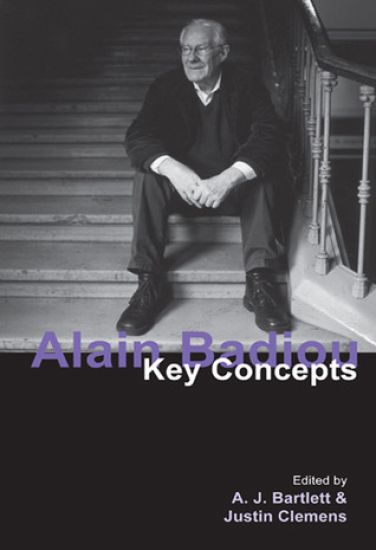
Alain Badiou is one of the world's most influential living philosophers. Few contemporary thinkers display his breadth of argument and reference, or his ability to intervene in debates critical to both analytic and continental philosophy. Alain Badiou: Key Concepts presents an overview of and introduction to the full range of Badiou's thinking. Essays focus on the foundations of Badiou's thought, his "key concepts" - truth, being, ontology, the subject, and conditions - and on his engagement with a range of thinkers central to his philosophy, including Plato, Descartes, Spinoza, Heidegger and Deleuze.
Lacan Deleuze Badiou

Lacan Deleuze Badiou

A. J. Bartlett; Justin Clemens; Roffe Jon

Edinburgh University Press
2014
sidottu
This is a critical intervention into the key conceptual dissensions between contemporary Continental philosophy's three most influential thinkers. The writings of Lacan, Deleuze and Badiou stand at the heart of contemporary thought. While the collective corpus of these three figures contains a significant number of references to each other's work, these are often simply critical, obscure, or both. Lacan Deleuze Badiou guides academics working in philosophy, psychoanalysis and critical theory through the sensitive moments in their respective work and identifies the passages, connections and disjunctions that underlie the often superficial statements of critique, indifference or accord. This is the first book to examine Lacan, Deleuze and Badiou together. It reconstructs a fundamental conceptual history of Badiou, Deleuze and Lacan's influences and intellectual context. It identifies and examines the key themes in contemporary European thought: the event, time and truth. It shows how Deleuze and Badiou have followed and contravened the Lacanian intervention without reverting to pre-Lacanian positions.
Psychoanalysis is an Antiphilosophy

Psychoanalysis is an Antiphilosophy

Justin Clemens

Edinburgh University Press
2013
nidottu
Psychoanalysis was the most important intellectual development of the twentieth century, which left no practice from psychiatry to philosophy to politics untouched. Yet it was also in many ways an untouchable project, caught between science and poetry, medicine and hermeneutics. This unsettled, unsettling status has recently induced the philosopher Alain Badiou to characterise psychoanalysis as an 'antiphilosophy', that is, as a practice that issues the strongest possible challenges to thought. Justin Clemens takes up the challenge of this denomination here, by re-examining a series of crucial psychoanalytic themes: addiction, fanaticism, love, slavery and torture. Drawing from the work of Freud, Lacan, Badiou, Agamben and others, 'Psychoanalysis is an Antiphilosophy' offers a radical reconstruction of the operations and import of key psychoanalytic concepts and a renewed sense of the indispensable powers of psychoanalysis for today.
Psychoanalysis is an Antiphilosophy

Psychoanalysis is an Antiphilosophy

Justin Clemens

Edinburgh University Press
2013
sidottu
This is a radical reconstruction of how psychoanalysis operates and a renewed sense of its indispensable power. Psychoanalysis was the most important intellectual development of the 20th century. From psychiatry to politics, it left no field untouched. Yet it is itself an untouchable discipline: not really science, not really criticism. Alain Badiou described psychoanalysis as an 'antiphilosophy': a practice that offers the strongest possible challenges to thought. Now, Justin Clemens examines psychoanalysis under this rubric. He shows how this impacts on the key concepts that continue to be misrepresented by disciplines hostile to psychoanalysis; above all, regarding the relationships of humans to drugs, animality and sexuality. It analyses psychoanalysis in a new way, under the rubric of 'antiphilosophy'. It identifies and clarifies a set of previously undeveloped psychoanalytic concepts: torture, slavery and swarming. It applies these concepts to a range of key topics raised in the work of theorists including Freud, Lacan, Zizek and Agamben.
Alain Badiou

Alain Badiou

A. J. Bartlett; Justin Clemens

Acumen Publishing Ltd
2010
sidottu
Alain Badiou is one of the world's most influential living philosophers. Few contemporary thinkers display his breadth of argument and reference, or his ability to intervene in debates critical to both analytic and continental philosophy. Alain Badiou: Key Concepts presents an overview of and introduction to the full range of Badiou's thinking. Essays focus on the foundations of Badiou's thought, his "key concepts" - truth, being, ontology, the subject, and conditions - and on his engagement with a range of thinkers central to his philosophy, including Plato, Descartes, Spinoza, Heidegger and Deleuze.
The Romanticism of Contemporary Theory

The Romanticism of Contemporary Theory

Justin Clemens

Ashgate Publishing Limited
2003
sidottu
Using Phillipe Lacoue-Labarthe and Jean-Luc Nancy's groundbreaking study of the persistence of German Idealist philosophy as his starting point, Justin Clemens presents a valuable study of the links between Romanticism and contemporary theory. The central contention of this book is that contemporary theory is still essentially Romantic - despite all its declarations to the contrary, and despite all its attempts to elude or exceed the limits bequeathed it by Romantic thought. The argument focuses on the ruses of 'Romanticism's indefinable character' under two main rubrics, 'Contexts' and 'Interventions'. The first three chapters investigate 'Contexts', examining some of the broad trends in the historical and institutional development of Romantic criticism; the second section, 'Interventions', comprises close readings of the work of Jacques Lacan, Gilles Deleuze and Félix Guattari, Eve Kosofsky Sedgwick, Ian Hunter and Alain Badiou. In the first chapter Clemens identifies and traces the development of two interlocking recurrent themes in Romantic criticism: the Romantic desire to escape Romanticism, and the problem posed to aesthetico-philosophical thought by the modern domiciliation of philosophy in the university. He develops these themes in the second chapter by examining the link forged between aesthetics and the subject in the work of Immanuel Kant. In the third chapter, Clemens shows how the Romantic problems of the academic institution and aesthetics were effectively bound together by the philosophical diagnosis of nihilism. Chapter Four focuses on two key moments in the work of Jacques Lacan - his theory of the 'mirror stage' and his 'formulas of sexuation' - and demonstrates how Lacan returns to the grounding claims of Kantian aesthetics in such a way as to render him complicit with the Romantic thought he often seems to contest. In the following chapter, taking Deleuze and Guattari's notion of 'multiplicity' as a guiding thread, Clemens links their account to their professed 'anti-Platonism', showing how they find themselves forced back onto emblematically Romantic arguments. Chapter Six provides a close reading of Sedgwick's most influential text, Epistemology of the Closet. Clemens' reading localizes her practice both in the newly consolidated academic field of 'Queer Theory' and in a conceptual genealogy whose roots can be traced back to a particular anti-Enlightenment strain of Romanticism. Clemens next turns to the professedly anti-Romantic arguments of Ian Hunter, a major figure in the ongoing re-writing of modern histories of education. In the final chapter he examines the work of the contemporary French philosopher Alain Badiou. Clemens argues that, if Badiou's hostility to the diagnosis of nihilism, his return to Plato and mathematics, and his expulsion of poetry from philosophical method, all place him at a genuine distance from dominant Romantic trends, even this attempt admits ciphered Romantic elements. This study will be of interest to literary theorists, philosophers, political theorists, and cultural studies scholars.