Kirjojen hintavertailu. Mukana 12 595 353 kirjaa ja 12 kauppaa.

Kirjailija

K. Anders Ericsson

Kirjat ja teokset yhdessä paikassa: 5 kirjaa, julkaisuja vuosilta 1993-2019, suosituimpien joukossa Numero Uno / Peak: Secrets from the New Science of Expertise: Secretos Para Ser Mejor En Lo Que Nos Propongamos. Vertaile teosten hintoja ja tarkista saatavuus suomalaisista kirjakaupoista.

5 kirjaa

Kirjojen julkaisuhaarukka 1993-2019.

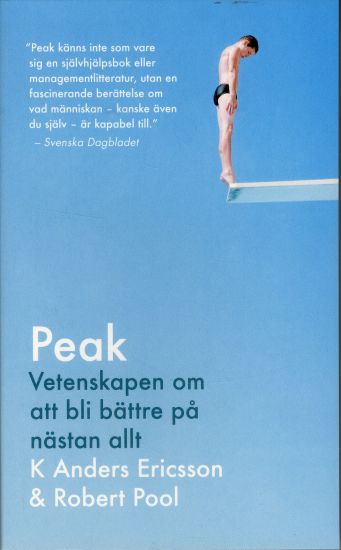
Peak : vetenskapen om att bli bättre på nästan allt : sanningen bakom 10 000-timmarsregeln
Ingen är begränsad till talang. Vi skapar själva gränsen för våra förmågor.Vart vi än vänder oss från idrott och musik till naturvetenskap och näringsliv finns människor som uppvisar extraordinära förmågor. Människor som vi gärna kallar särskilt begåvade eller talangfulla .Men Mozart föddes inte med absolut gehör och Zlatan har inte kunnat luta sig enbart mot talang. Det handlar i stället om träning och övning och framför allt rätt sorts övning vilket K Anders Ericsson visat i sin banbrytande forskning.De principer för att utvecklas som beskrivs i Peak gäller för oss alla: oavsett vad vi vill bli bättre på eller om vi vill hjälpa andra att nå längre.*K Anders Ericsson är professor i psykologi. Det är hans forskning om exceptionella prestationer som ligger till grund för den omtalade 10 000-timmarsregeln .br> Peak känns inte som vare sig en självhjälpsbok eller managementlitteratur, utan en fascinerande berättelse om vad människan - kanske även du själv - är kapabel till. - Svenska Dagbladet
Numero Uno / Peak: Secrets from the New Science of Expertise: Secretos Para Ser Mejor En Lo Que Nos Propongamos
El mayor experto mundial en rendimiento y desarrollo de habilidades, Anders Ericsson, nos ense a los secretos para conseguir ser el mejor en lo que nos propongamos. «Este libro es el gu a que nos mostrar el camino hasta la cumbre. Lo lejos que queramos llegar es una decisi n personal. Anders Ericsson Por qu hay algunas personas que son incre blemente buenas en lo que hacen? En el deporte, la m sica, la ciencia o los negocios siempre ha habido figuras excepcionales. «Tiene un aut ntico don , decimos asombrados. Pero existe realmente el talento innato? Anders Ericsson ha descubierto ese don en atletas, m sicos, m dicos o ajedrecistas entre otros, pero tambi n asegura que en realidad todos nacemos con alg n don y que tenemos la capacidad de crear habilidades, mediante el entrenamiento y la pr ctica, gracias a la incre ble adaptabilidad del cerebro y del cuerpo humanos. Tambi n nos asegura que los principios de la pr ctica deliberada que aplican los «n meros uno de las m s variadas disciplinas ofrecen tambi n excelentes resultados a todas aquellas personas o empresas que desean mejorar. Queremos mejorar en tenis? Nuestra escritura? Las dotes de vendedor? Necesitamos pr ctica deliberada, y he aqu una buena forma de concebirla: Imaginemos que queremos subir una monta a. Podemos simplemente tomar un camino que parezca prometedor, aunque probablemente no lleguemos muy lejos, o confiar en un gu a que conoce el mejor camino y alcanzar la cima de forma mucho m s eficiente y efectiva. Esta forma mejor es la pr ctica deliberada y este libro es el gu a que nos mostrar el camino hasta la cumbre. Luego, cada uno decide hasta d nde quiere llegar. El talento innato es un mito y todos podemos ser n meros uno gracias a nuestro potencial y a la pr ctica deliberada, un principio revolucionario para mejorar lashabilidades y alcanzar la excelencia. Rese as: «Quien siga al pie de la letra las lecciones de este libro, podr cambiar el mundo. - Joshua Foer, autor de Los desaf os de la memoria «La ciencia de la excelencia se divide en dos eras: el antes y el despu s de Ericsson. - Dan Coyle, autor de Las claves del talento «Un excelente destilado del valioso trabajo de toda una vida. - Stephen J. Dubner, coautor de Freakonomics y SuperFreakonomics ENGLISH DESCRIPTION For the first time in decades of groundbreaking research, the inventor of the 10,000-hour rule explains his techniques for developing mastery of any skill We live in a world full of people with extraordinary abilities. Consider what Roger Federer can do with a tennis ball, or Connor McDavid with a puck. There are chess grandmasters who can play several dozen different games simultaneously--while blindfolded--and a seemingly unending supply of young musical prodigies who would have astonished aficionados a century ago. We are dramatically better at just about everything than we were just a generation ago. We assume, though, that these peak performers are the lucky ones, the ones with a gift. That's only partly true. The fact is we are all lucky. We all have that gift. As Ericsson's whole career has shown, with the proper practice, we are all capable of extraordinary feats. On the surface, the techniques that chess players use to develop their skills seem quite different from the methods soccer players use to perfect their games, which in turn seem quite different from how pianists improve their playing. But at a deeper level, they are all variations on a single fundamental approach to learning, what Ericsson, a world-renowned researcher, has named "deliberate practice" a simple, yet powerful system for enhancing learning. This approach to expertise has the potential to revolutionize how we think about every sort of education and training. We are not limited by an endowment of natural talent. We create our own limits. Whether you want to step up your game at work or on the weekend, or help your kid achieve athletic or academic goals, Ericsson's revolutionary methods will show you how to master almost anything.From the world's reigning expert on expertise comes a powerful new approach to mastering almost any skill.Have you ever wanted to learn a language or pick up an instrument, only to become too daunted by the task at hand? Expert performance guru Anders Ericsson has made a career studying chess champions, violin virtuosos, star athletes, and memory mavens. Peak condenses three decades of original research to introduce an incredibly powerful approach to learning that is fundamentally different from the way people traditionally think about acquiring a skill. Ericsson's findings have been lauded and debated, but never properly explained. So the idea of expertise still intimidates us -- we believe we need innate talent to excel, or think excelling seems prohibitively difficult. Peak belies both of these notions, proving that almost all of us have the seeds of excellence within us -- it's just a question of nurturing them by reducing expertise to a discrete series of attainable practices. Peak offers invaluable, often counterintuitive, advice on setting goals, getting feedback, identifying patterns, and motivating yourself. Whether you want to stand out at work, or help your kid achieve academic goals, Ericsson's revolutionary methods will show you how to master nearly anything.
Peak: Secrets from the New Science of Expertise

Peak: Secrets from the New Science of Expertise

K. Anders Ericsson

HOUGHTON MIFFLIN
2016
nidottu
For the first time in decades of groundbreaking research, the inventor of the 10,000-hour rule explains his techniques for developing mastery of any skill We live in a world full of people with extraordinary abilities. Consider what Roger Federer can do with a tennis ball, or Connor McDavid with a puck. There are chess grandmasters who can play several dozen different games simultaneously--while blindfolded--and a seemingly unending supply of young musical prodigies who would have astonished aficionados a century ago. We are dramatically better at just about everything than we were just a generation ago. We assume, though, that these peak performers are the lucky ones, the ones with a gift. That's only partly true. The fact is we are all lucky. We all have that gift. As Ericsson's whole career has shown, with the proper practice, we are "all" capable of extraordinary feats. On the surface, the techniques that chess players use to develop their skills seem quite different from the methods soccer players use to perfect their games, which in turn seem quite different from how pianists improve their playing. But at a deeper level, they are all variations on a single fundamental approach to learning, what Ericsson, a world-renowned researcher, has named "deliberate practice": a simple, yet powerful system for enhancing learning. This approach to expertise has the potential to revolutionize how we think about every sort of education and training. We are not limited by an endowment of natural talent. We create our own limits. Whether you want to step up your game at work or on the weekend, or help your kid achieve athletic or academic goals, Ericsson's revolutionary methods will show you how to master almost anything."
Expert Performance in Sports

Expert Performance in Sports

Janet Starkes; K. Anders Ericsson

Human Kinetics
2003
sidottu
Expert Performance in Sports: Advances in Research on Sport Expertise presents an overview of the critical issues facing researchers who study how athletes reach—and stay at—the pinnacle of their sports. The text will allow you to update your knowledge of sport expertise with the most current research and practical applications for the development of sport expertise in athletes, referees, and judges.This comprehensive reference reflects both theoretical underpinnings and future directions in the understanding of sport expertise research and is the first book to look specifically at how elite athletes are developed. Editors Janet L. Starkes and K. Anders Ericsson identify the questions typically asked in the study of sport expertise; they provide a stimulating, scientific debate that addresses the question of whether a general theory of expert performance is achievable; and they conclude with a glimpse of future directions for research on sport expertise. This new reference answers controversial questions that arise with regard to the training of high-level performers:-How can you potentially speed up the acquisition process?-How easy or difficult is it for experts to retain high performance levels as they age?-How can coaches structure practices to maximize active time and preparation for the next competition?-What is the role of coaches and mentors who work with elite performers?-What aspects of performance best reflect expert behaviors in a particular sport—anticipation, perceptual accuracy, decision speed, attention focus, response selection, response consistency, strategy, or others?With Expert Performance in Sports, you not only can read about sport expertise research but also find out how athletes and coaches benefit the most. "Experts' Comments" at the end of each chapter present the opinions of two world-class experts, Therese Brisson and Nick Cipriano. These experts' opinions bridge the gap between the research presented and its practical applications. Dr. Therese Brisson's academic training is in motor behavior; she also is an Olympic gold medalist, silver medalist, and six-time world champion in ice hockey. Professor Nick Cipriano is both an academic and an international-level wrestling coach. He is a former international-level wrestler and world-renowned coach in freestyle and Greco-Roman wrestling, and he has coached both male and female athletes from the high school level to the Olympic team.This is a must-have reference that will challenge researchers to identify both their theoretical underpinnings and future directions in their study of how the best excel at sports.
Protocol Analysis

Protocol Analysis

K. Anders Ericsson; Herbert A. Simon

Bradford Books
1993
pokkari
Since the publication of Ericsson and Simon's ground-breaking work in the early 1980s, verbal data has been used increasingly to study cognitive processes in many areas of psychology, and concurrent and retrospective verbal reports are now generally accepted as important sources of data on subjects' cognitive processes in specific tasks. In this revised edition of the book that first put protocol analysis on firm theoretical ground, the authors review major advances in verbal reports over the past decade, including new evidence on how giving verbal reports affects subjects' cognitive processes, and on the validity and completeness of such reports.In a substantial new preface Ericsson and Simon summarize the central issues covered in the book and provide an updated version of their information-processing model, which explains verbalization and verbal reports. They describe new studies on the effects of verbalization, interpreting the results of these studies and showing how their theory can be extended to account for them. Next, they address the issue of completeness of verbally reported information, reviewing the new evidence in three particularly active task domains. They conclude by citing recent contributions to the techniques for encoding protocols, raising general issues, and proposing directions for future research.All references and indexes have been updated.