Kirjojen hintavertailu. Mukana 12 595 353 kirjaa ja 12 kauppaa.

Kirjailija

K. D. Ewing

Kirjat ja teokset yhdessä paikassa: 7 kirjaa, julkaisuja vuosilta 1991-2026, suosituimpien joukossa Labour Law, the Cold War, and the Right to Strike. Vertaile teosten hintoja ja tarkista saatavuus suomalaisista kirjakaupoista.

Mukana myös kirjoitusasut: K D Ewing

7 kirjaa

Kirjojen julkaisuhaarukka 1991-2026.

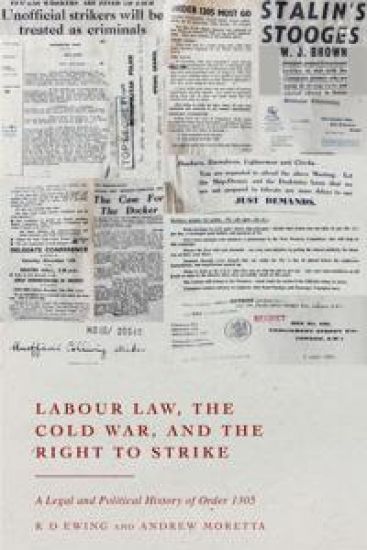
Labour Law, the Cold War, and the Right to Strike

Labour Law, the Cold War, and the Right to Strike

K D Ewing; Andrew Moretta

BLOOMSBURY PUBLISHING PLC
2026
sidottu
This book examines the origins, deployment, and legacy of Order 1305, a measure introduced in 1940 to make it a criminal offence to take part in a strike. Surprisingly, the prohibition on the right to strike was retained by the Attlee administration after the Second World War, and was transformed to become a weapon of government during the Cold War to deal with what were wrongly claimed by ministers to be Communist-inspired strikes engineered for subversive purposes. In a deep analysis of Order 1305, the authors provide a reassessment of the role of the State in industrial relations. Challenging much contemporary learning in labour law, the book is informed by a very detailed engagement with Cabinet and ministerial papers, which highlight the contradictions on the part of government in simultaneously promoting and containing trade union power. These sources also highlight the extent to which trade unions both relied on and were co-opted by the State. The main focus of the book, however, is the role of Order 1305 in the control of trade union activists. Allegations of Communist-inspired strikes and the role of the criminal law provided an important function in post-war industrial relations for MI5 and Special Branch. Material unearthed at the National Archives demonstrates unequivocally not only that trade unions were deeply penetrated, but also that trade union activists were the subject of extensive surveillance, as the authors fully reveal.
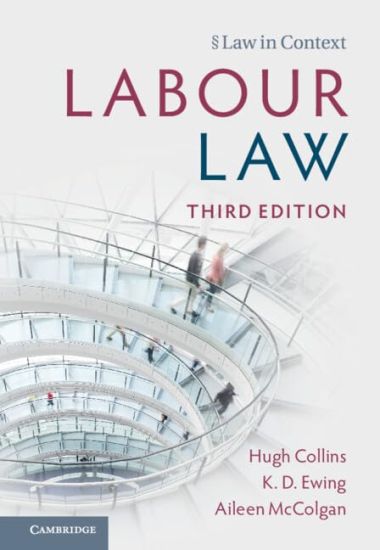
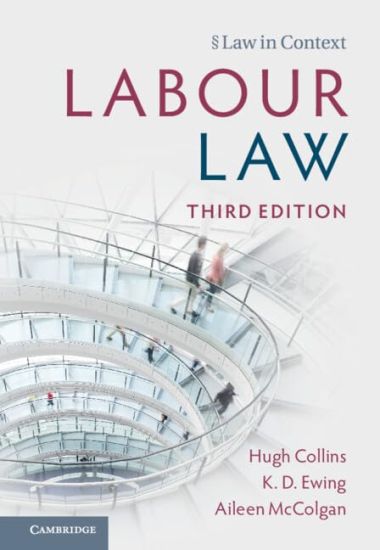
Labour Law

Labour Law

Hugh Collins; K. D. Ewing; Aileen McColgan

Cambridge University Press
2025
pokkari
Labour Law, now in its third edition, is a well established text which offers a comprehensive and critical account of the subject by a team of prominent labour lawyers. It examines both collective labour relations and individual employment rights, including equality law, and does so while having full regard to the international labour standards as well as the implications of Brexit. Case studies and reports from government and other public agencies illuminate the text to show how the law works in practice, ensuring that students acquire not only a sophisticated knowledge of the law but also an appreciation of its purpose and the complexity of the issues which it addresses.
Labour Law

Labour Law

Hugh Collins; K. D. Ewing; Aileen McColgan

Cambridge University Press
2025
sidottu
Labour Law, now in its third edition, is a well established text which offers a comprehensive and critical account of the subject by a team of prominent labour lawyers. It examines both collective labour relations and individual employment rights, including equality law, and does so while having full regard to the international labour standards as well as the implications of Brexit. Case studies and reports from government and other public agencies illuminate the text to show how the law works in practice, ensuring that students acquire not only a sophisticated knowledge of the law but also an appreciation of its purpose and the complexity of the issues which it addresses.
The Right to Strike in International Law

The Right to Strike in International Law

Jeffrey Vogt; Janice Bellace; Lance Compa; K. D. Ewing; John Hendy; Klaus Lorcher; Tonia Novitz

BLOOMSBURY PUBLISHING PLC
2021
nidottu
This monograph was originally developed as a direct response to the claim made by members of the ‘Employers Group’ at the 2012 International Labour Conference, namely that the right to strike is not protected in international law, and in particular by ILO Convention 87 on the right to freedom of association.The group’s apparent aim was to sow sufficient doubt as to the existence of an internationally protected right so that governments might seek to limit or prohibit the right to strike at the national level while still claiming compliance with their international obligations. In consequence, some governments have seized on the employers’ arguments to justify new limitations on that right.The Right to Strike in International Law not merely refutes this claim but is the only complete and exhaustive analysis on this subject. Based on deep legal research, it finds that there is simply no credible basis for the claim that the right to strike does not enjoy the protection of international law; indeed, the authors demonstrate that it has attained the status of customary international law.
The Right to Strike in International Law

The Right to Strike in International Law

Jeffrey Vogt; Janice Bellace; Lance Compa; K D Ewing; John Hendy QC; Klaus Lörcher; Tonia Novitz

Hart Publishing
2020
sidottu
This monograph was originally developed as a direct response to the claim made by members of the ‘Employers Group’ at the 2012 International Labour Conference, namely that the right to strike is not protected in international law, and in particular by ILO Convention 87 on the right to freedom of association.The group’s apparent aim was to sow sufficient doubt as to the existence of an internationally protected right so that governments might seek to limit or prohibit the right to strike at the national level while still claiming compliance with their international obligations. In consequence, some governments have seized on the employers’ arguments to justify new limitations on that right.The Right to Strike in International Law not merely refutes this claim but is the only complete and exhaustive analysis on this subject. Based on deep legal research, it finds that there is simply no credible basis for the claim that the right to strike does not enjoy the protection of international law; indeed, the authors demonstrate that it has attained the status of customary international law.
The Cost of Democracy

The Cost of Democracy

K D Ewing

Hart Publishing
2007
sidottu
Party funding has given rise to great controversy since 1997, and continues to do so. In recent years, row has followed row - from million-pound donations, to the so-called 'loans for peerages' affair. The question was the subject of an official investigation by Sir Hayden Phillips, whose blueprint for reform was produced in March 2007. This book charts the evolution of the party funding problem in recent years and explores the weaknesses of the Political Parties, Elections and Referendums Act 2000, which was enacted in a vain attempt to clean up British politics. The book sets out a number of core principles which should inform the development of public policy in this field, and examines the different strategies for the implementation of these principles. Having regard to the experience of othercountries, including Canada, Germany and Sweden, a radical framework ofreform is proposed, designed to address the emerging crisis of party government with serious implications for democracy itself. The main concern is with the development of bold reform initiatives to encourage political parties to recruit and retain members, and give members rights in relation to the government and administration of these parties. This thoughtful yet hard-hitting account by one of the leading scholars in the field will be of interest to constitutional lawyers and political scientists, as well as journalists and those with an interest in the way we are governed.
The Right to Strike

The Right to Strike

K. D. Ewing

Clarendon Press
1991
sidottu
The right to strike in Britain is one of the most important, albeit neglected, issues of modern labour law. It is also one of the most controversial, particularly since the dismissal of 5,500 workers at Wapping, which led not only to calls for law reform (and with it a greater degree of positive state intervention in industrial relations) but also to condemnation of the British government by the ILO. The Right to Strike concentrates on the hitherto neglected issue of the liability of union members and their families. It examines the effect of strikes and other industrial action on the contract of employment, the question of the payment of wages to those engaged in industrial action, and the social security implications of unemployment caused by trade disputes. The study also examines the position of striking workers under international law (focusing on the ILO and European Social Charter) and concludes by offering proposals for law reform.