Kirjojen hintavertailu. Mukana 12 652 820 kirjaa ja 12 kauppaa.
Kirjailija
K. Sridhar
Kirjat ja teokset yhdessä paikassa: 6 kirjaa, julkaisuja vuosilta 2005-2025, suosituimpien joukossa Supplier Selection in Cement Manufacturing Industry by MCDM Approach. Vertaile teosten hintoja ja tarkista saatavuus suomalaisista kirjakaupoista.
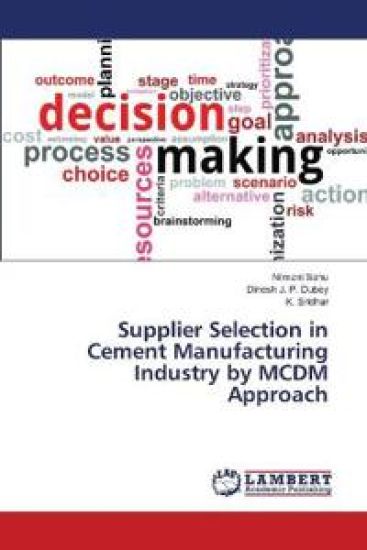
The aim of the book is to identify the major fundamental selection criteria for selecting of cement supplier in construction industry. The Supplier selection model (SSM) is used for solving the problem of supplier selection & selecting the best supplier considering the various parameters and criteria within an appropriate time, appropriate quality, price, quantity etc in an organization. This model seems to be capable for decision making when multiple options & criteria's are available. The SSM model can be seen as a framework that can be used for decision making in various sector. As the model offers rapid and accurate assessment technique for successful decision making.
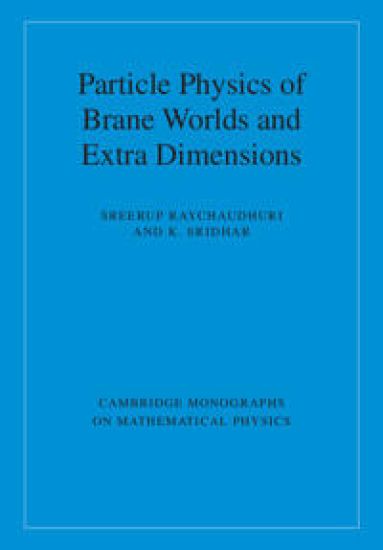
The possibility that we live in a higher-dimensional world with spatial dimensions greater than three started with the early work of Kaluza and Klein. However, in addressing experimental constraints, early model-builders were forced to compactify these extra dimensions to very tiny scales. With the development of brane-world scenarios it became possible to consider novel compactifications which allow the extra dimensions to be large or to provide observable effects of these dimensions at experimentally accessible energy scales. This book provides a comprehensive account of these recent developments, keeping the high-energy physics implications in focus. After an historical survey of the idea of extra dimensions, the book deals in detail with models of large extra dimensions, warped extra dimensions and other models such as universal extra dimensions. The theoretical and phenomenological implications are discussed in a pedagogical manner for both researchers and graduate students.
This book offers cross-national evidence of the effectiveness of financial and physical incentives for regional development. It challenges the traditional wisdom that competition is harmful for regional development or can be zero-sum. It answers questions such as: What are the effects of tax incentives on the rest of the economy? Do such incentives merely redistribute employment? Do tax and infrastructure incentives have any effect on the unemployment rate of areas adopting them?
This book offers cross-national evidence of the effectiveness of financial and physical incentives for regional development. It challenges the traditional wisdom that competition is harmful for regional development or can be zero-sum. It answers questions such as: What are the effects of tax incentives on the rest of the economy? Do such incentives merely redistribute employment? Do tax and infrastructure incentives have any effect on the unemployment rate of areas adopting them?