Kirjojen hintavertailu. Mukana 12 209 446 kirjaa ja 12 kauppaa.

Kirjailija

Karen Kruse Thomas

Kirjat ja teokset yhdessä paikassa: 3 kirjaa, julkaisuja vuosilta 2011-2016, suosituimpien joukossa Health and Humanity. Vertaile teosten hintoja ja tarkista saatavuus suomalaisista kirjakaupoista.

3 kirjaa

Kirjojen julkaisuhaarukka 2011-2016.

Health and Humanity

Health and Humanity

Karen Kruse Thomas

Johns Hopkins University Press
2016
sidottu
Between 1935 and 1985, the nascent public health profession developed scientific evidence and practical know-how to prevent death on an unprecedented scale. Thanks to public health workers, life expectancy rose rapidly as generations grew up free from the scourges of smallpox, typhoid, and syphilis. In Health and Humanity, Karen Kruse Thomas offers a thorough account of the growth of academic public health in the United States through the prism of the oldest and largest independent school of public health in the world. Thomas follows the transformation of the Johns Hopkins School of Hygiene and Public Health (JHSPH), now known as the Bloomberg School of Public Health, from a small, private institute devoted to doctoral training and tropical disease research into a leading global educator and innovator in fields from biostatistics to mental health to pathobiology. A provocative, wide-ranging account of how midcentury public health leveraged federal grants and anti-Communist fears to build the powerful institutional networks behind the health programs of the CDC, WHO, and USAID, the book traces how Johns Hopkins helped public health take center stage during the scientific research boom triggered by World War II. It also examines the influence of politics on JHSPH, the school's transition to federal grant funding, the globalization of public health in response to hot and cold war influences, and the expansion of the school's teaching program to encompass social science as well as lab science. Revealing how faculty members urged foreign policy makers to include saving lives in their strategy of "winning hearts and minds," Thomas argues that the growth of chronic disease and the loss of Rockefeller funds moved the JHSPH toward international research funded by the federal government, creating a situation in which it was sometimes easier for the school to improve the health of populations in India and Turkey than on its own doorstep in East Baltimore. Health and Humanity is a comprehensive account of the ways that JHSPH has influenced the practice, pedagogy, and especially our very understanding of public health on both global and local scales.
Deluxe Jim Crow

Deluxe Jim Crow

Karen Kruse Thomas

University of Georgia Press
2011
sidottu
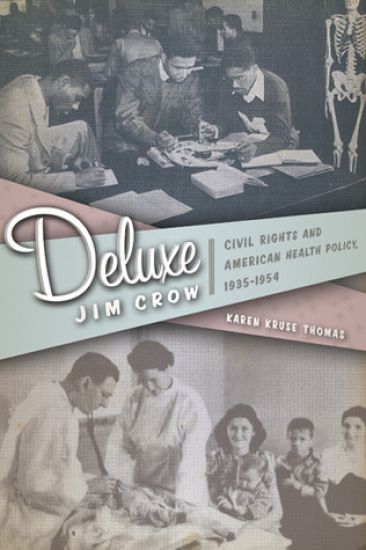
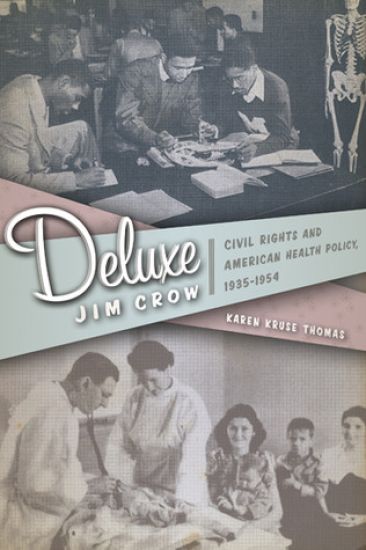
Plagued by geographic isolation, poverty, and acute shortages of health professionals and hospital beds, the South was dubbed by Surgeon General Thomas Parran “the nation’s number one health problem.” The improvement of southern, rural, and black health would become a top priority of the U.S. Public Health Service during the Roosevelt and Truman administrations.Karen Kruse Thomas details how NAACP lawsuits pushed southern states to equalize public services and facilities for blacks just as wartime shortages of health personnel and high rates of draft rejections generated broad support for health reform. Southern Democrats leveraged their power in Congress and used the war effort to call for federal aid to uplift the South. The language of regional uplift, Thomas contends, allowed southern liberals to aid blacks while remaining silent on race. Reformers embraced, at least initially, the notion of “deluxe Jim Crow”—support for health care that maintained segregation. Thomas argues that this strategy was, in certain respects, a success, building much-needed hospitals and training more black doctors.By the 1950s, deluxe Jim Crow policy had helped to weaken the legal basis for segregation. Thomas traces this transformation at the national level and in North Carolina, where “deluxe Jim Crow reached its fullest potential.” This dual focus allows her to examine the shifting alliances—between blacks and liberal whites, southerners and northerners, activists and doctors—that drove policy. Deluxe Jim Crow provides insight into a variety of historical debates, including the racial dimensions of state building, the nature of white southern liberalism, and the role of black professionals during the long civil rights movement.
Deluxe Jim Crow

Deluxe Jim Crow

Karen Kruse Thomas

University of Georgia Press
2011
pokkari
Plagued by geographic isolation, poverty, and acute shortages of health professionals and hospital beds, the South was dubbed by Surgeon General Thomas Parran “the nation’s number one health problem.” The improvement of southern, rural, and black health would become a top priority of the U.S. Public Health Service during the Roosevelt and Truman administrations.Karen Kruse Thomas details how NAACP lawsuits pushed southern states to equalize public services and facilities for blacks just as wartime shortages of health personnel and high rates of draft rejections generated broad support for health reform. Southern Democrats leveraged their power in Congress and used the war effort to call for federal aid to uplift the South. The language of regional uplift, Thomas contends, allowed southern liberals to aid blacks while remaining silent on race. Reformers embraced, at least initially, the notion of “deluxe Jim Crow”—support for health care that maintained segregation. Thomas argues that this strategy was, in certain respects, a success, building much-needed hospitals and training more black doctors.By the 1950s, deluxe Jim Crow policy had helped to weaken the legal basis for segregation. Thomas traces this transformation at the national level and in North Carolina, where “deluxe Jim Crow reached its fullest potential.” This dual focus allows her to examine the shifting alliances—between blacks and liberal whites, southerners and northerners, activists and doctors—that drove policy. Deluxe Jim Crow provides insight into a variety of historical debates, including the racial dimensions of state building, the nature of white southern liberalism, and the role of black professionals during the long civil rights movement.