Kirjojen hintavertailu. Mukana 12 152 606 kirjaa ja 12 kauppaa.

Kirjailija

Karin Barber

Kirjat ja teokset yhdessä paikassa: 11 kirjaa, julkaisuja vuosilta 1997-2026, suosituimpien joukossa Reading from the South. Vertaile teosten hintoja ja tarkista saatavuus suomalaisista kirjakaupoista.

11 kirjaa

Kirjojen julkaisuhaarukka 1997-2026.

Reading from the South

Reading from the South

Charne Lavery; Sarah Nuttall; Sunil Amrith; Gabeba Baderoon; Karin Barber; Rimli Bhattacharya; Antoinette Burton; Pumla Dineo Gqola; Carolyn Hamilton; Khwezi Mkhize; Danai S Mupotsa; James Ogude; Christopher Ew Ouma; Ranka Primorac; Madhumita Lahiri; Meg Samuelson; Lakshmi Subramanian

WITS UNIVERSITY PRESS
2023
sidottu
This set of essays analyses the work of Isabel Hofmeyr, globally recognised as one of South Africa's foremost literary and Indian Ocean scholars. The essays elucidate Hofmeyr's path-breaking studies of transnational histories of the book, African print cultures, and cultural circulations in the Indian Ocean world. This book draws together reflective and analytical essays by renowned intellectuals from around the world who critically engage with the work of one of the global South's leading scholars of African print cultures and the oceanic humanities. Isabel Hofmeyr's scholarship spans more than four decades, and its sustained and long-term influence on her discipline and beyond is formidable. While much of the history of print cultures has been written primarily from the North, Isabel Hofmeyr is one of the leading thinkers producing new knowledge in this area from Africa, the Indian Ocean world and the global South. Her major contribution encompasses the history of the book as well as shorter textual forms and abridged iterations of canonical works such as John Bunyan's The Pilgrim's Progress. She has done pioneering research on the ways in which such printed matter moves across the globe, focusing on intra-African trajectories and circulations as well as movements across land and sea, port and shore. The essays gathered here are written in a blend of intellectual and personal modes, and mostly by scholars of Indian and African descent. Via their engagement with Hofmeyr's path-breaking work, the essays in turn elaborate and contribute to studies of print culture as well as critical oceanic studies, consolidating their findings from the point of view of global South historical contexts and textual practices.
Reading from the South

Reading from the South

Charne Lavery; Sarah Nuttall; Sunil Amrith; Gabeba Baderoon; Karin Barber; Rimli Bhattacharya; Antoinette Burton; Pumla Dineo Gqola; Carolyn Hamilton; Khwezi Mkhize; Danai S Mupotsa; James Ogude; Christopher EW Ouma; Ranka Primorac; Madhumita Lahiri; Meg Samuelson; Lakshmi Subramanian

WITS UNIVERSITY PRESS
2023
pokkari
This book covers concepts and methods from the work of Isabel Hofmeyr, a leading South African scholar of print cultures and intellectual trajectories in the Atlantic and Indian oceans.
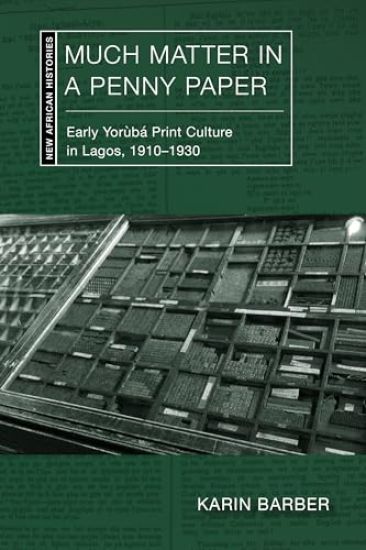
Much Matter in a Penny Paper

Much Matter in a Penny Paper

Karin Barber

OHIO UNIVERSITY PRESS
2026
pokkari
A groundbreaking study of Yorùbá-language print culture in colonial Lagos Much Matter in a Penny Paper offers the first in-depth exploration of the emergence of an African-language print culture in early twentieth-century Lagos, Nigeria. Focusing on the 1910s and 1920s-a period of rapid experimentation and innovation-Karin Barber examines the rise of Yorùbá-language newspapers and the vibrant civic sphere they helped create. The 1910s was notable for an upsurge of local Yorùbá-language history books, and during the 1920s entrepreneurial editors and writers launched five Yorùbá-language weeklies in quick succession. These publications drew in readers beyond the educated elite, expanding public discourse and experimenting with new genres of writing. From moralizing pamphlets and dramatic sketches to serialized narratives voiced by women, Yorùbá print producers reimagined oral and written traditions, blending popular songs, anecdotes, and poetic forms into a dynamic new medium. This book is about not only what was printed but also how and why. It investigates the material practices of print production, the motivations of its creators, and the expectations of its audiences. Drawing on editorials, reader correspondence, and other paratextual commentary, it reveals how Yorùbá writers and readers understood the role of print in capturing the present, preserving the past, projecting the wisdom of the day forward for the benefit of future generations, and generating deep Yorùbá texts rich in poetic energy. Through detailed portraits of key figures-editors, pamphleteers, and a mysterious oral historian-Barber traces the interconnections between publications and genres, showing how they formed an active bilingual sphere of communication. The interplay between Yorùbá- and English-language media, as well as the creative exploitation of both languages, emerges as a defining feature of this period’s print culture. By treating the Yorùbá print archive as a “transcript of emergence,” this study offers new insights into how cultural innovations take shape. It is essential reading for scholars of African history, media studies, sociolinguistics, and print culture.
Much Matter in a Penny Paper

Much Matter in a Penny Paper

Karin Barber

OHIO UNIVERSITY PRESS
2026
sidottu
A groundbreaking study of Yorùbá-language print culture in colonial Lagos Much Matter in a Penny Paper offers the first in-depth exploration of the emergence of an African-language print culture in early twentieth-century Lagos, Nigeria. Focusing on the 1910s and 1920s-a period of rapid experimentation and innovation-Karin Barber examines the rise of Yorùbá-language newspapers and the vibrant civic sphere they helped create. The 1910s was notable for an upsurge of local Yorùbá-language history books, and during the 1920s entrepreneurial editors and writers launched five Yorùbá-language weeklies in quick succession. These publications drew in readers beyond the educated elite, expanding public discourse and experimenting with new genres of writing. From moralizing pamphlets and dramatic sketches to serialized narratives voiced by women, Yorùbá print producers reimagined oral and written traditions, blending popular songs, anecdotes, and poetic forms into a dynamic new medium. This book is about not only what was printed but also how and why. It investigates the material practices of print production, the motivations of its creators, and the expectations of its audiences. Drawing on editorials, reader correspondence, and other paratextual commentary, it reveals how Yorùbá writers and readers understood the role of print in capturing the present, preserving the past, projecting the wisdom of the day forward for the benefit of future generations, and generating deep Yorùbá texts rich in poetic energy. Through detailed portraits of key figures-editors, pamphleteers, and a mysterious oral historian-Barber traces the interconnections between publications and genres, showing how they formed an active bilingual sphere of communication. The interplay between Yorùbá- and English-language media, as well as the creative exploitation of both languages, emerges as a defining feature of this period’s print culture. By treating the Yorùbá print archive as a “transcript of emergence,” this study offers new insights into how cultural innovations take shape. It is essential reading for scholars of African history, media studies, sociolinguistics, and print culture.
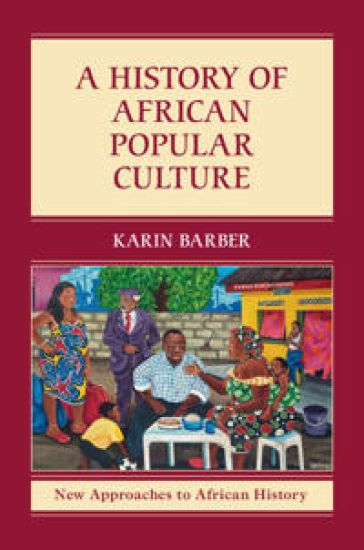
A History of African Popular Culture

A History of African Popular Culture

Karin Barber

Cambridge University Press
2018
sidottu
Popular culture in Africa is the product of everyday life: the unofficial, the non-canonical. And it is the dynamism of this culture that makes Africa what it is. In this book, Karin Barber offers a journey through the history of music, theatre, fiction, song, dance, poetry, and film from the seventeenth century to the present day. From satires created by those living in West African coastal towns in the era of the slave trade, to the poetry and fiction of townships and mine compounds in South Africa, and from today's East African streets where Swahili hip hop artists gather to the juggernaut of the Nollywood film industry, this book weaves together a wealth of sites and scenes of cultural production. In doing so, it provides an ideal text for students and researchers seeking to learn more about the diversity, specificity and vibrancy of popular cultural forms in African history.
A History of African Popular Culture

A History of African Popular Culture

Karin Barber

Cambridge University Press
2018
pokkari
Popular culture in Africa is the product of everyday life: the unofficial, the non-canonical. And it is the dynamism of this culture that makes Africa what it is. In this book, Karin Barber offers a journey through the history of music, theatre, fiction, song, dance, poetry, and film from the seventeenth century to the present day. From satires created by those living in West African coastal towns in the era of the slave trade, to the poetry and fiction of townships and mine compounds in South Africa, and from today's East African streets where Swahili hip hop artists gather to the juggernaut of the Nollywood film industry, this book weaves together a wealth of sites and scenes of cultural production. In doing so, it provides an ideal text for students and researchers seeking to learn more about the diversity, specificity and vibrancy of popular cultural forms in African history.
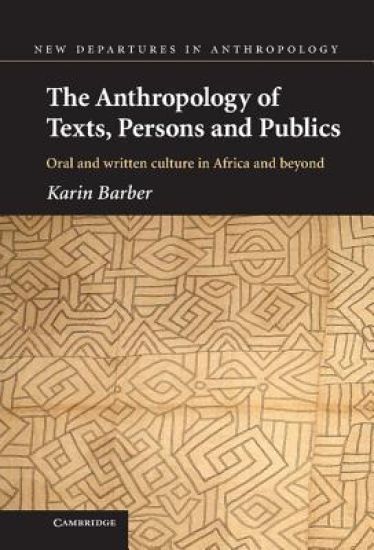
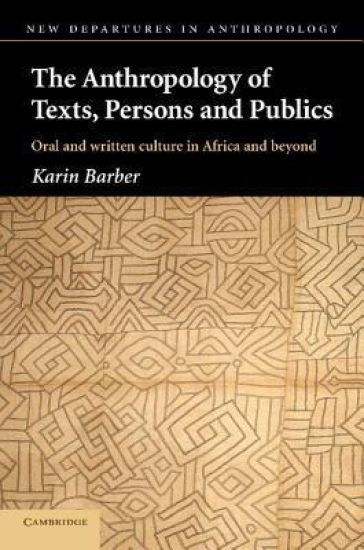
The Anthropology of Texts, Persons and Publics

The Anthropology of Texts, Persons and Publics

Karin Barber

Cambridge University Press
2007
sidottu
What can texts - both written and oral - tell us about the societies that produce them? How are texts constituted in different cultures, and how do they shape societies and individuals? How can we understand the people who compose them? Drawing on examples from Africa and other countries, this original study sets out to answer these questions, by exploring textuality from a variety of angles. Topics covered include the importance of genre, the ways in which oral genres transcend the here-and-now, and the complex relationship between texts and the material world. Barber considers the ways in which personhood is evoked, both in oral poetry and in written diaries and letters, discusses the audience's role in creating the meaning of texts, and shows textual creativity to be a universal human capacity expressed in myriad forms. Engaging and thought-provoking, this book will be welcomed by anyone interested in anthropology, literature and cultural studies.
The Anthropology of Texts, Persons and Publics

The Anthropology of Texts, Persons and Publics

Karin Barber

Cambridge University Press
2007
pokkari
What can texts - both written and oral - tell us about the societies that produce them? How are texts constituted in different cultures, and how do they shape societies and individuals? How can we understand the people who compose them? Drawing on examples from Africa and other countries, this original study sets out to answer these questions, by exploring textuality from a variety of angles. Topics covered include the importance of genre, the ways in which oral genres transcend the here-and-now, and the complex relationship between texts and the material world. Barber considers the ways in which personhood is evoked, both in oral poetry and in written diaries and letters, discusses the audience's role in creating the meaning of texts, and shows textual creativity to be a universal human capacity expressed in myriad forms. Engaging and thought-provoking, this book will be welcomed by anyone interested in anthropology, literature and cultural studies.
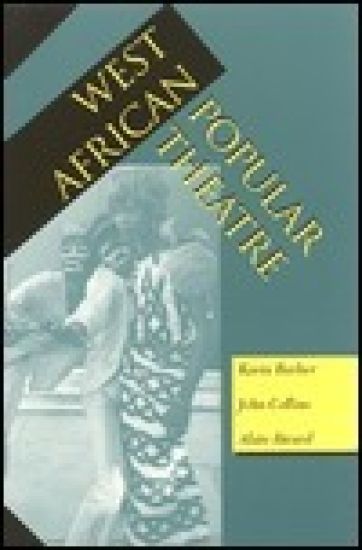
West African Popular Theatre

West African Popular Theatre

Karin Barber; John Collins; Alain Ricard

James Currey
2007
pokkari
This text provides a view from below on the new forms of theatre in West Africa. Throughout, the voices of the theatre practitioners are heard, reminiscing, explaining, philosophizing and grumbling. Their personalities come across vividly, and their views play a vital role. North America: Indiana University Press
The Generation of Plays

The Generation of Plays

Karin Barber

Indiana University Press
2003
pokkari
NEW CATALOG COPY (announcing paperback edition): In The Generation of Plays, Karin Barber recounts the history of the Odin Adéjobi Theater Company and uncovers the pulse points of generation, production, and improvisation that merge when a Yorùbá popular drama is brought to the stage. This rich and detailed book opens a window into the social and cultural worlds of actors and audiences. ORIGINAL CATALOG COPY: "Karin Barber has given us a vivid picture of one of the most vital forms of modern African popular art. It is beautifully written and informed by a deep affection for the subject . . . . a major contribution to the cultural history of Nigeria." —J. D. Y. Peel From the 1940s to the 1980s, Yoruba popular theater was one of the most spectacularly successful theaters in Africa. Today, these traveling companies have virtually disappeared, largely as a result of economic hardship and the rise of video entertainment. In The Generation of Plays, Karin Barber recounts the history of the Oyin Adejobi Theatre company. Drawing on archival sources as well as extensive interviews and transcriptions of plays, Barber uncovers the pulse points of generation, production, and improvisation that merge when a Yoruba popular drama is brought to the stage. Barber reveals the personalities of the principal actors, how plays are created—from the germ of an idea through the logistics of rehearsal and staging—how a play is made meaningful to its audience, and how a play changes and develops after several productions or according to the sensibilities of its viewers. The expansion of popular drama into television is also considered. This rich and detailed narrative illuminates notions of gender, language, politics, and self as they are expressed in popular cultural forms. It affords a unique view of the social and cultural perspectives of the actors and audiences involved in what was a flourishing and vital enterprise.
West African Popular Theatre

West African Popular Theatre

Karin Barber; John Collins; Alain Ricard

Indiana University Press
1997
pokkari
" . . . a ground-breaking contribution to the field of African literature . . . " —Research in African Literatures "Anyone with the slightest interest in West African cultures, performance or theatre should immediately rush out and buy this book." —Leeds African Studies Bulletin "A seminal contribution to the fields of performance studies, cultural studies, and popular culture. " —Margaret Drewal "A fine book. The play texts are treasures." —Richard Bauman African popular culture is an arena where the tensions and transformations of colonial and post-colonial society are played out, offering us a glimpse of the view from below in Africa. This book offers a comparative overview of the history, social context, and style of three major West African popular theatre genres: the concert party of Ghana, the concert party of Togo, and the traveling popular theatre of western Nigeria.