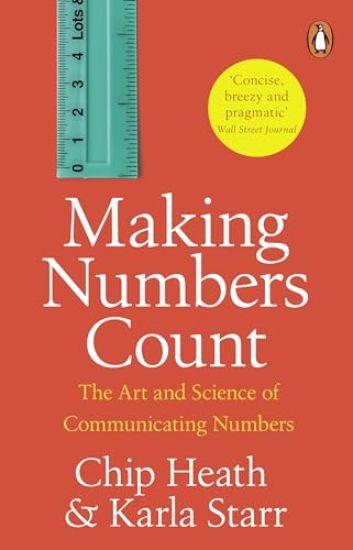
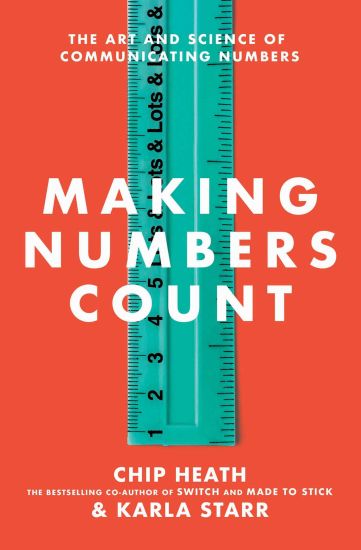
Kirjojen hintavertailu. Mukana 12 595 353 kirjaa ja 12 kauppaa.
Kirjailija
Karla Starr
Kirjat ja teokset yhdessä paikassa: 6 kirjaa, julkaisuja vuosilta 2019-2024, suosituimpien joukossa Can You Learn to Be Lucky?. Vertaile teosten hintoja ja tarkista saatavuus suomalaisista kirjakaupoista.
'Concise, breezy and pragmatic' Wall Street Journal'Remarkably practical techniques for comprehending and communicating the maths that really matters’ Adam GrantUntil very recently, most languages had no words for numbers greater than five – anything from six to infinity was known as 'lots'. Understanding numbers is essential in the modern world, but we simply aren’t built to understand them.What does 5GB of storage actually mean? (Two months of commutes, without repeating a song.)What’s the size of a nucleus compared to a cell? (Imagine a bee in a cathedral.)How much bigger is a billion than a million? (Well, a million seconds is twelve days. A billion seconds is…thirty-two years.)Drawing on years of research into making ideas stick, Chip Heath and Karla Starr outline six critical principles that will give anyone the tools to understand and communicate numbers with more transparency and meaning. Offering practical principles to help us imagine numbers at all scales, Making Numbers Count shows us how to transform them into concrete, vivid and meaningful messages so that we can make better decisions every day.
Making Numbers Count is a lively, practical, first-of-its-kind guide to turning cold, clinical data into a memorable story. __________How many hours' worth of songs are on your Spotify Wrapped this year?How much is your commute time really worth?How do you work out how likely you are to get Covid based on the official statistics?How do your viewing hours track against the most popular shows on Netflix?Whether you're interested in global problems like climate change, and understanding that the Australian wildfires destroyed an area twice the size of Portugal, or just grasping how few people have washed their hands between visiting the bathroom and touching your hands, this book will help math-lovers and math-haters alike translate the numbers that animate our world. Until very recently, most languages had no words for numbers greater than five - anything from six to infinity was known as 'lots'. While the numbers in our world have become increasingly complex, our brains are stuck in the past. Yet the ability to communicate and understand numbers has never mattered more. How can we more effectively translate numbers and stats - so fundamental to the next big idea - to make data come to life?Drawing on years of research into making ideas stick, Chip Heath and Karla Starr outline six critical principles that will give anyone the tools to communicate numbers with more transparency and meaning. Using concepts such as simplicity, concreteness and familiarity, they reveal what's compelling about a number and show how to transform it into its most engaging form.
A clear, practical, first-of-its-kind guide to communicating and understanding numbers and data--from bestselling business author Chip Heath. How much bigger is a billion than a million? Well, a million seconds is twelve days. A billion seconds is...thirty-two years. Understanding numbers is essential--but humans aren't built to understand them. Until very recently, most languages had no words for numbers greater than five--anything from six to infinity was known as "lots." While the numbers in our world have gotten increasingly complex, our brains are stuck in the past. How can we translate millions and billions and milliseconds and nanometers into things we can comprehend and use? Author Chip Heath has excelled at teaching others about making ideas stick and here, in Making Numbers Count, he outlines specific principles that reveal how to translate a number into our brain's language. This book is filled with examples of extreme number makeovers, vivid before-and-after examples that take a dry number and present it in a way that people click in and say "Wow, now I get it " You will learn principles such as: -SIMPLE PERSPECTIVE CUES: researchers at Microsoft found that adding one simple comparison sentence doubled how accurately users estimated statistics like population and area of countries. -VIVIDNESS: get perspective on the size of a nucleus by imagining a bee in a cathedral, or a pea in a racetrack, which are easier to envision than "1/100,000th of the size of an atom." -CONVERT TO A PROCESS: capitalize on our intuitive sense of time (5 gigabytes of music storage turns into "2 months of commutes, without repeating a song"). -EMOTIONAL MEASURING STICKS: frame the number in a way that people already care about ("that medical protocol would save twice as many women as curing breast cancer"). Whether you're interested in global problems like climate change, running a tech firm or a farm, or just explaining how many Cokes you'd have to drink if you burned calories like a hummingbird, this book will help math-lovers and math-haters alike translate the numbers that animate our world--allowing us to bring more data, more naturally, into decisions in our schools, our workplaces, and our society.
A clear, practical, first-of-its-kind guide to communicating and understanding numbers and data--from bestselling business author Chip Heath. How much bigger is a billion than a million? Well, a million seconds is twelve days. A billion seconds is...thirty-two years. Understanding numbers is essential--but humans aren't built to understand them. Until very recently, most languages had no words for numbers greater than five--anything from six to infinity was known as "lots." While the numbers in our world have gotten increasingly complex, our brains are stuck in the past. How can we translate millions and billions and milliseconds and nanometers into things we can comprehend and use? Author Chip Heath has excelled at teaching others about making ideas stick and here, in Making Numbers Count, he outlines specific principles that reveal how to translate a number into our brain's language. This book is filled with examples of extreme number makeovers, vivid before-and-after examples that take a dry number and present it in a way that people click in and say "Wow, now I get it " You will learn principles such as: -SIMPLE PERSPECTIVE CUES: researchers at Microsoft found that adding one simple comparison sentence doubled how accurately users estimated statistics like population and area of countries. -VIVIDNESS: get perspective on the size of a nucleus by imagining a bee in a cathedral, or a pea in a racetrack, which are easier to envision than "1/100,000th of the size of an atom." -CONVERT TO A PROCESS: capitalize on our intuitive sense of time (5 gigabytes of music storage turns into "2 months of commutes, without repeating a song"). -EMOTIONAL MEASURING STICKS: frame the number in a way that people already care about ("that medical protocol would save twice as many women as curing breast cancer"). Whether you're interested in global problems like climate change, running a tech firm or a farm, or just explaining how many Cokes you'd have to drink if you burned calories like a hummingbird, this book will help math-lovers and math-haters alike translate the numbers that animate our world--allowing us to bring more data, more naturally, into decisions in our schools, our workplaces, and our society.