Kirjojen hintavertailu. Mukana 12 657 676 kirjaa ja 12 kauppaa.

Kirjailija

Karsten Urban

Kirjat ja teokset yhdessä paikassa: 6 kirjaa, julkaisuja vuosilta 2002-2024, suosituimpien joukossa Model Order Reduction and Applications. Vertaile teosten hintoja ja tarkista saatavuus suomalaisista kirjakaupoista.

6 kirjaa

Kirjojen julkaisuhaarukka 2002-2024.

Partial Differential Equations

Partial Differential Equations

Wolfgang Arendt; Karsten Urban

Springer International Publishing AG
2024
nidottu
This textbook introduces the study of partial differential equations using both analytical and numerical methods. By intertwining the two complementary approaches, the authors create an ideal foundation for further study. Motivating examples from the physical sciences, engineering, and economics complete this integrated approach. A showcase of models begins the book, demonstrating how PDEs arise in practical problems that involve heat, vibration, fluid flow, and financial markets. Several important characterizing properties are used to classify mathematical similarities, then elementary methods are used to solve examples of hyperbolic, elliptic, and parabolic equations. From here, an accessible introduction to Hilbert spaces and the spectral theorem lay the foundation for advanced methods. Sobolev spaces are presented first in dimension one, before being extended to arbitrary dimension for the study of elliptic equations. An extensive chapter on numerical methods focuses onfinite difference and finite element methods. Computer-aided calculation with Maple™ completes the book. Throughout, three fundamental examples are studied with different tools: Poisson’s equation, the heat equation, and the wave equation on Euclidean domains. The Black–Scholes equation from mathematical finance is one of several opportunities for extension. Partial Differential Equations offers an innovative introduction for students new to the area. Analytical and numerical tools combine with modeling to form a versatile toolbox for further study in pure or applied mathematics. Illuminating illustrations and engaging exercises accompany the text throughout. Courses in real analysis and linear algebra at the upper-undergraduate level are assumed.
Model Order Reduction and Applications

Model Order Reduction and Applications

Michael Hinze; J. Nathan Kutz; Olga Mula; Karsten Urban

Springer International Publishing AG
2023
nidottu
This book addresses the state of the art of reduced order methods for modelling and computational reduction of complex parametrised systems, governed by ordinary and/or partial differential equations, with a special emphasis on real time computing techniques and applications in various fields.Consisting of four contributions presented at the CIME summer school, the book presents several points of view and techniques to solve demanding problems of increasing complexity. The focus is on theoretical investigation and applicative algorithm development for reduction in the complexity – the dimension, the degrees of freedom, the data – arising in these models.The book is addressed to graduate students, young researchers and people interested in the field. It is a good companion for graduate/doctoral classes.
Partial Differential Equations

Partial Differential Equations

Wolfgang Arendt; Karsten Urban

Springer International Publishing AG
2023
sidottu
This textbook introduces the study of partial differential equations using both analytical and numerical methods. By intertwining the two complementary approaches, the authors create an ideal foundation for further study. Motivating examples from the physical sciences, engineering, and economics complete this integrated approach. A showcase of models begins the book, demonstrating how PDEs arise in practical problems that involve heat, vibration, fluid flow, and financial markets. Several important characterizing properties are used to classify mathematical similarities, then elementary methods are used to solve examples of hyperbolic, elliptic, and parabolic equations. From here, an accessible introduction to Hilbert spaces and the spectral theorem lay the foundation for advanced methods. Sobolev spaces are presented first in dimension one, before being extended to arbitrary dimension for the study of elliptic equations. An extensive chapter on numerical methods focuses onfinite difference and finite element methods. Computer-aided calculation with Maple™ completes the book. Throughout, three fundamental examples are studied with different tools: Poisson’s equation, the heat equation, and the wave equation on Euclidean domains. The Black–Scholes equation from mathematical finance is one of several opportunities for extension. Partial Differential Equations offers an innovative introduction for students new to the area. Analytical and numerical tools combine with modeling to form a versatile toolbox for further study in pure or applied mathematics. Illuminating illustrations and engaging exercises accompany the text throughout. Courses in real analysis and linear algebra at the upper-undergraduate level are assumed.

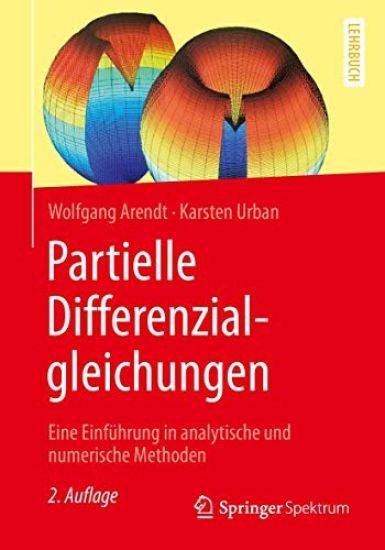
Partielle Differenzialgleichungen

Partielle Differenzialgleichungen

Wolfgang Arendt; Karsten Urban

Springer-Verlag Berlin and Heidelberg GmbH Co. K
2019
nidottu
Dieses Lehrbuch gibt eine Einführung in die partiellen Differenzialgleichungen. Wir beginnen mit einigen ganz konkreten Beispielen aus den Natur-, Ingenieur und Wirtschaftswissenschaften. Danach werden elementare Lösungsmethoden dargestellt, z.B. für die Black-Scholes-Gleichung aus der Finanzmathematik. Schließlich wird die analytische Untersuchung großer Klassen von partiellen Differenzialgleichungen dargestellt, wobei Hilbert-Raum-Methoden im Mittelpunkt stehen. Numerische Verfahren werden eingeführt und mit konkreten Beispielen behandelt. Zu jedem Kapitel finden sich Übungsaufgaben, mit deren Hilfe der Stoff eingeübt und vertieft werden kann. Dieses Buch richtet sich an Studierende im Bachelor oder im ersten Master-Jahr sowohl in der (Wirtschafts-)Mathematik als auch in den Studiengängen Informatik, Physik und Ingenieurwissenschaften.Die 2. Auflage ist vollständig durchgesehen, an vielen Stellen didaktisch weiter optimiert und umdie Beschreibung variationeller Methoden in Raum und Zeit für zeitabhängige Probleme ergänzt.Stimme zur ersten AuflageAuf dieses Lehrbuch haben wir gewartet.Prof. Dr. Andreas Kleinert in zbMATH
Wavelet Methods for Elliptic Partial Differential Equations
The origins of wavelets go back to the beginning of the last century and wavelet methods are by now a well-known tool in image processing (jpeg2000). These functions have, however, been used successfully in other areas, such as elliptic partial differential equations, which can be used to model many processes in science and engineering. This book, based on the author's course and accessible to those with basic knowledge of analysis and numerical mathematics, gives an introduction to wavelet methods in general and then describes their application for the numerical solution of elliptic partial differential equations. Recently developed adaptive methods are also covered and each scheme is complemented with numerical results, exercises, and corresponding software tools.
Wavelets in Numerical Simulation

Wavelets in Numerical Simulation

Karsten Urban

Springer-Verlag Berlin and Heidelberg GmbH Co. K
2002
nidottu
Sapere aude! Immanuel Kant (1724-1804) Numerical simulations playa key role in many areas of modern science and technology. They are necessary in particular when experiments for the underlying problem are too dangerous, too expensive or not even possible. The latter situation appears for example when relevant length scales are below the observation level. Moreover, numerical simulations are needed to control complex processes and systems. In all these cases the relevant problems may become highly complex. Hence the following issues are of vital importance for a numerical simulation: - Efficiency of the numerical solvers: Efficient and fast numerical schemes are the basis for a simulation of 'real world' problems. This becomes even more important for realtime problems where the runtime of the numerical simulation has to be of the order of the time span required by the simulated process. Without efficient solution methods the simulation of many problems is not feasible. 'Efficient' means here that the overall cost of the numerical scheme remains proportional to the degrees of freedom, i. e. , the numerical approximation is determined in linear time when the problem size grows e. g. to upgrade accuracy. Of course, as soon as the solution of large systems of equations is involved this requirement is very demanding.